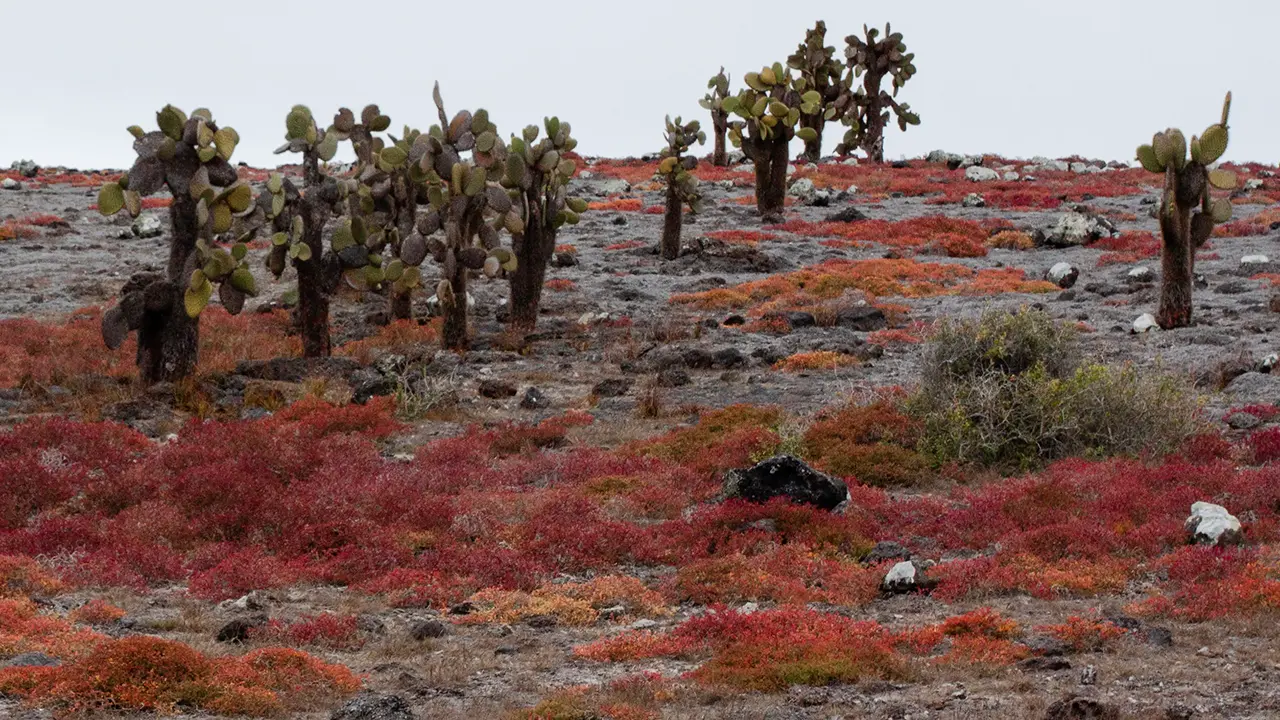
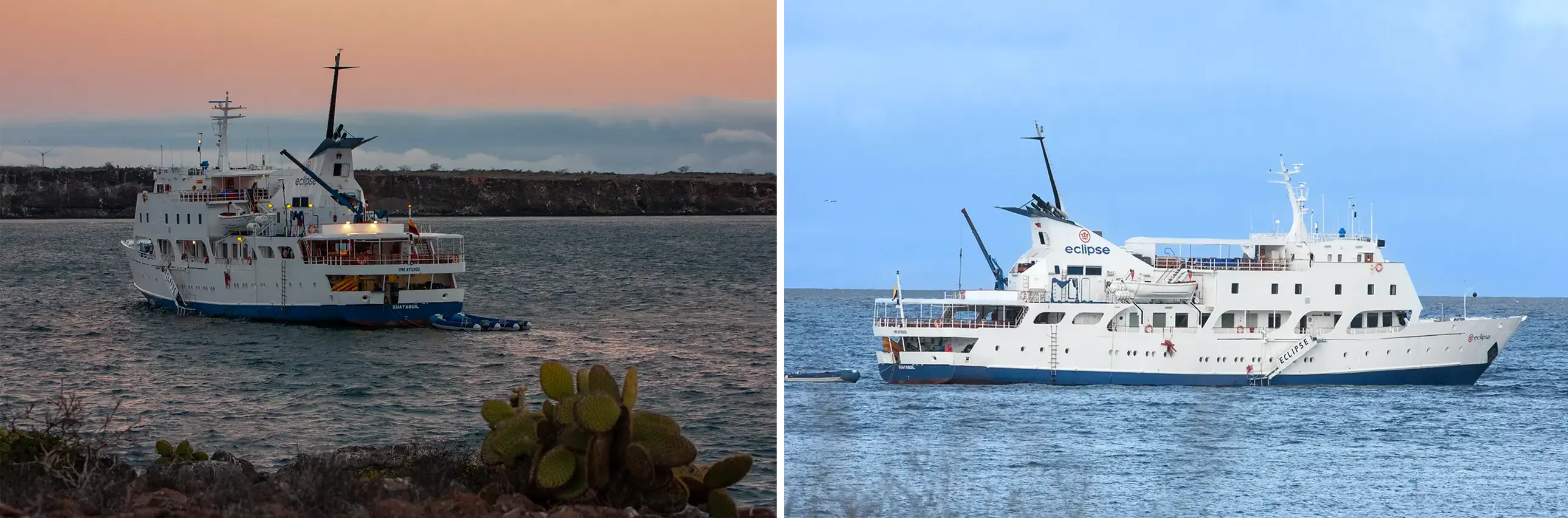
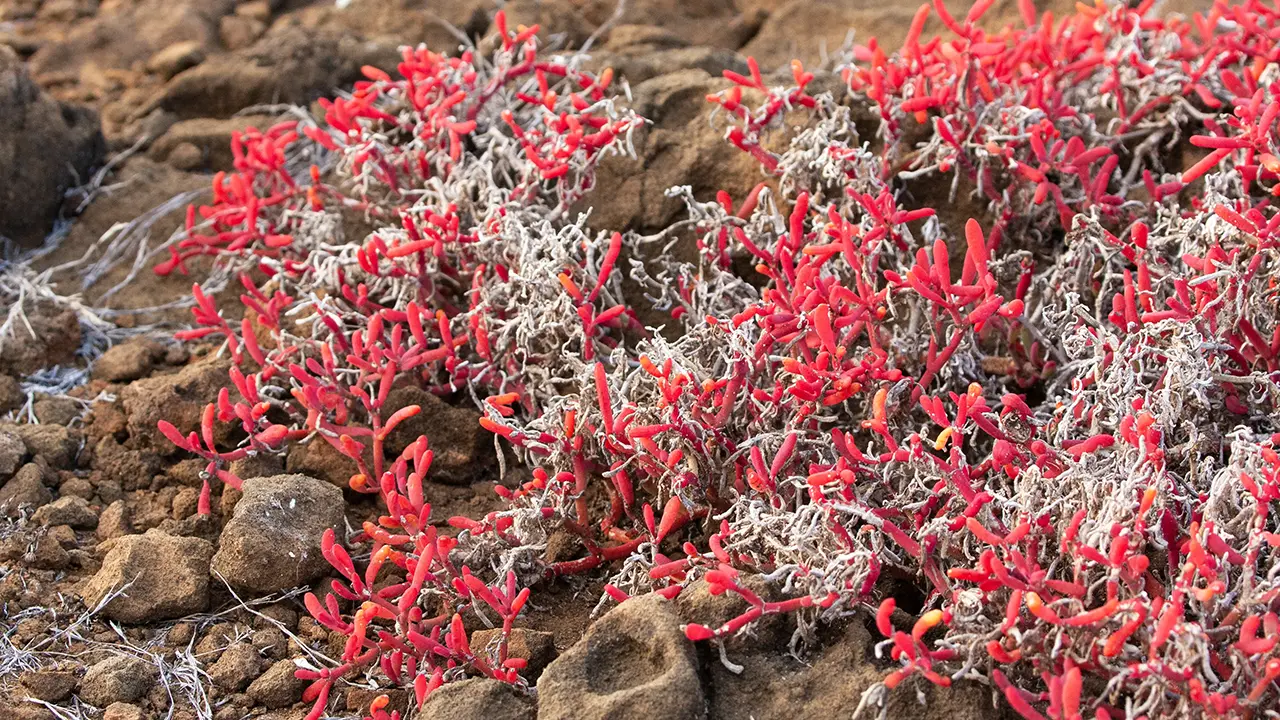
When I started researching the Galápagos, I learned that, because of ecosystem protection and limited accommodation, visitors usually either island-hop or travel by cruise ship. The rules seemed complicated, so I arranged the trip through Art Tour, a travel agency in Japan specializing in South America and the Galápagos. Since my idea was “a journey to see red sesuvium,” I chose a five-night, six-day southern islands cruise on the mid-sized M/V Eclipse, because it would visit South Plaza Island, where sesuvium grows in broad red carpets.
The Eclipse changed ownership in 2016, but it can still be booked through several agencies, including Nature Galapagos & Ecuador.
Itinerary
The usual route from Japan to the Galápagos is through the United States, but arranging the onward flights to Ecuador was complicated and often involved multiple U.S. connections. To avoid both issues, we chose to travel via the Netherlands. We left Narita in the morning and arrived in Amsterdam that evening, spending one night near Schiphol Airport. In Ecuador, the flight first landed in Quito and then continued on the same aircraft to Guayaquil. After another eleven-hour flight in as many days, we were tired. In Guayaquil we went straight to the hotel for a second stopover before reaching the islands.
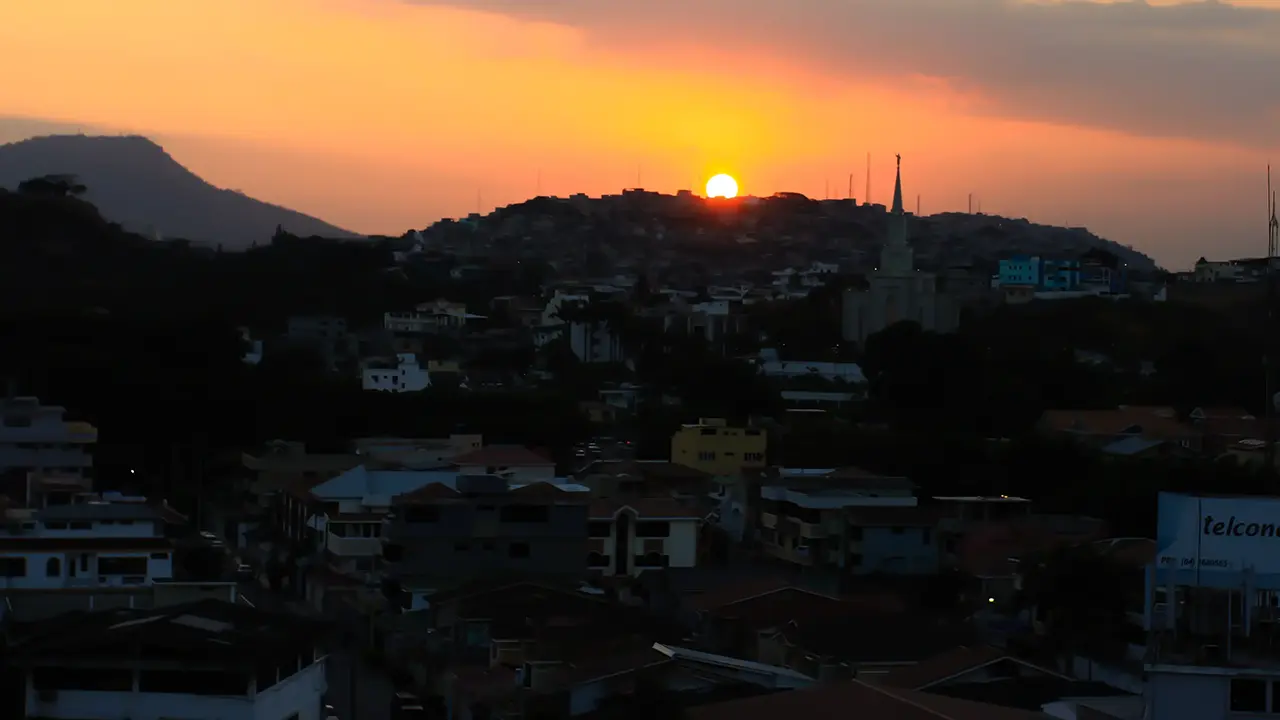
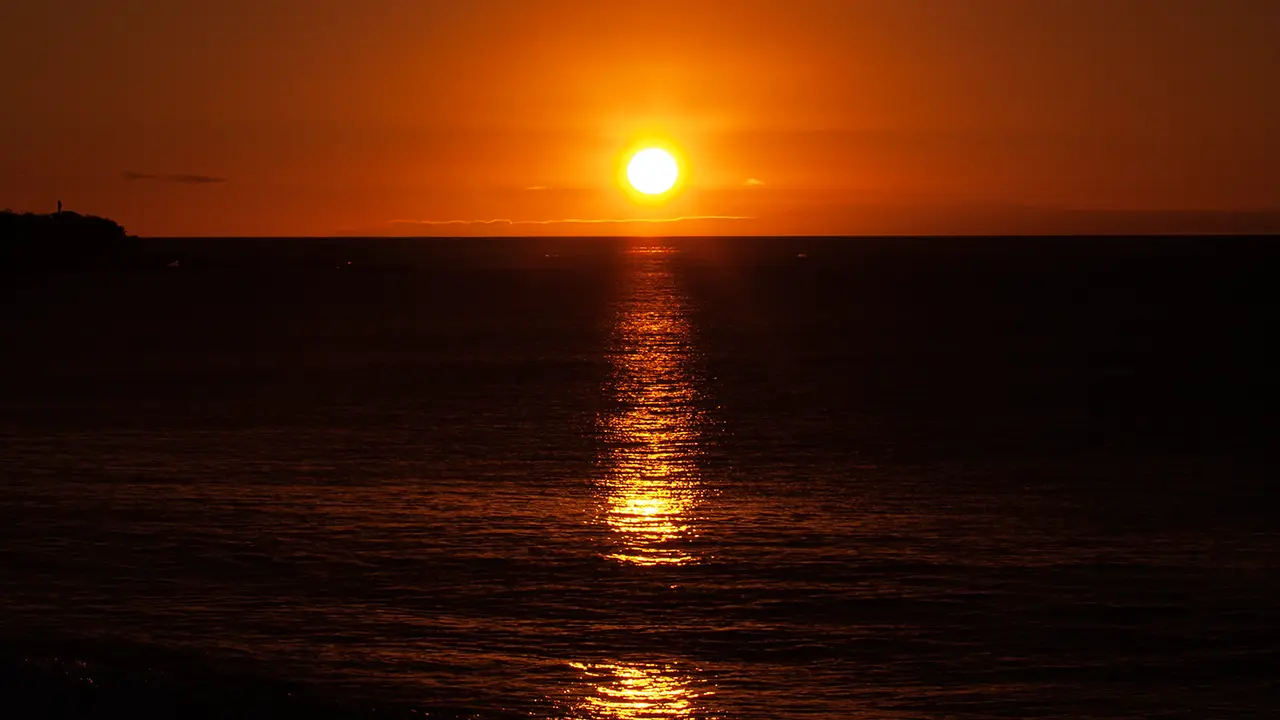
The sunset beyond the district visible from the hotel was beautiful.
At the hotel, we were warned not to wander outside unnecessarily and not to hail taxis at places like the airport. The atmosphere I saw between the airport and the hotel made me feel no desire to go out. Later, I read a news report about a Japanese honeymoon couple who had been attacked after getting into a taxi they had hailed on the street. It reminded me how tense the city had felt at the time.
On the way home, we flew directly from Guayaquil to Amsterdam and connected to Narita after only about three hours. Compared with the outbound trip, the journey back felt remarkably easy.
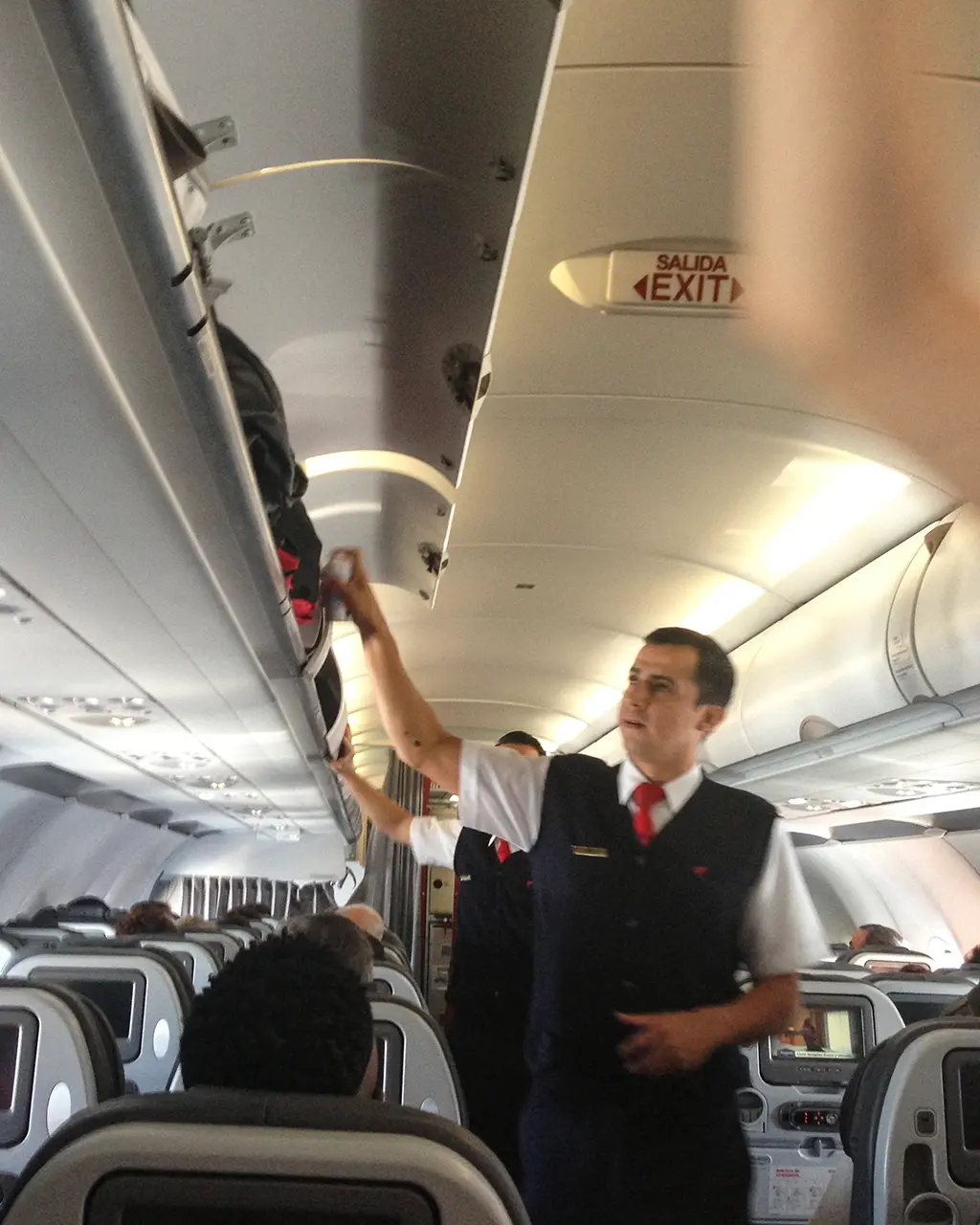
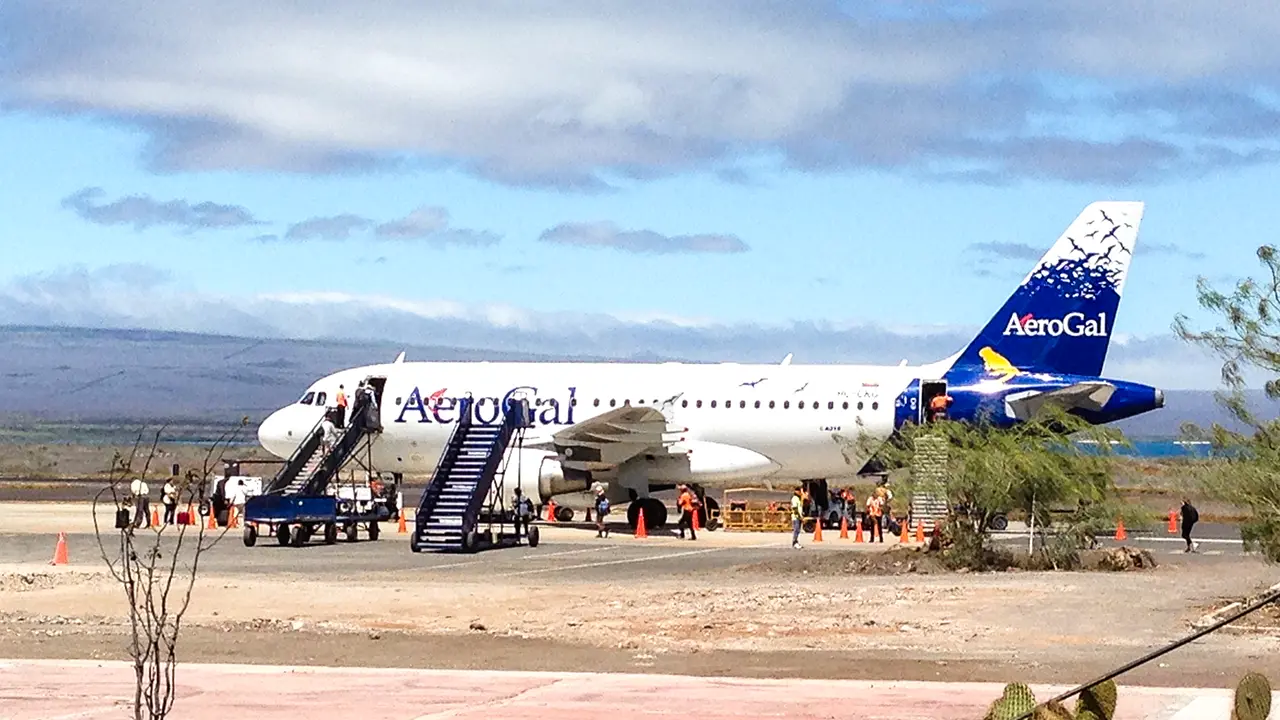
The next morning we returned to José Joaquín de Olmedo International Airport and flew with AeroGal to Seymour Airport on Baltra Island. The procedures to prevent the introduction of insects and other invasive species were stricter than anywhere I had been before. Shoe soles were cleaned, spare shoes were inspected, and the crew sprayed insecticide inside the cabin. It clearly served conservation, and it also made visitors conscious of their behavior in the islands.
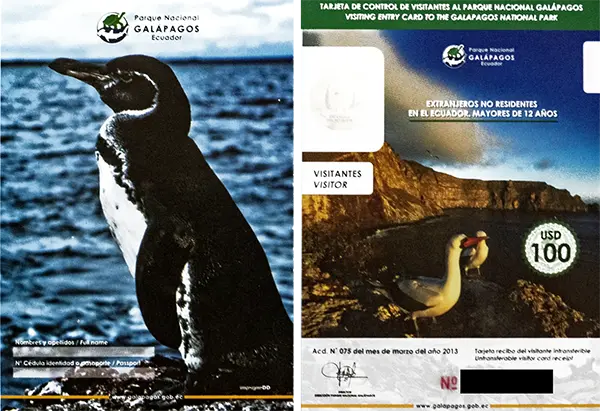
At that time, visitors paid a Galápagos National Park entry fee of 100 U.S. dollars per person; as of 2026 it is 200 dollars. Given the need to fund conservation, I did not feel it was expensive. Visitor numbers and procedures are tightly controlled, reminding me that this is truly one of the world’s great protected natural areas.
Aerolíneas Galápagos became part of Avianca Ecuador in 2009; the name is no longer used.
Cruise Ship: M/V Eclipse
After arriving at Seymour Airport, we transferred directly to the ship and the cruise began.
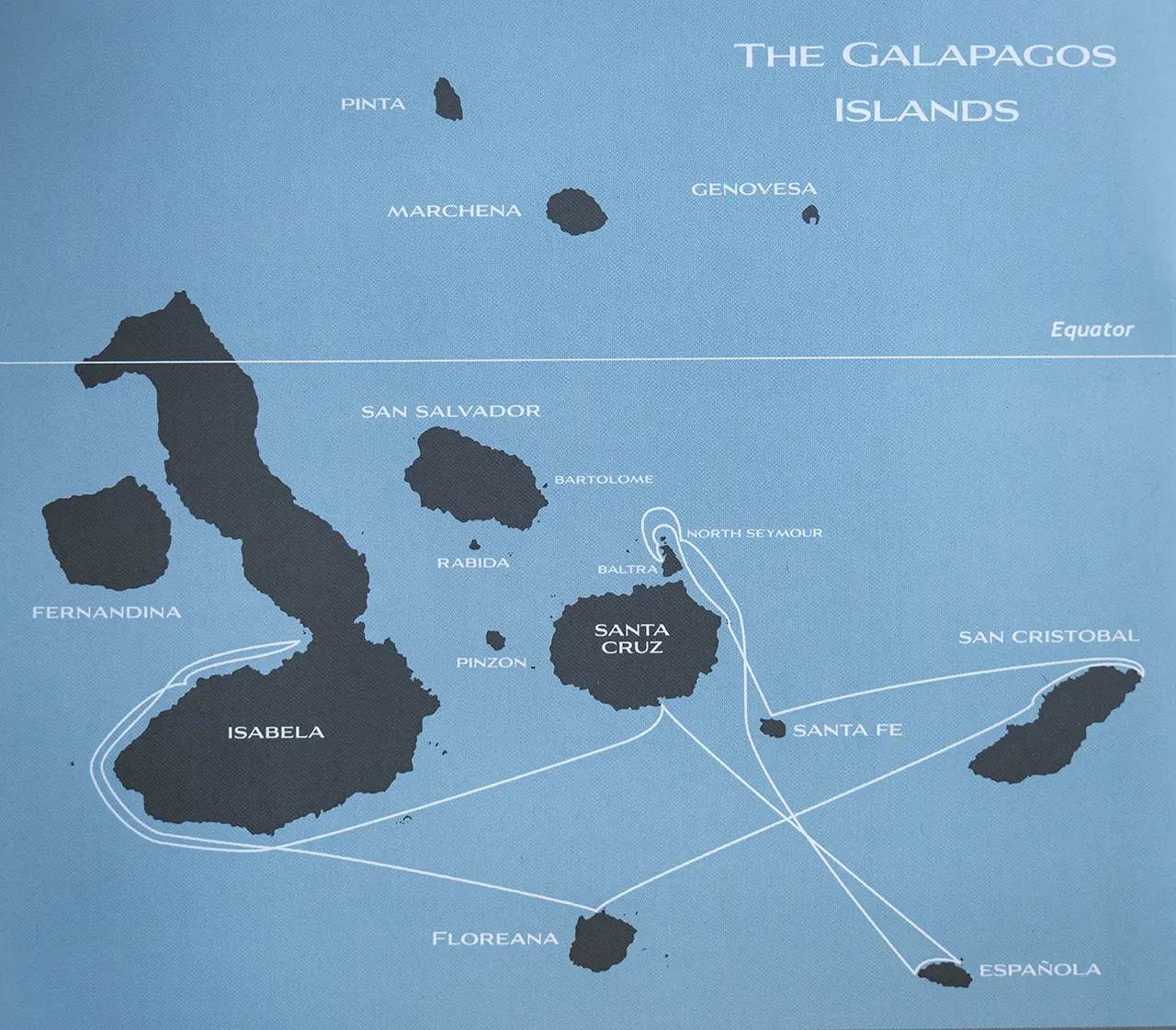
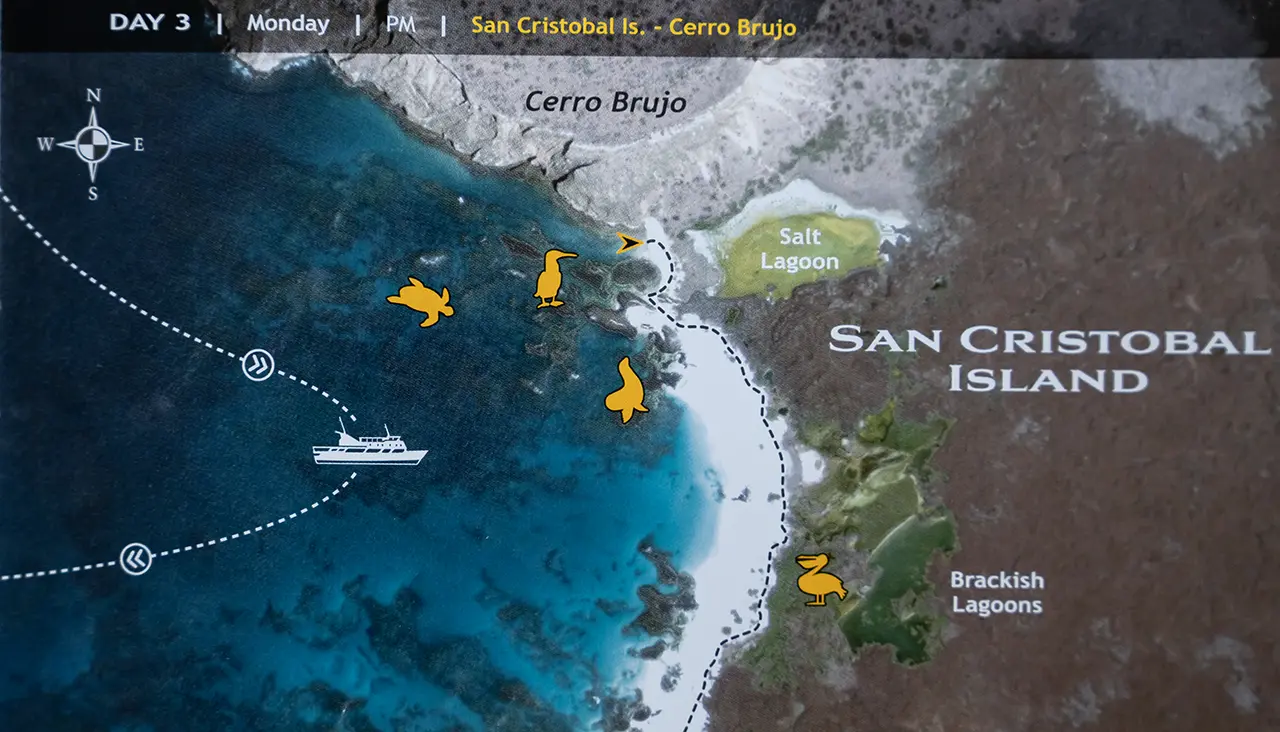
The route was roughly as follows.
- Day 1 (Sat)Baltra Island (departure point) ➔ North Seymour Island (Isla Seymour Norte)
- Day 2 (Sun)South Plaza Island (Isla Plaza Sur) ➔ Santa Fe Island (Isla Santa Fe)
- Day 3 (Mon)San Cristobal Island (Isla de San Cristobal) - Punta Pitt ➔ Cerro Brujo
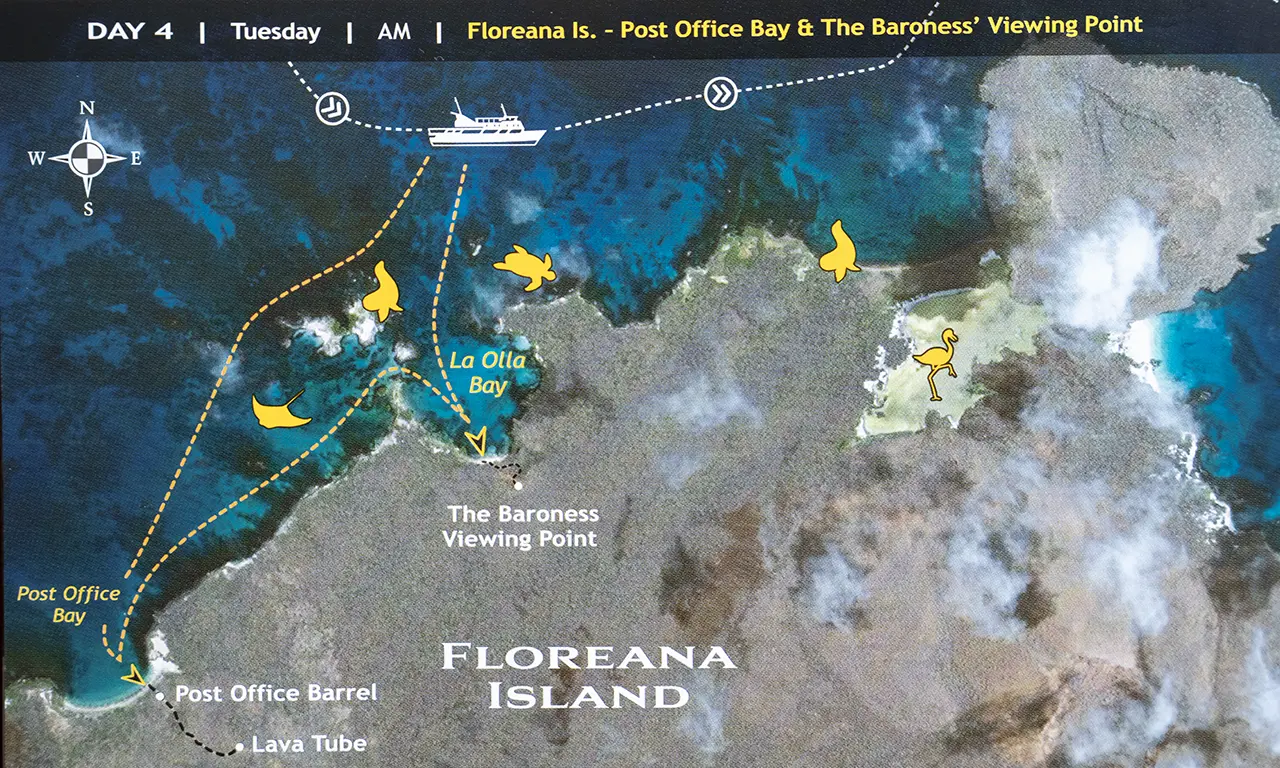
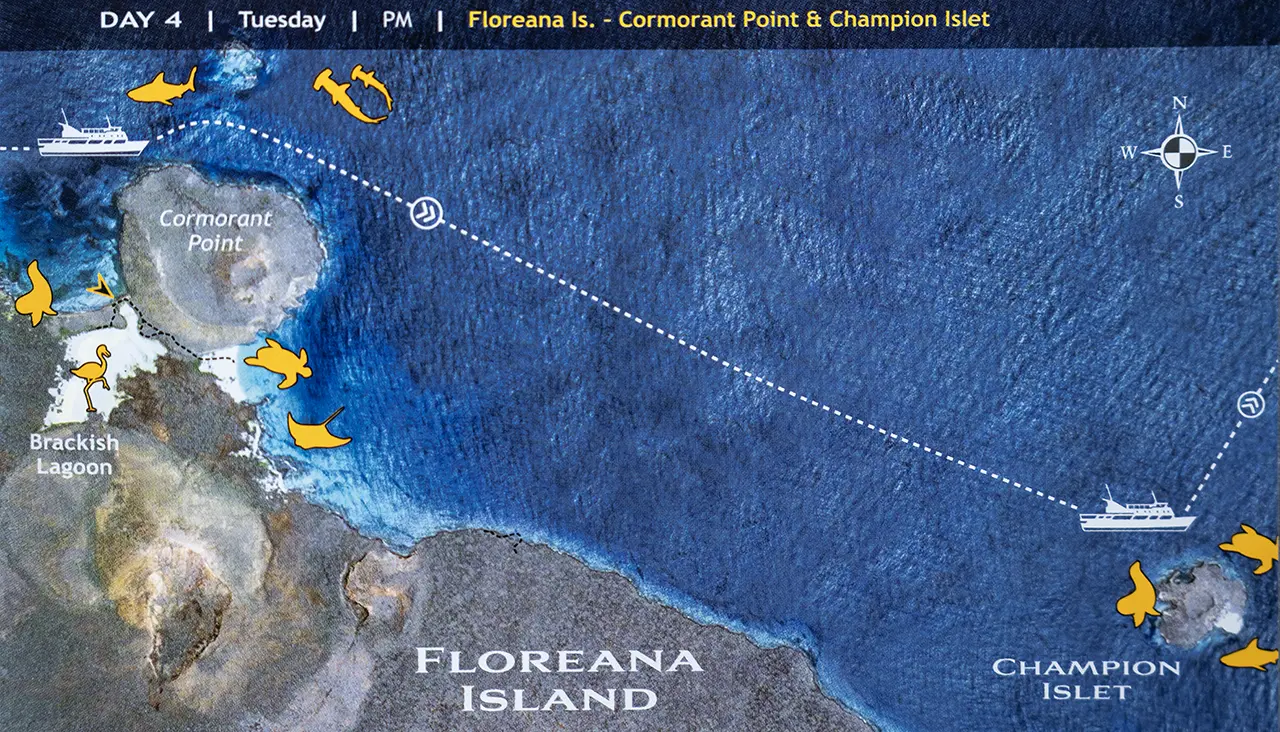
- Day 4 (Tue)Floreana Island (Isla Floreana) - Post Office Bay ➔ Punta Cormorant
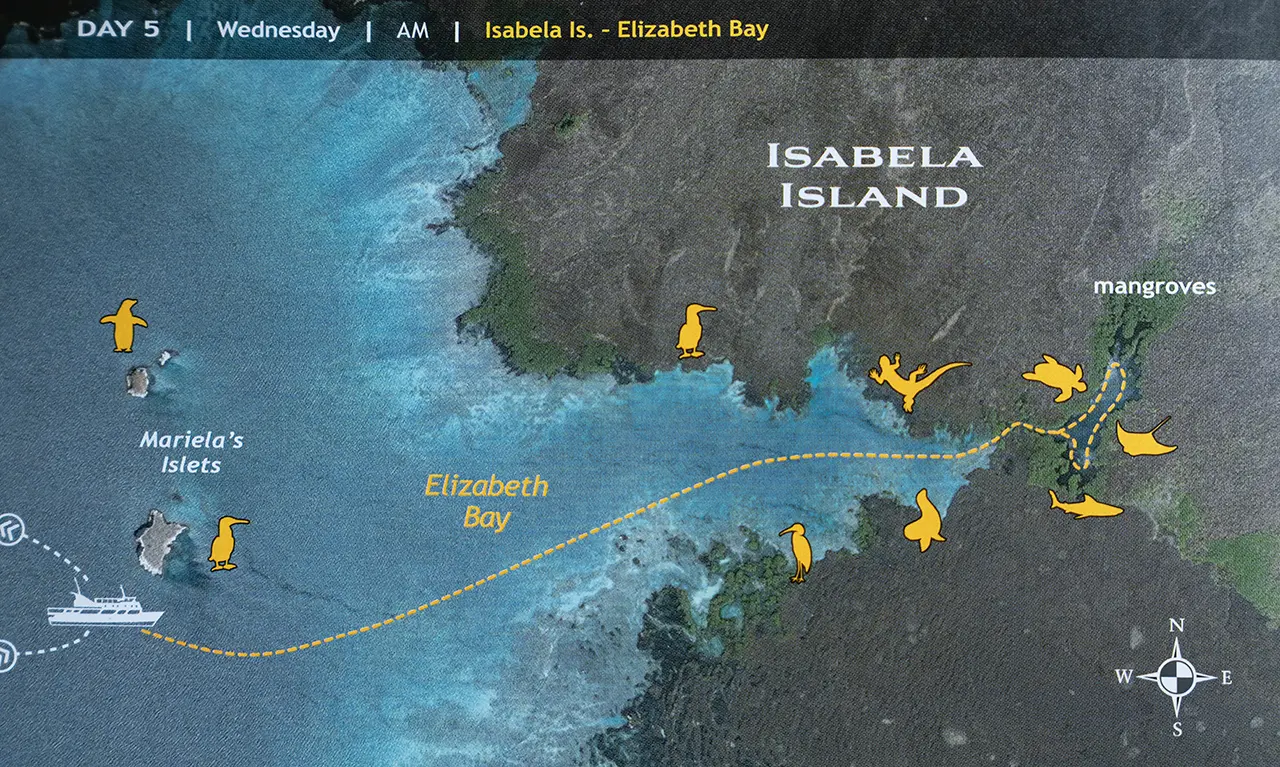
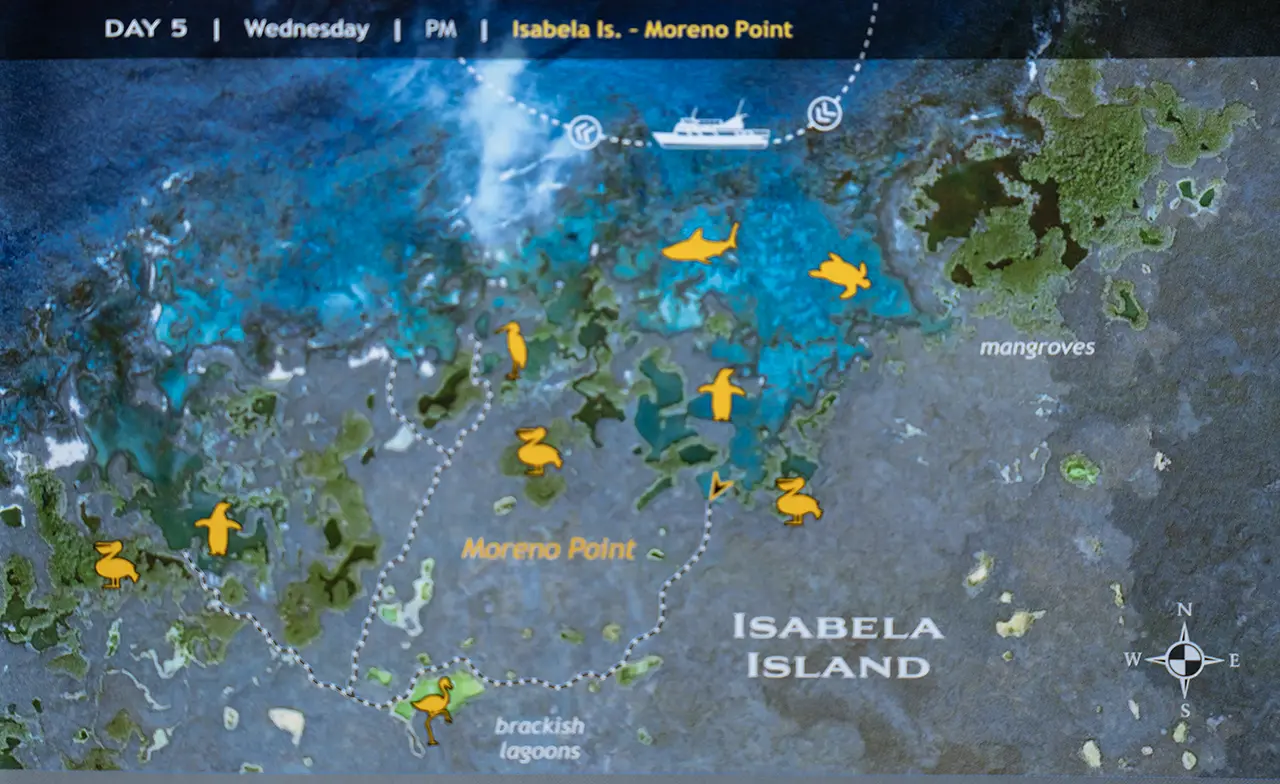
- Day 5 (Wed)Isabela Island (Isla Isabela) - Elizabeth Bay ➔ Punta Moreno
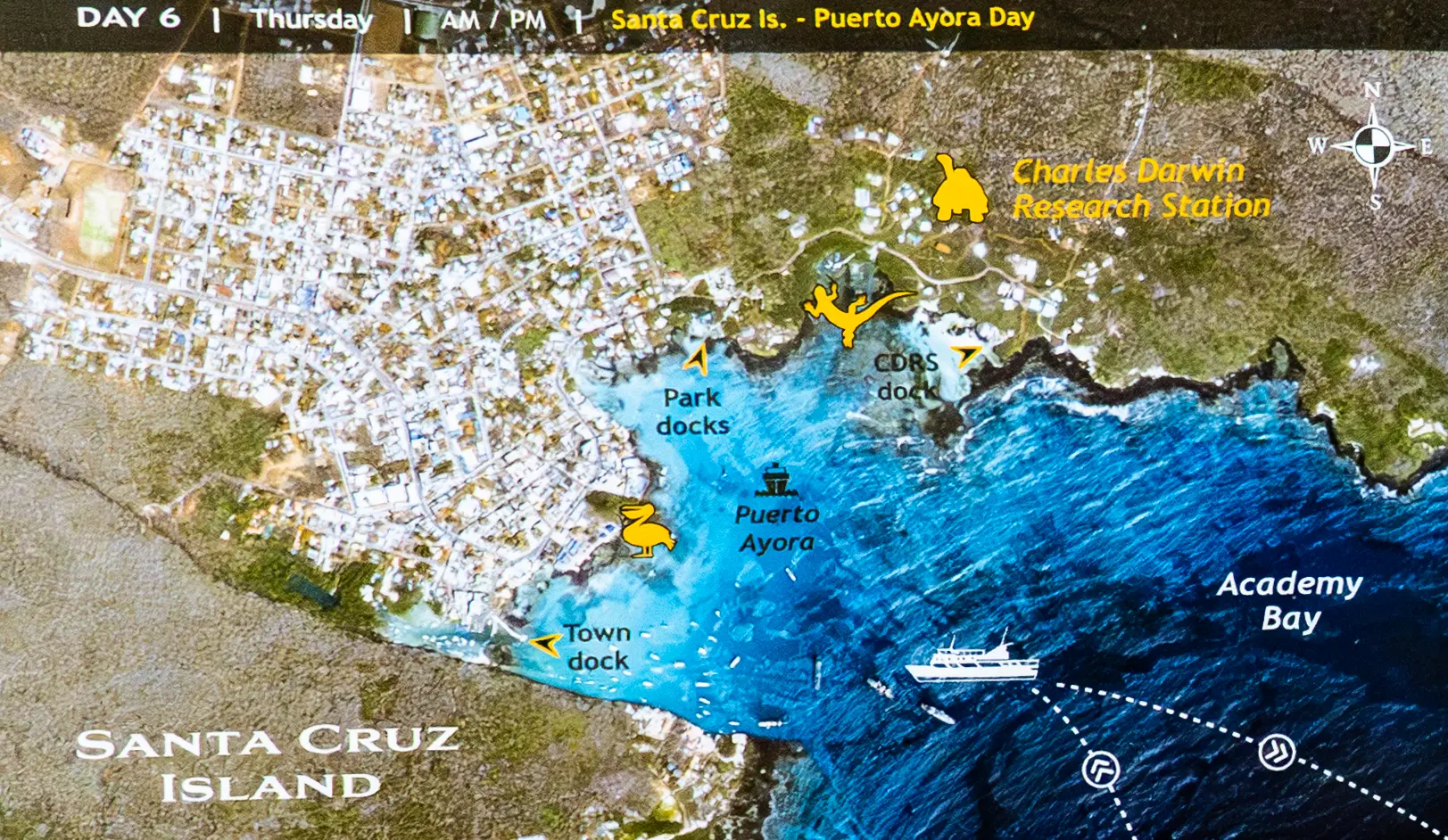
- Day 6 (Thu)Santa Cruz Island (Isla Santa Cruz) - Highland
The map above shows the seven-night, eight-day course; on our five-night, six-day itinerary, we did not visit Española Island.
The Eclipse was a mid-sized ship carrying up to 58 passengers. Our cabin had a window, shower, and toilet, and was spacious enough to be comfortable.
The ship rolled far more than I had expected. On a couple of nights it moved strongly enough that anything left on the desk would have fallen off. Even so, we were tired enough to sleep, and it simply became a topic at breakfast. Although it was summer and we were near the equator, it was often chilly, so long sleeves and a windbreaker were necessary. We had brought a bright pink windbreaker, only to be told that bright red and pink could attract insects on some islands. There was nothing to do but wear it anyway.
At each island we landed and explored, but independent wandering was not allowed; everyone moved in groups led by the ship’s guides. Meals were shared, so we came to know almost all the other passengers. They came from Greece, Israel, Monaco, the United States, Mexico, and elsewhere, and there was always something to talk about. It was unusual, and a little surprising, that we were the only Japanese passengers. The guides and crew were also friendly, which helped make the trip enjoyable.
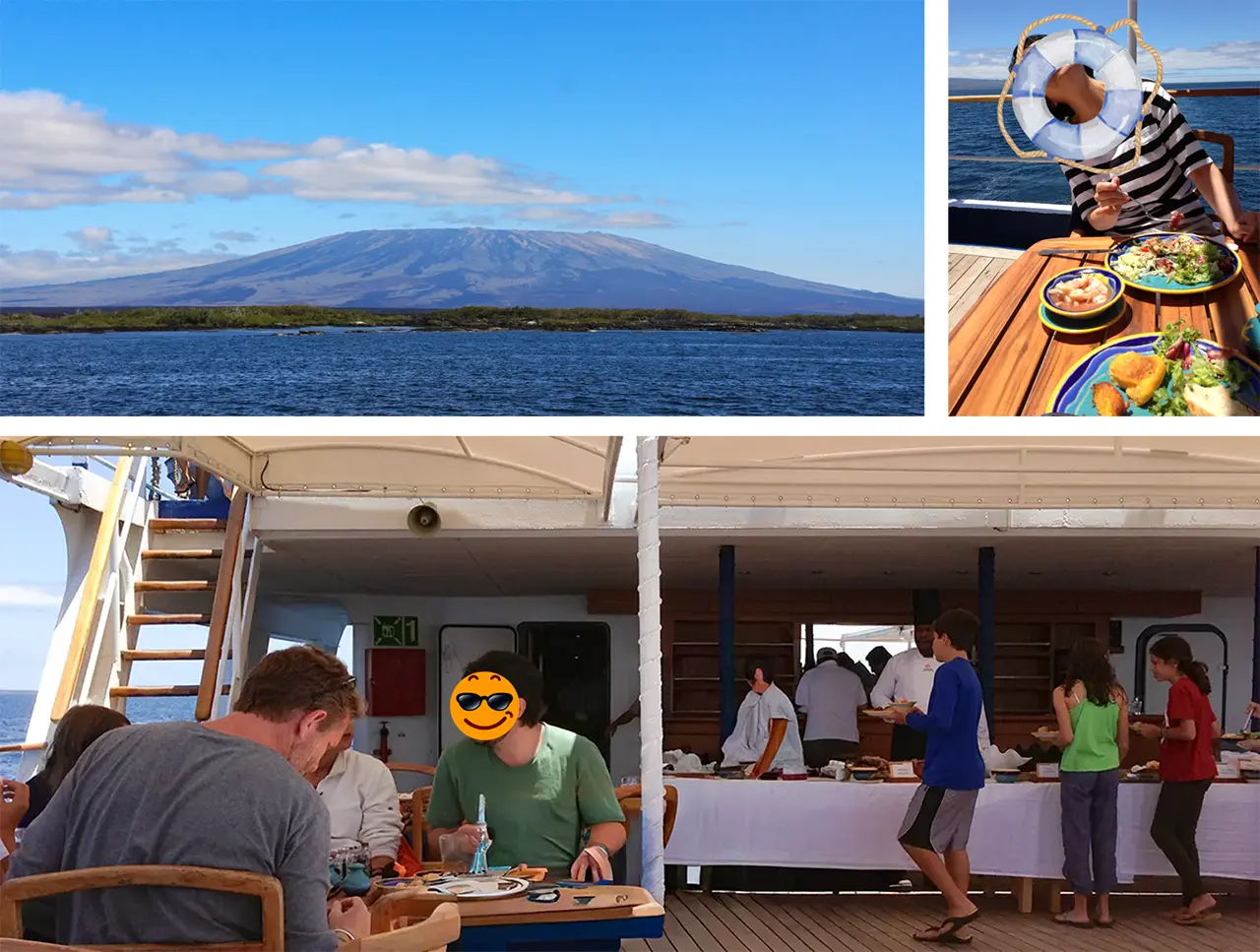
The food was fine: buffet style, with plenty to choose from. Alcohol cost extra, and the wine was not to my taste, so I hardly drank. Perhaps because of the climate, water tasted better than beer. Meals on deck, though, were exceptional and became one of the pleasures of the journey.
The photographs here are my own. At the time I was not yet deeply absorbed in photography, so I used the APS-C DSLR I already had. Many shots were taken with a 70-300mm F4-5.6L zoom lens that I bought in a hurry before departure, thinking it would surely be necessary. Looking back from 2026, the image quality is not what I would expect now, but the angles are often interesting. Some images are therefore not large enough, or not sharp enough, when enlarged. Images that can be enlarged show a plus cursor and open fullscreen when clicked.
Photographs that could not fit into this travelogue are collected separately in Galápagos Photo Gallery.
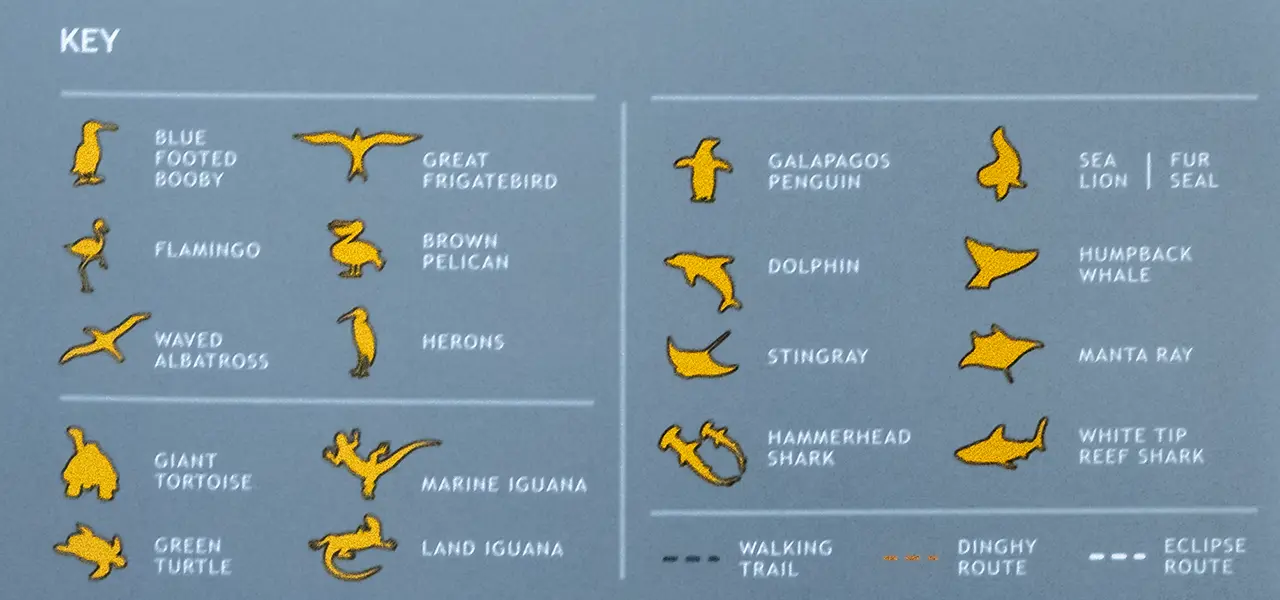
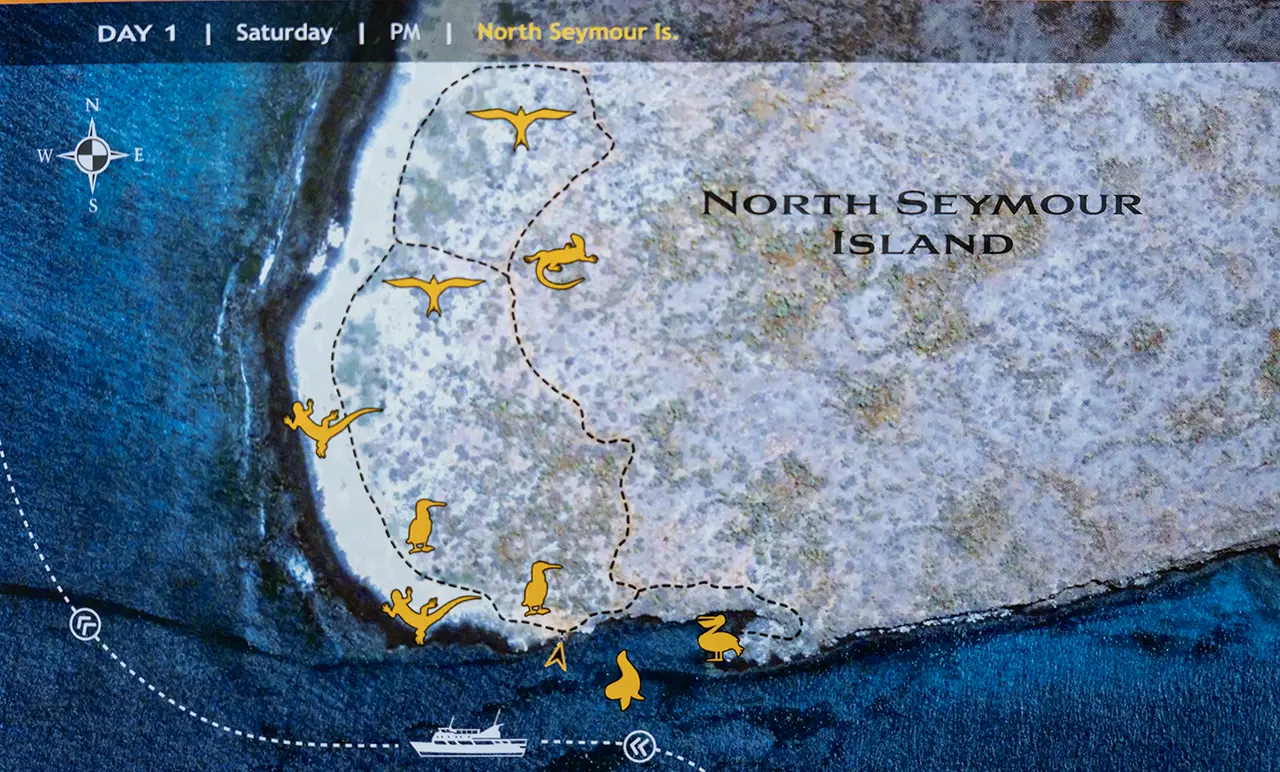
Legend from the visitor-site map showing what can be seen on each island
As in the Japanese original, place names and species names appear in a mixture of English, Spanish, and Japanese forms. I hope readers will forgive the occasional inconsistency.
Following the route, I will introduce the islands, the wildlife, and life aboard the ship.
North Seymour Island
This was the first island we visited after boarding from Baltra Island. Since it was the first island we visited, I had not expected much, but it became the beginning of many surprises.
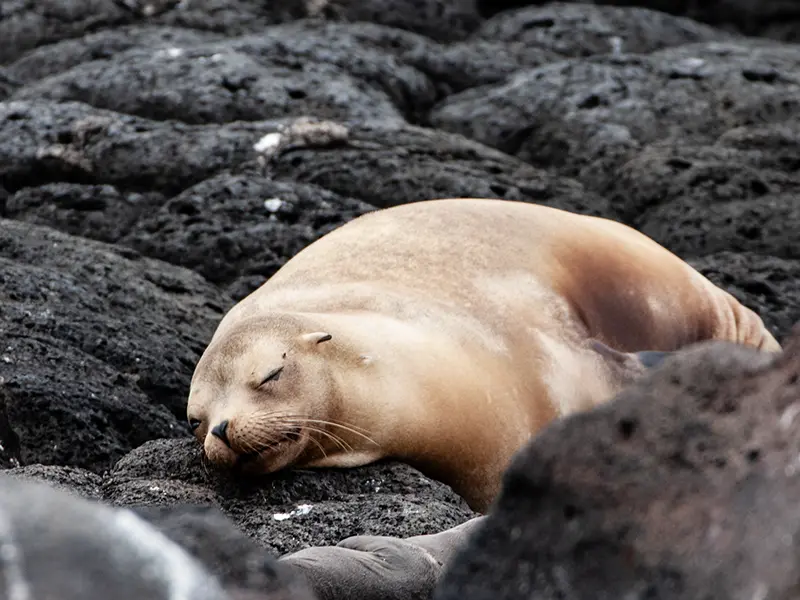
Galápagos Sea Lion
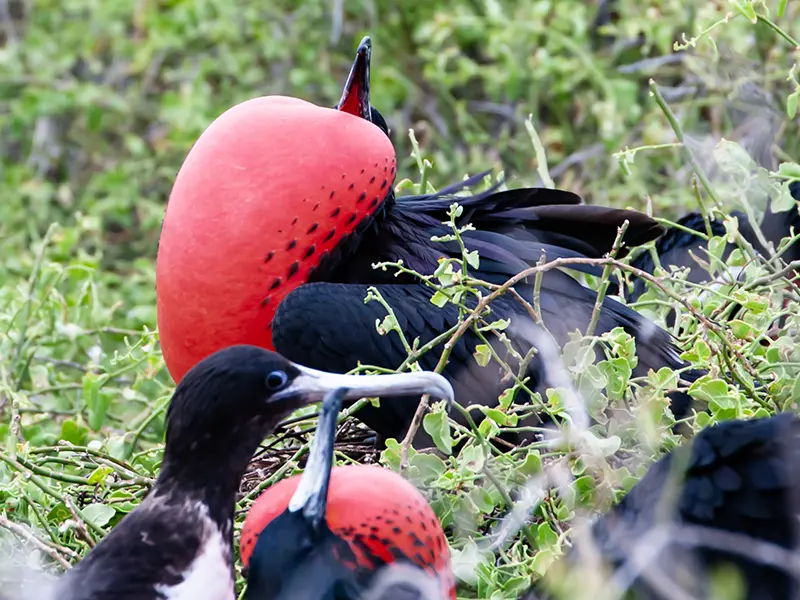
Magnificent Frigatebird
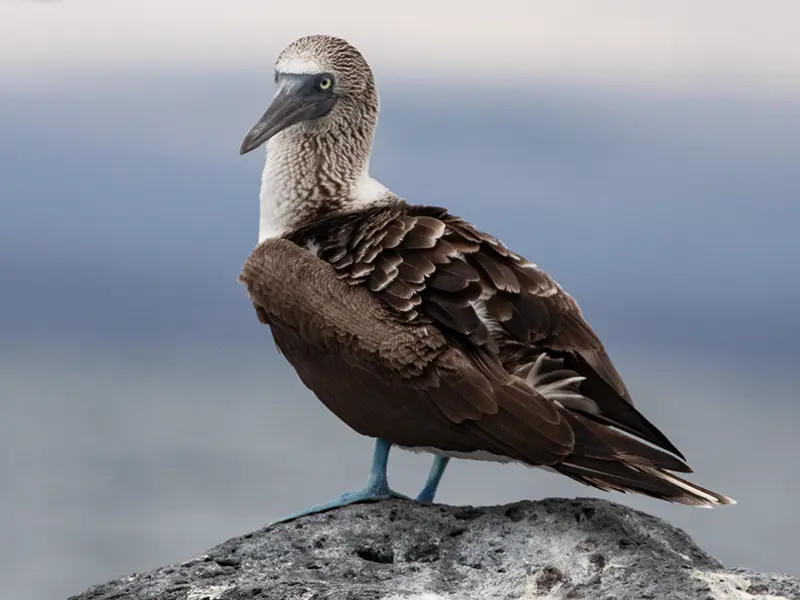
Blue-footed Booby
Sea lions, frigatebirds, and Blue-footed Boobies were right there at close range. I was especially fascinated by the frigatebirds, their scarlet throat pouches inflated like balloons. Before long, my attention had shifted from the scenery alone to the birds, animals, and plants around me. From then on I began photographing animals, and the telephoto lens rarely left the camera.
Since the visit started in the afternoon, it was around 7 p.m. when we returned to the Eclipse.
The North Seymour section of the Galápagos Photo Gallery contains additional photographs and notes on the island.
South Plaza Island
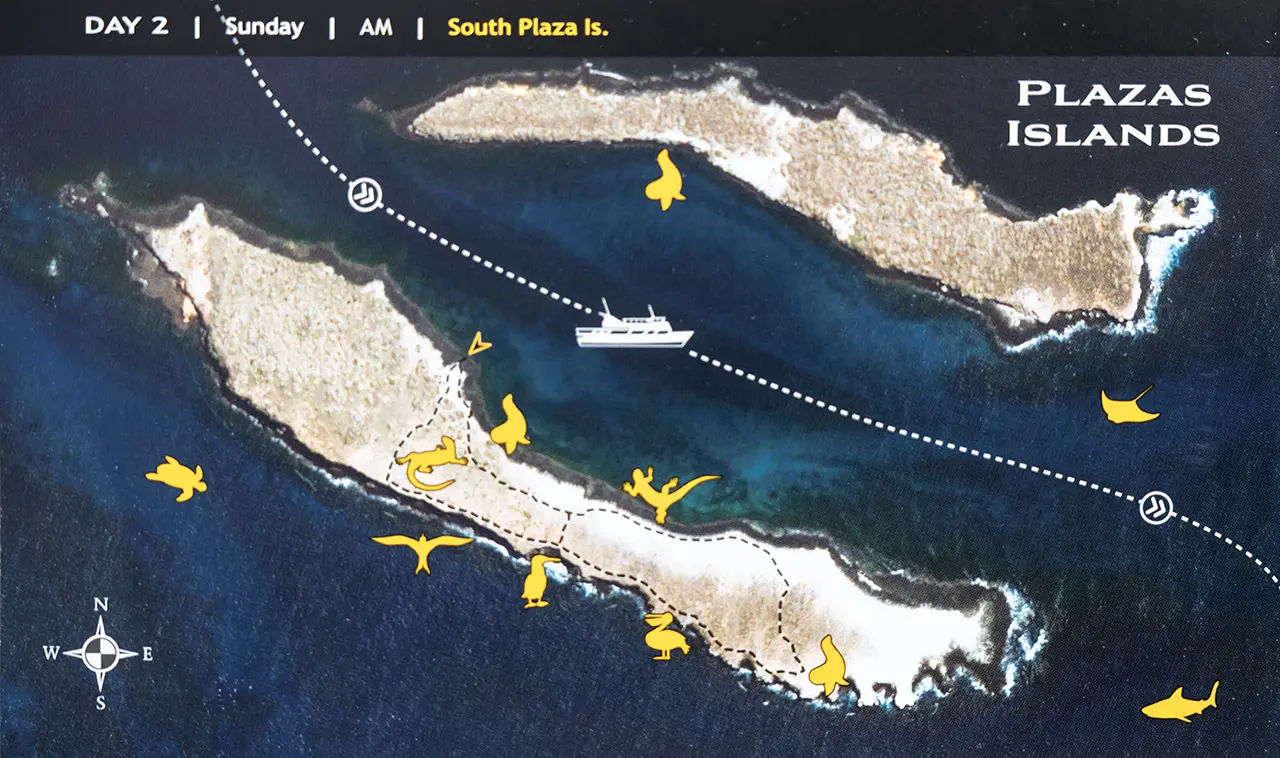
After leaving North Seymour the previous night, the ship anchored the next morning between South Plaza and North Plaza. After breakfast we went ashore by panga, a small boat.
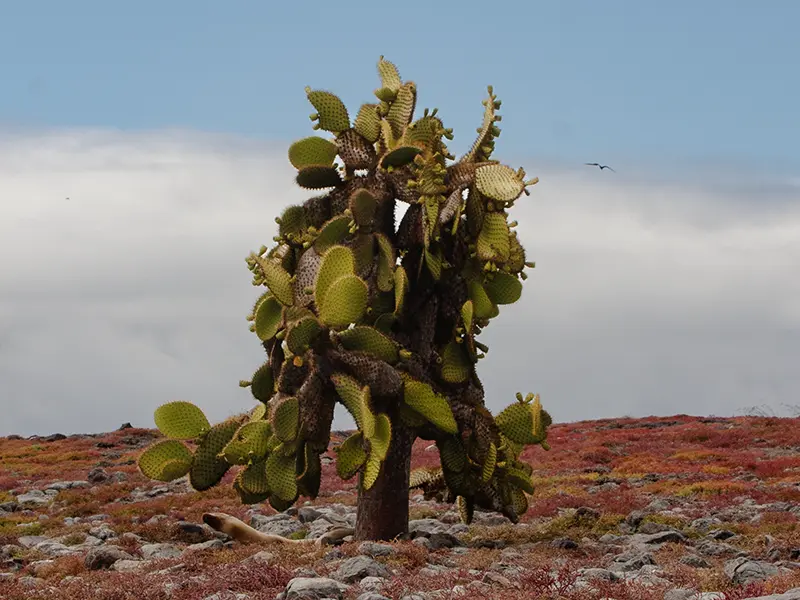
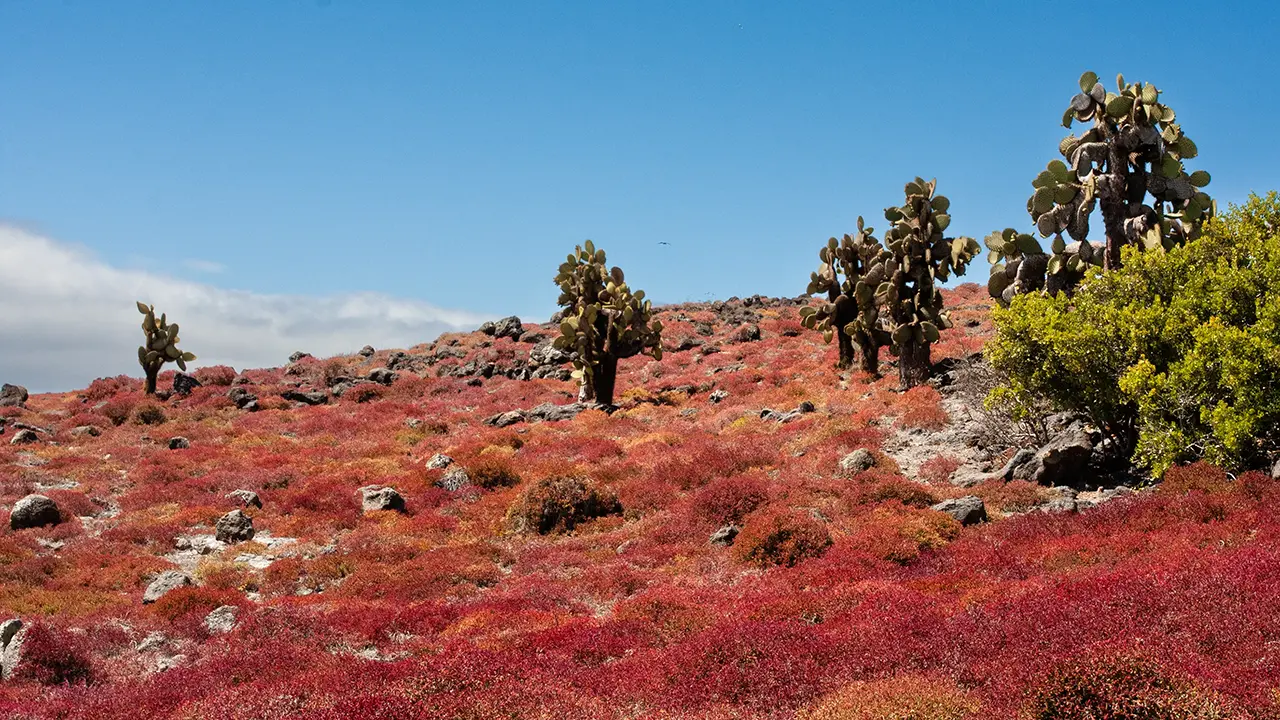
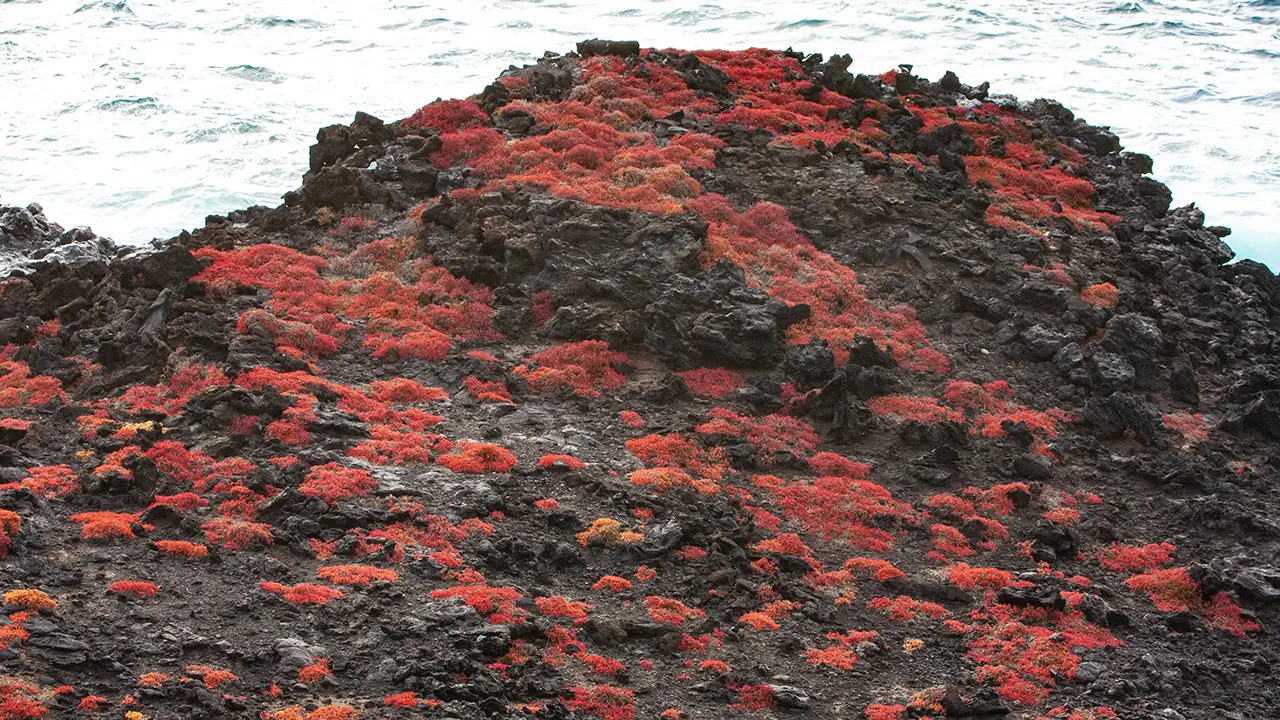
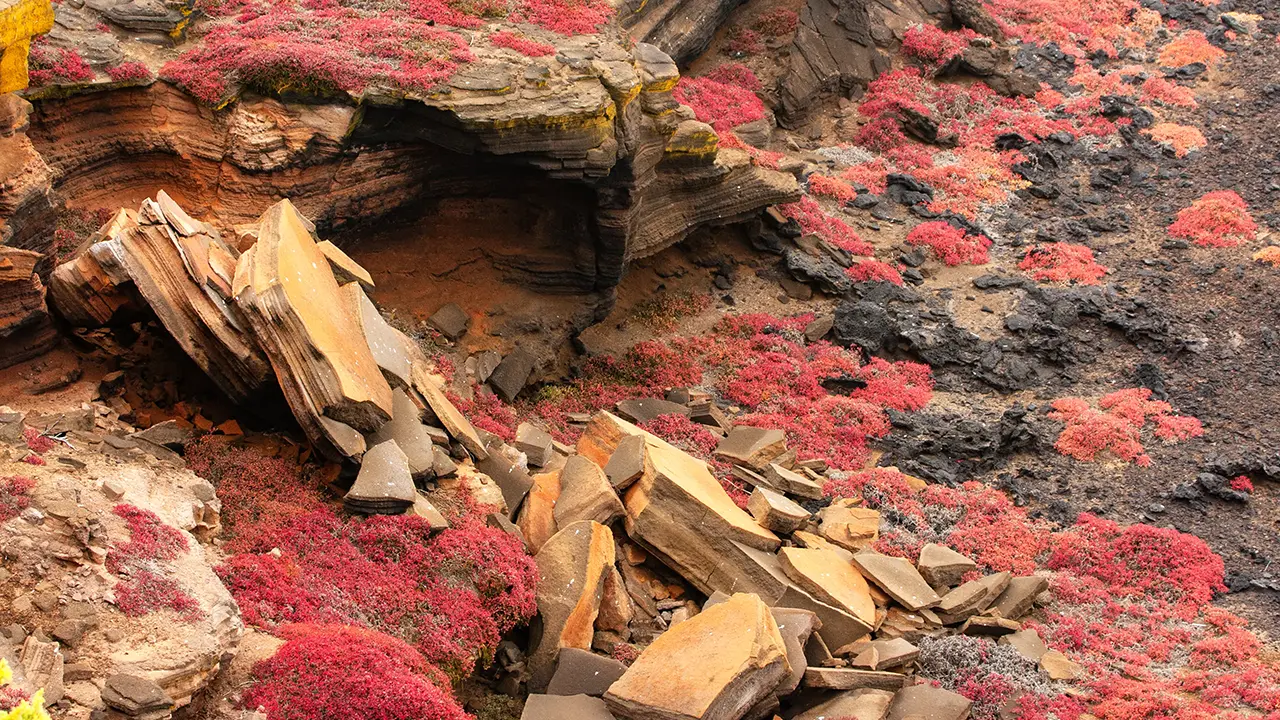
This was where I hoped to see the red sesuvium landscape that had first drawn me to the Galápagos. When we arrived, the sky was overcast, and it looked exactly like “that photograph”: rugged volcanic ground spread with dark-red sesuvium and dotted with dark-green cacti. Visiting in the dry season, when the sesuvium turns red, I was deeply satisfied to see the scene I had imagined.
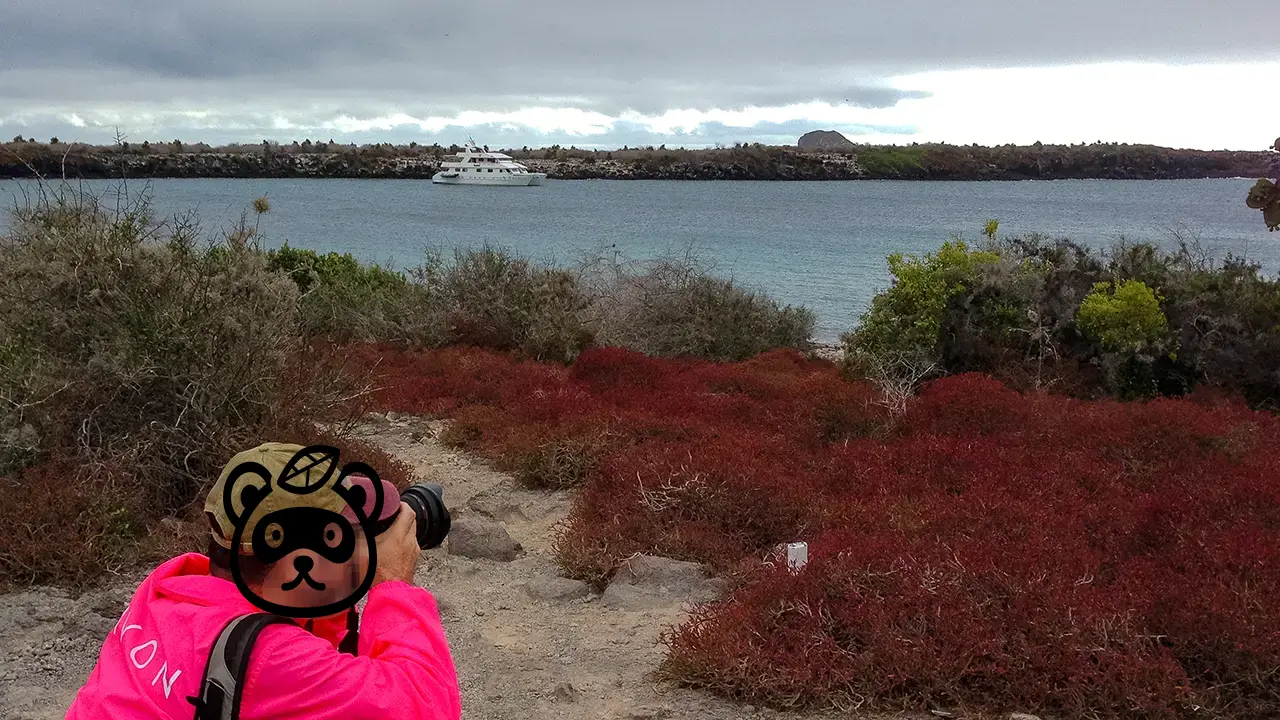
Photographed by my wife.
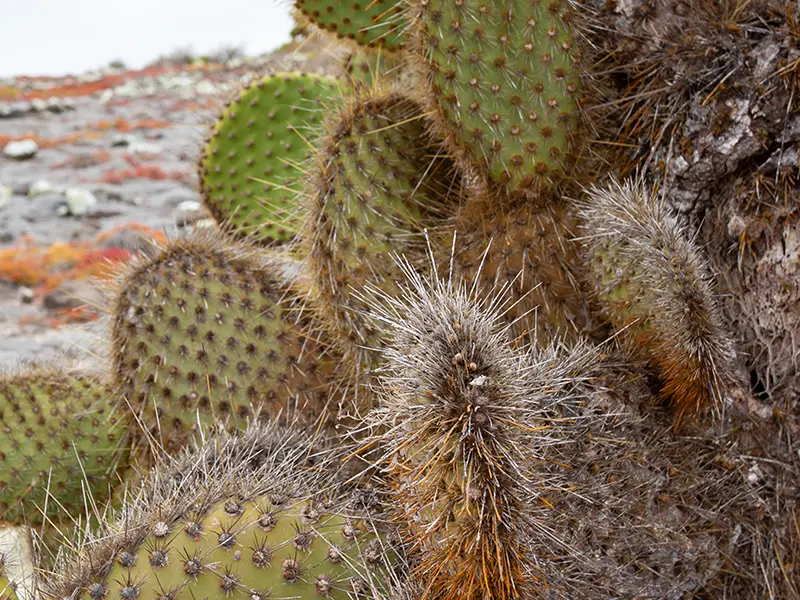
The cactus was introduced as “paddle cactus”; the formal English name seems to be Galápagos prickly pear. In practice, people often just called it cactus. The name tuna is also used.
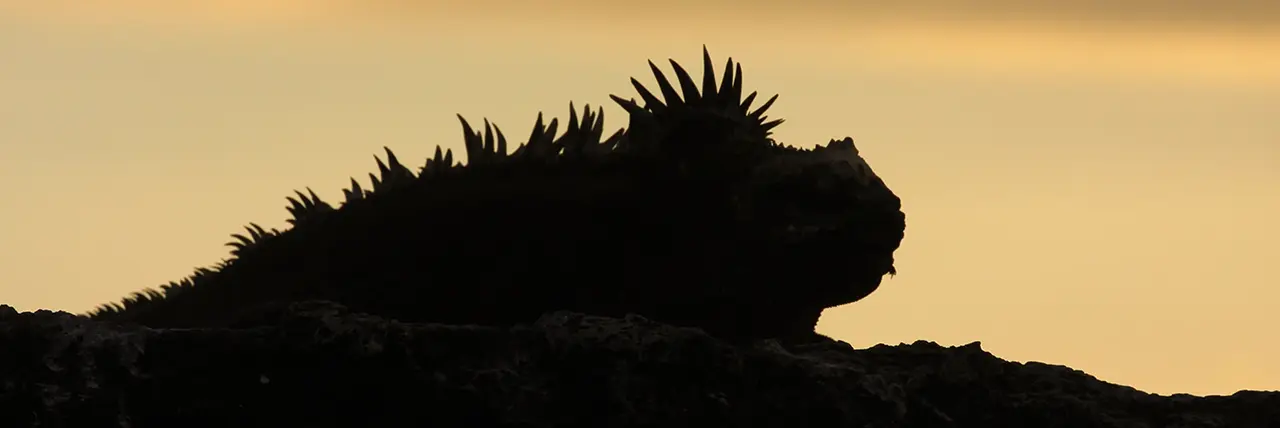
South Plaza is also home to many land iguanas. They exist on other islands too, but here land iguanas sometimes mate with marine iguanas, producing occasional hybrid offspring. These hybrids are said to be sterile. Perhaps it is only because this is the birthplace of evolutionary thought that I wondered whether, over immense time, such things might one day become something new.
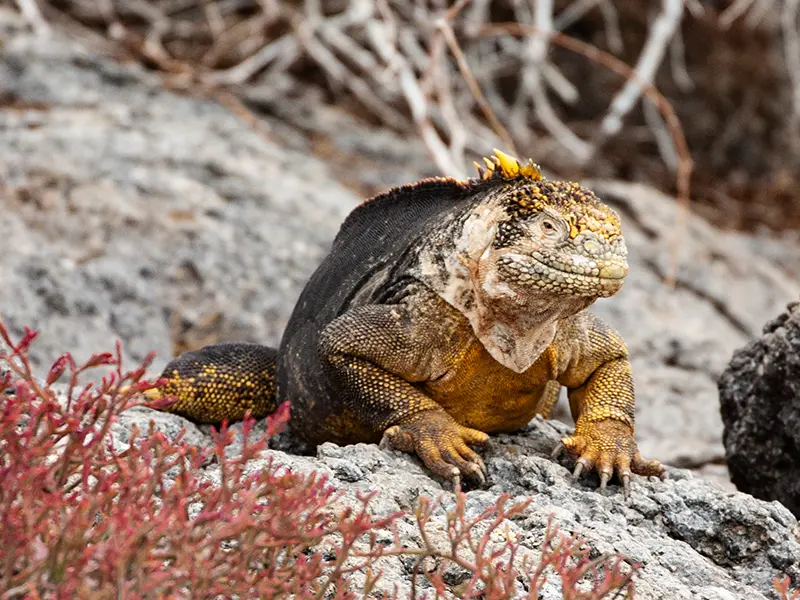
Land Iguana
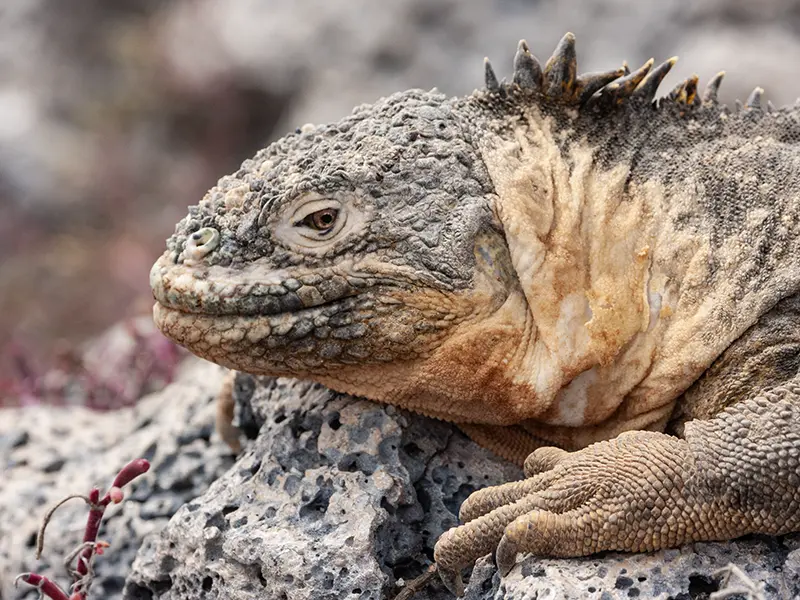
Land Iguana
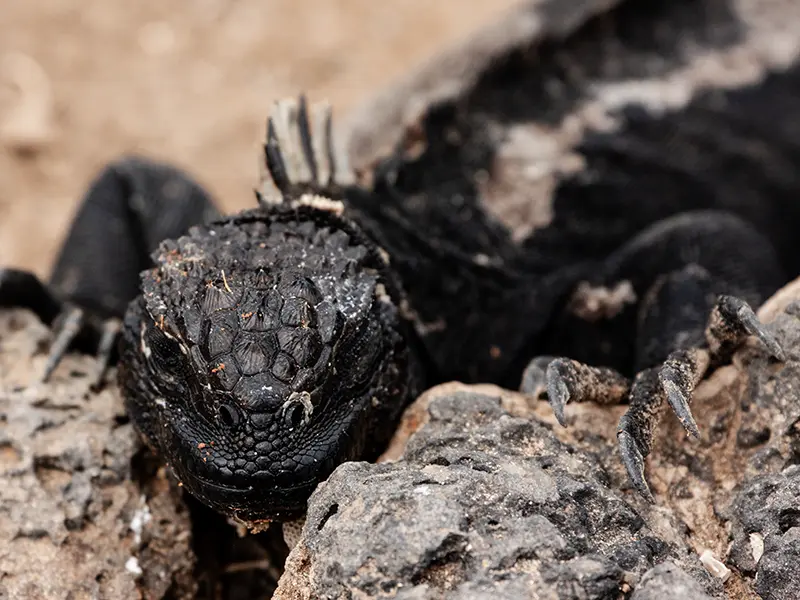
Marine Iguana
There were also sea lions and many kinds of birds. For them, this must be a kind of paradise.
After a while the weather changed and blue sky opened above us. Suddenly the same place looked entirely different: another otherworldly landscape of red and blue. Which was more spectacular? I may actually prefer the cloudy version.
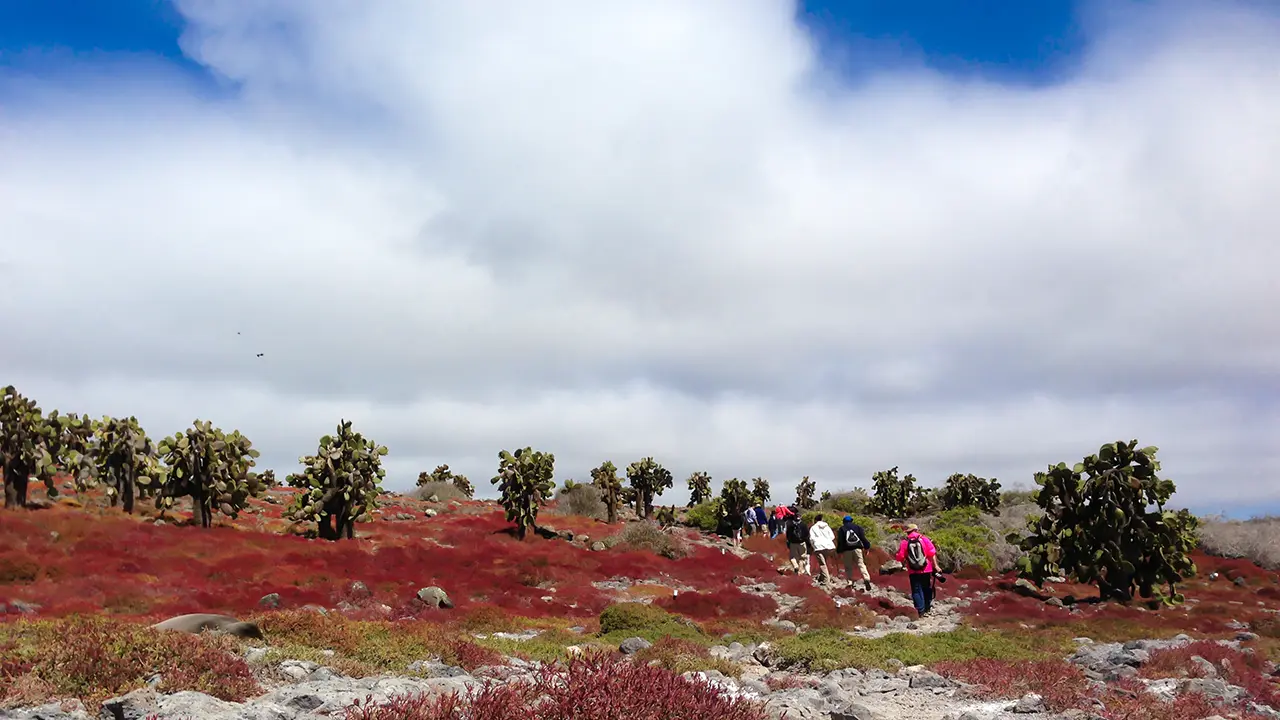
We moved along the trail as a group, then dispersed on the high ground and were free until the appointed time to return to the ship.
The South Plaza section of the Galápagos Photo Gallery contains additional photographs and notes on the island.
Santa Fe Island
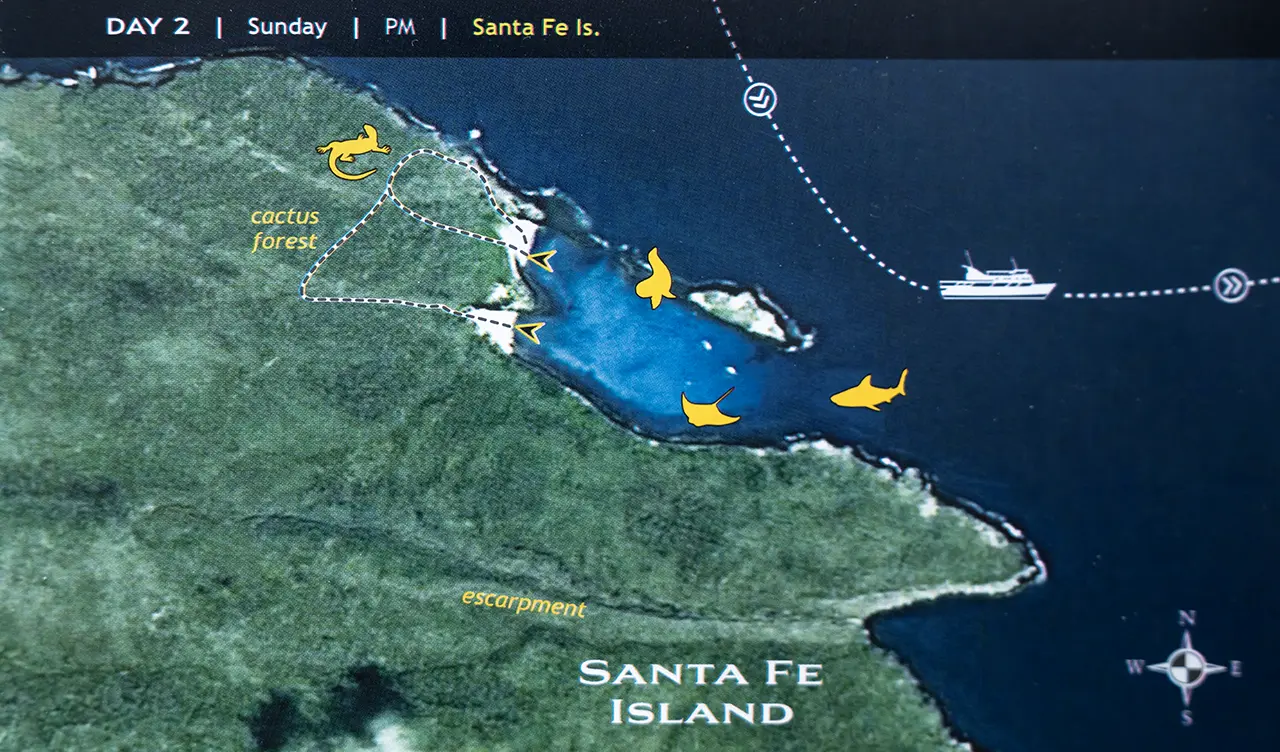
After South Plaza, we visited Santa Fe in the afternoon. We first tried snorkeling. The water here was clear and the current gentle, and the idea was to enjoy marine life against a lava-formed seascape. We saw sea lions and turtles swimming. But my first impression was: cold. Perhaps because of the current, the water was chilly, and with the sun hidden we had little warmth. My enthusiasm faded quickly, and although there were later opportunities to snorkel, I did not join them.
Ideally I would have included diving, but the schedule made that impossible from the start. Later I learned that Galápagos diving is often for intermediate or advanced divers because of strong currents, cold water, and depth, and that the best sites are about 200 km away. Not planning it was probably the right decision.
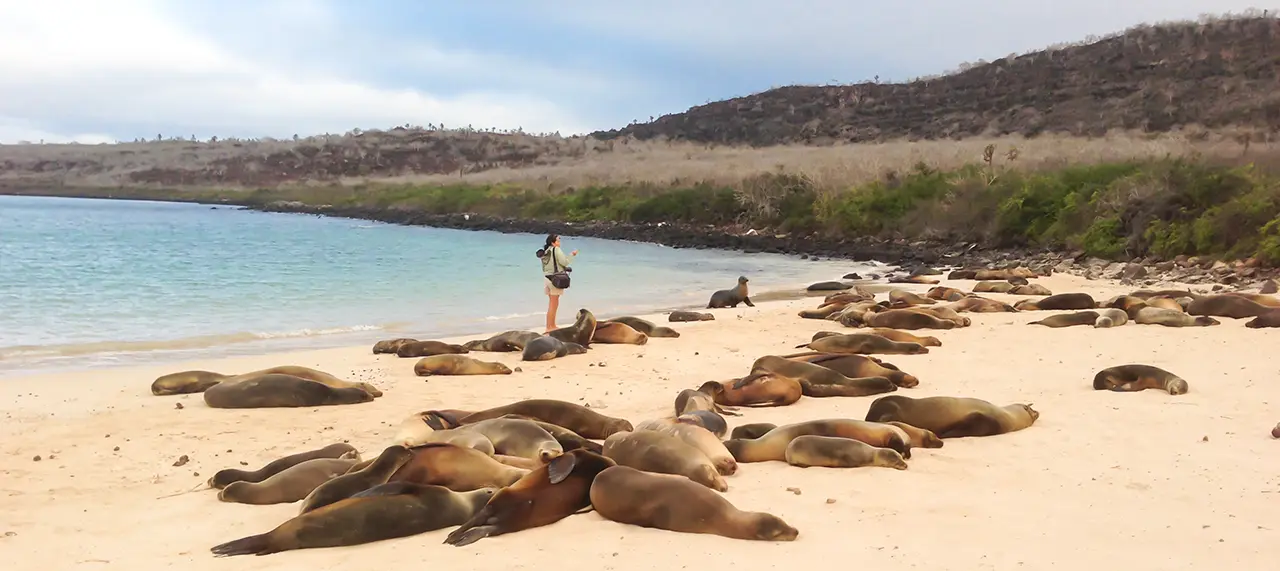
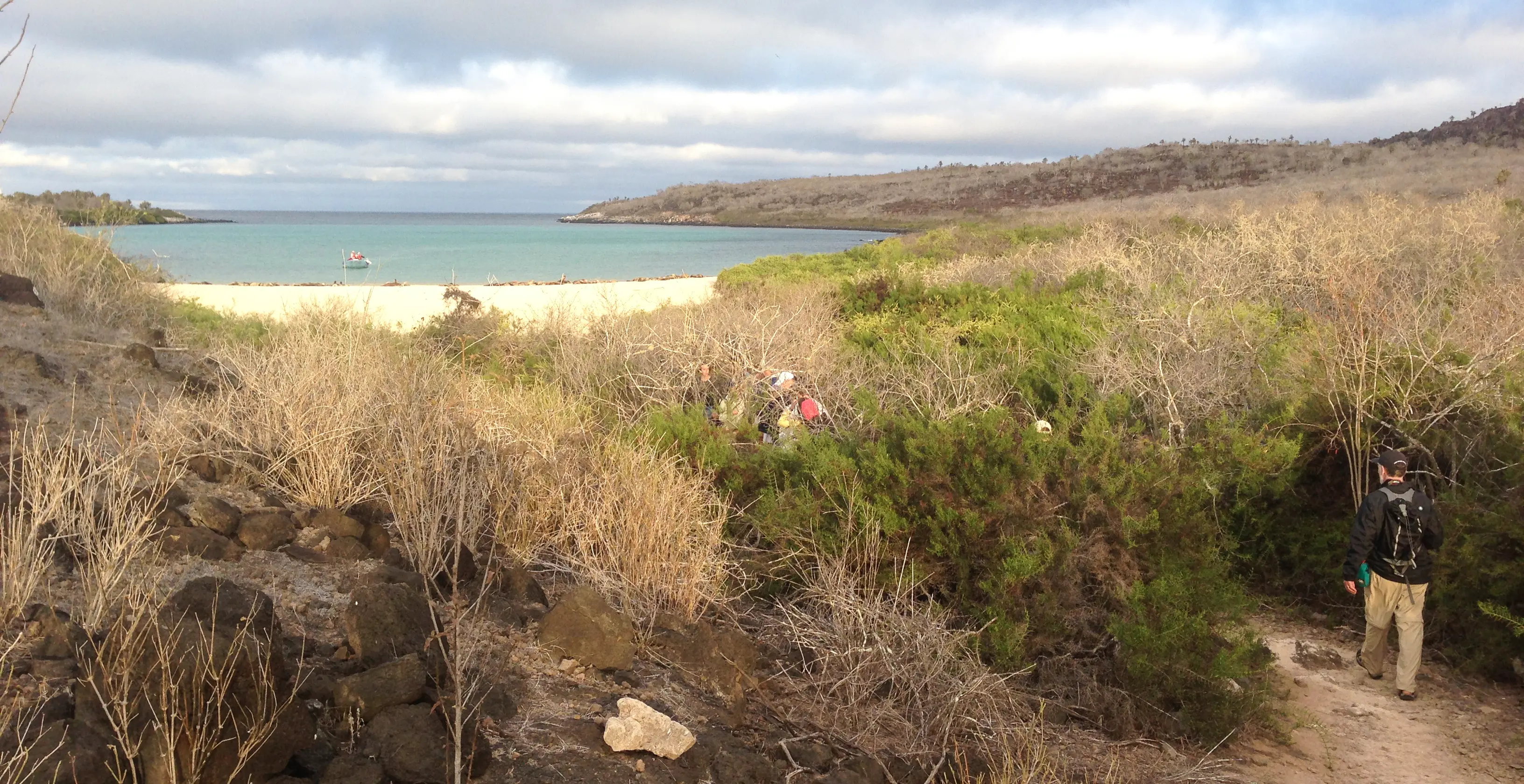
We then landed at Barrington Bay, known for its sea lion colony. This was a wet landing: unlike the previous landings, we stepped into the water before reaching the beach. The sandals I had brought finally proved useful. From the beach, an observation trail led inland. On North Seymour and South Plaza I had not been especially conscious of trails, but here, walking through a more wooded landscape, their importance became clear. Visitors must walk with a guide, and group size is limited; I think it was around fifteen people.
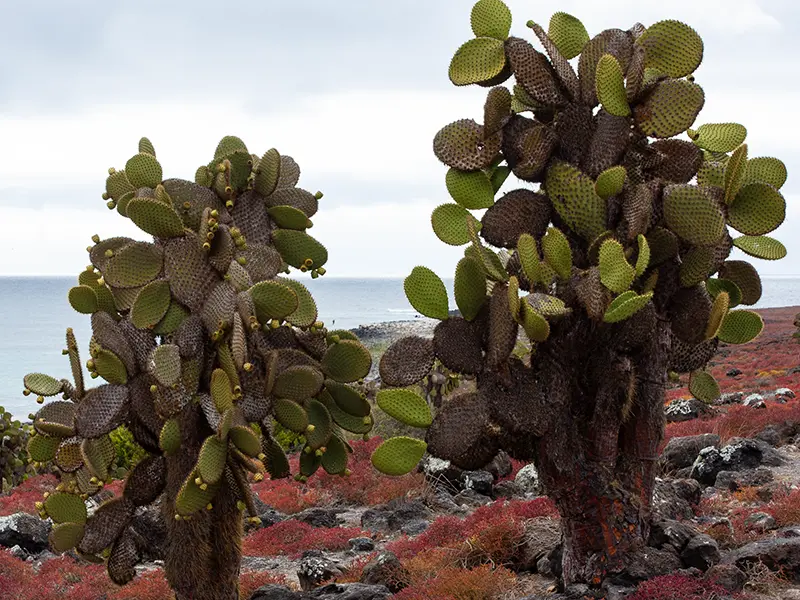
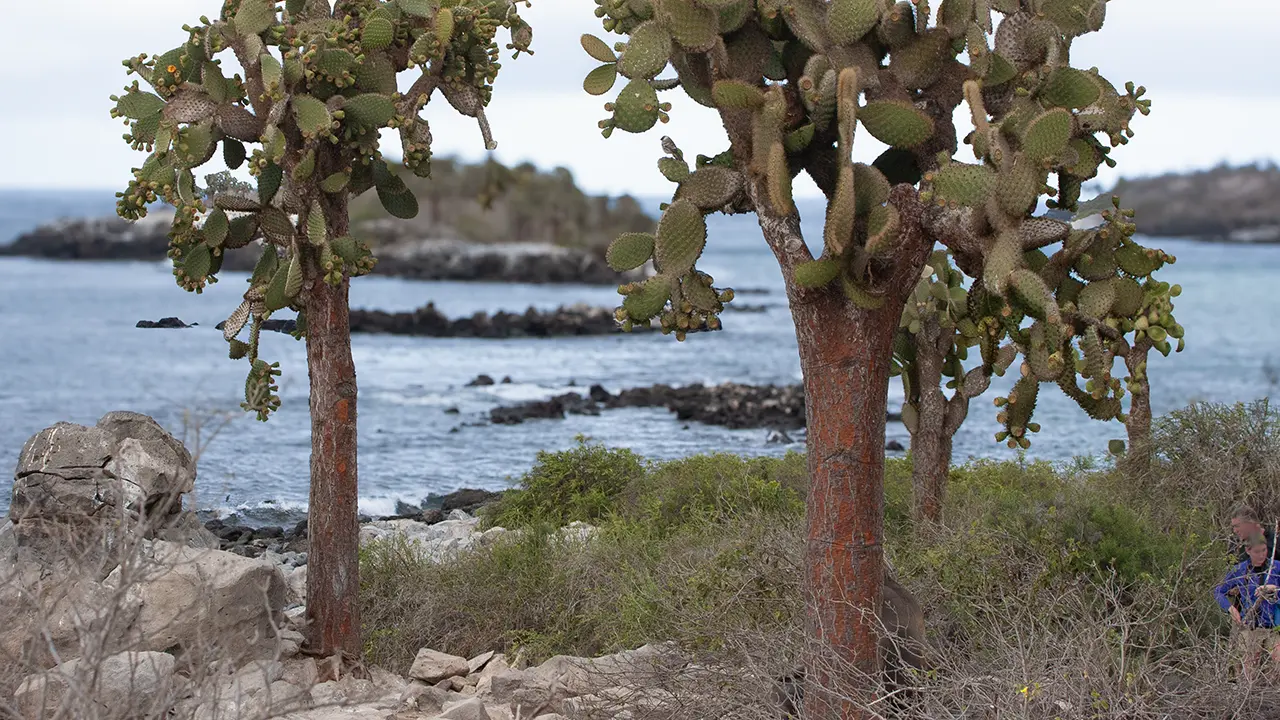
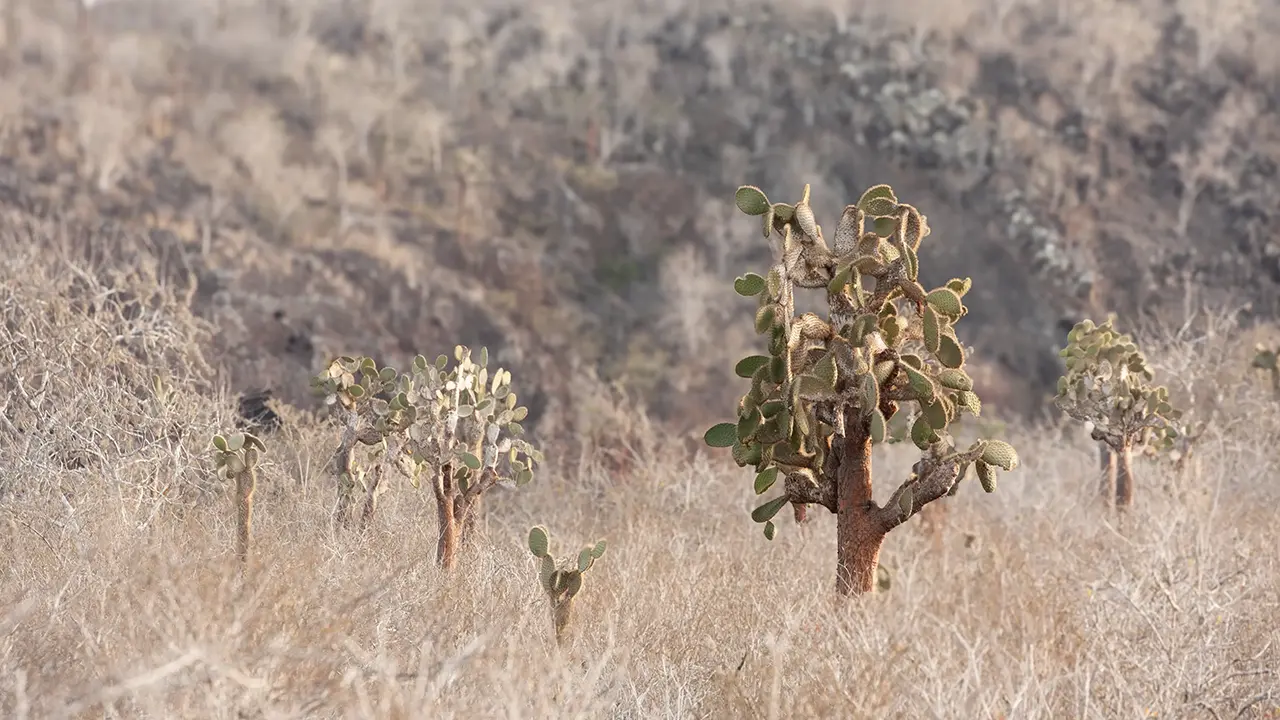
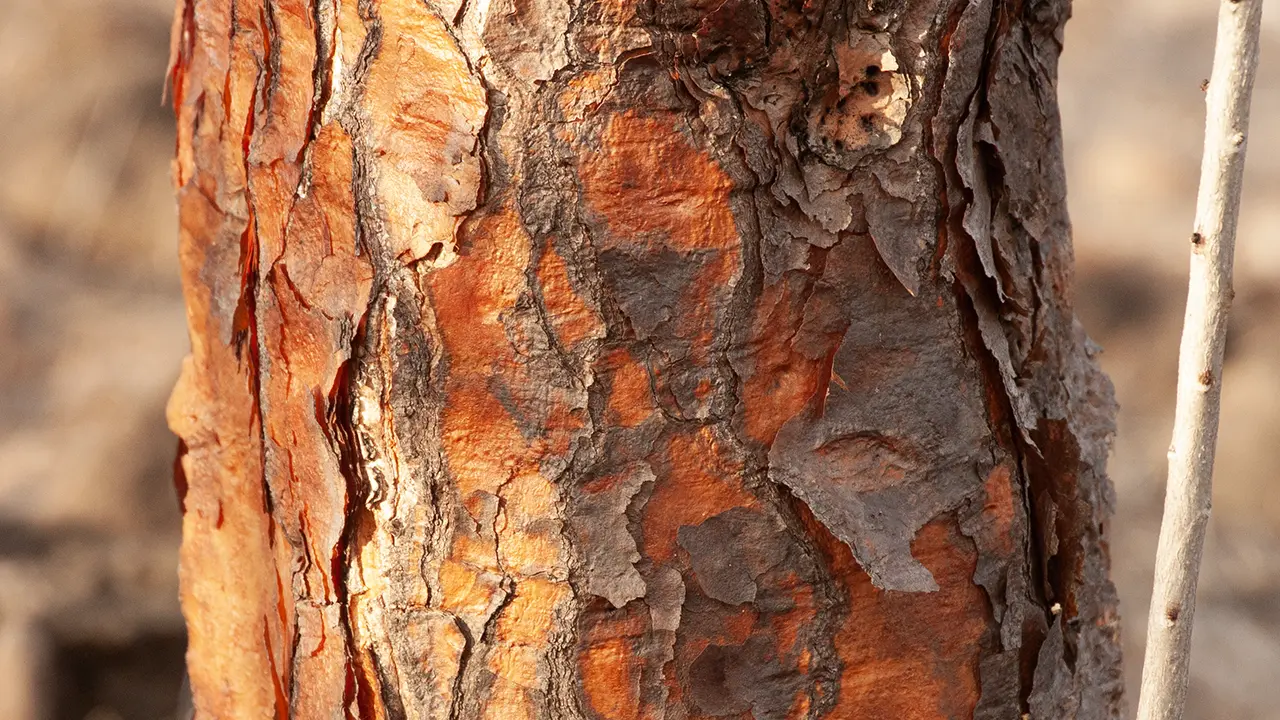
The trail passed beside towering cactus and around a small hill through a gentler landscape. The guide explained that the cactus had grown tall, with bark-like hardened trunks, as a form of coevolution to protect themselves from herbivores such as land iguanas. To understand their size, look at the person in the lower right of the first photo.
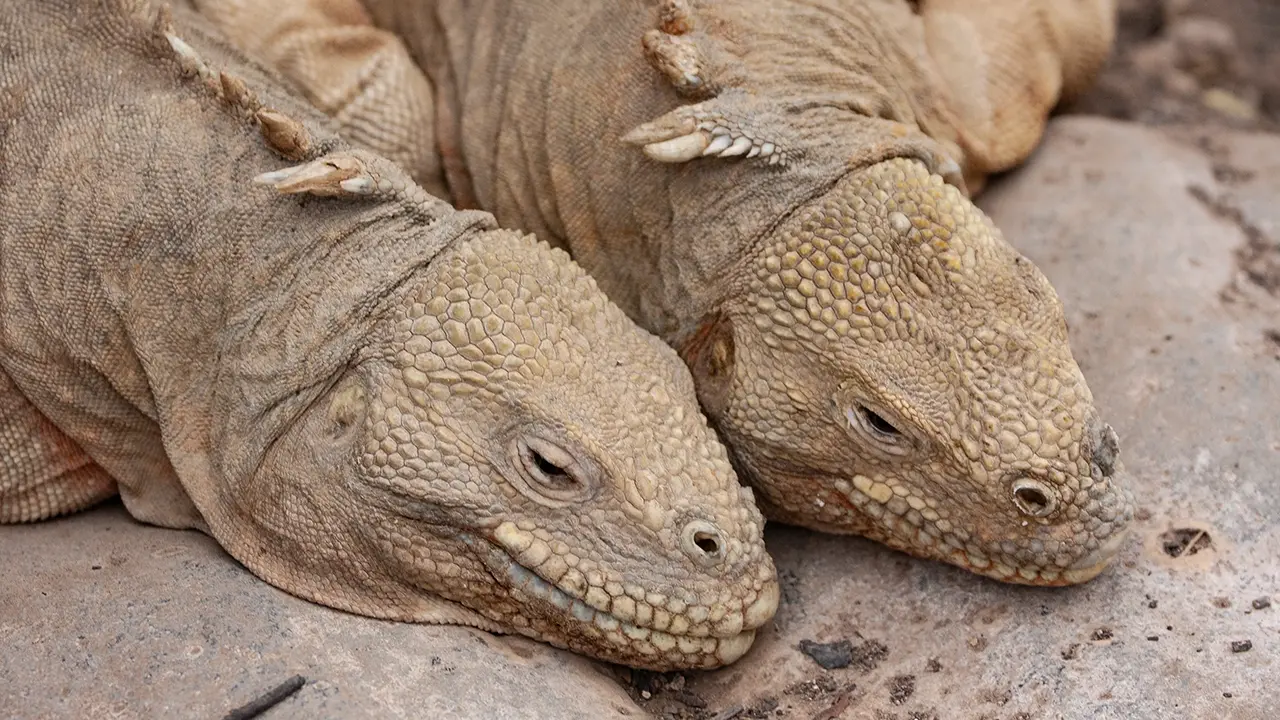
Santa Fe Land Iguana
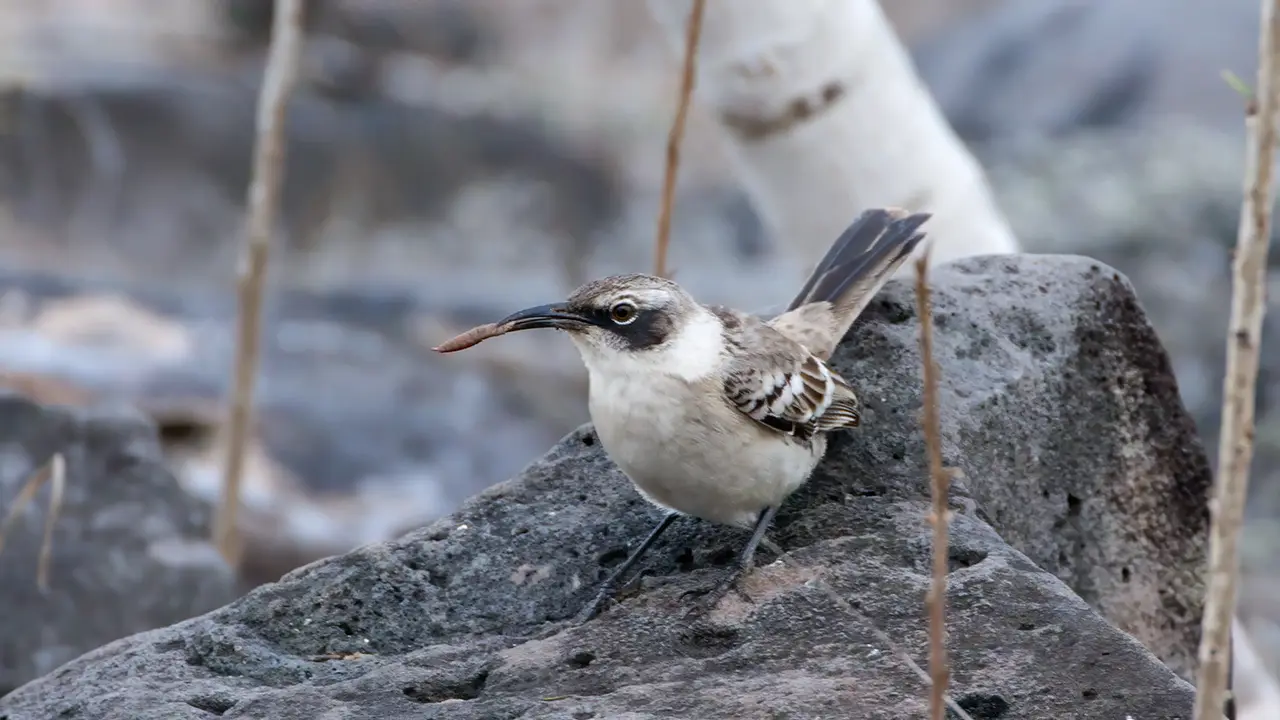
Galápagos Mockingbird
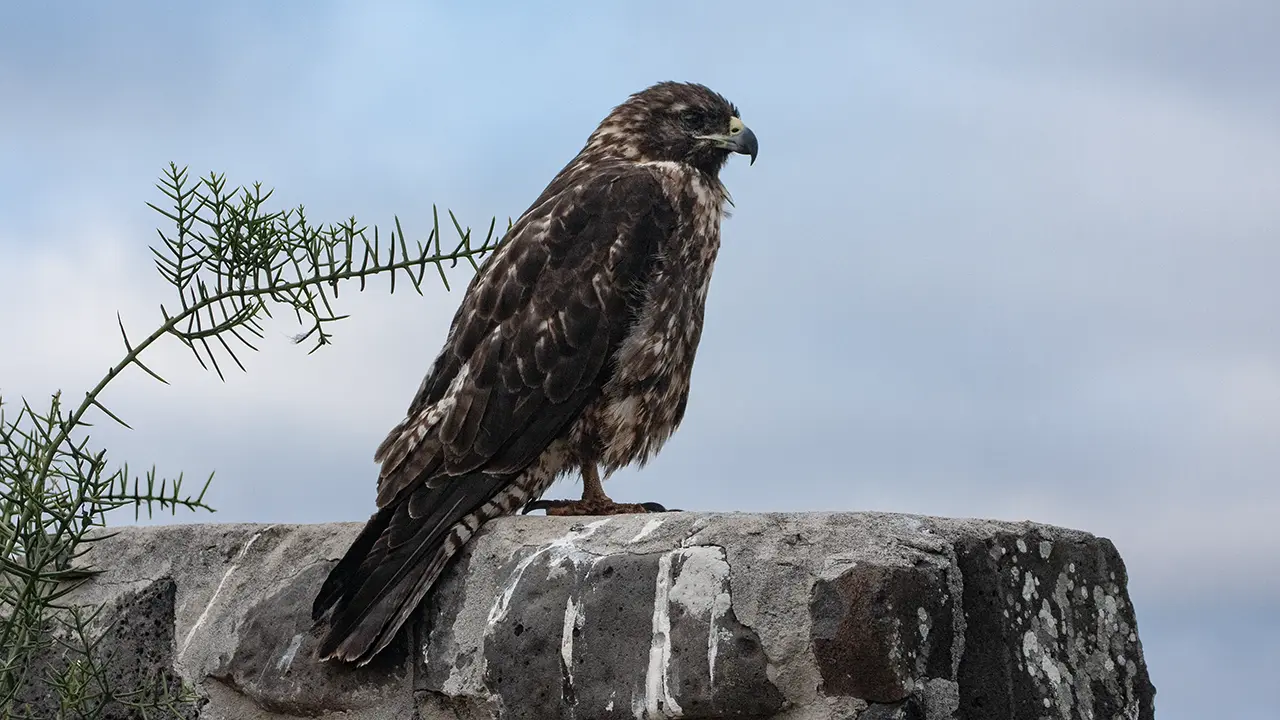
Galápagos Hawk
The trail circled the hill and returned to the beach.
Along the way, iguanas and sea lions blocked the trail, and in a nearby bush was a Galápagos Mockingbird. Like Darwin’s finches, mockingbirds are said to have given Darwin important clues while he was developing his ideas on evolution. The thirty-minute walk felt much shorter than it was. The Santa Fe Land Iguana, found only on this island, had an ocher-colored body that looked almost as if it had been made from fired clay. Just before we returned to the beach, we also saw a Galápagos Hawk, which the guide had told us we would be lucky to encounter. Perhaps we were lucky after all.
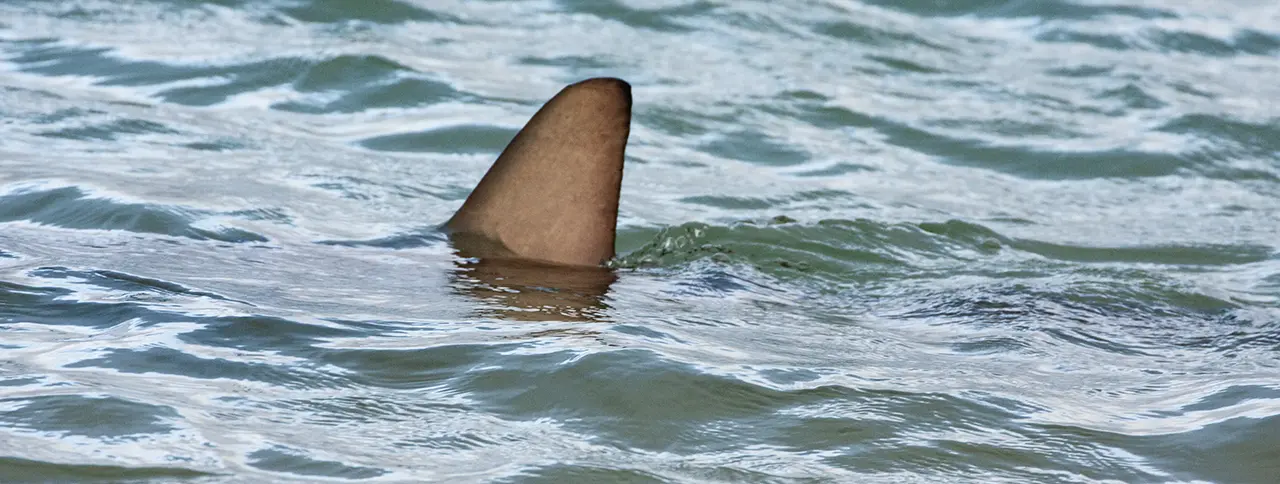
When it was time to return to the ship, a shark entered the bay and came within a few meters of the shore. Boarding the panga meant putting our legs into the water, so we had no choice but to wait.
The shark’s triangular fin was right in front of us, and everyone was saying “Jaws!” Apparently that reaction is not limited to Japanese people.
The Santa Fe section of the Galápagos Photo Gallery contains additional photographs and notes on the island.
Aboard the Eclipse
A few small scenes from life aboard the Eclipse.
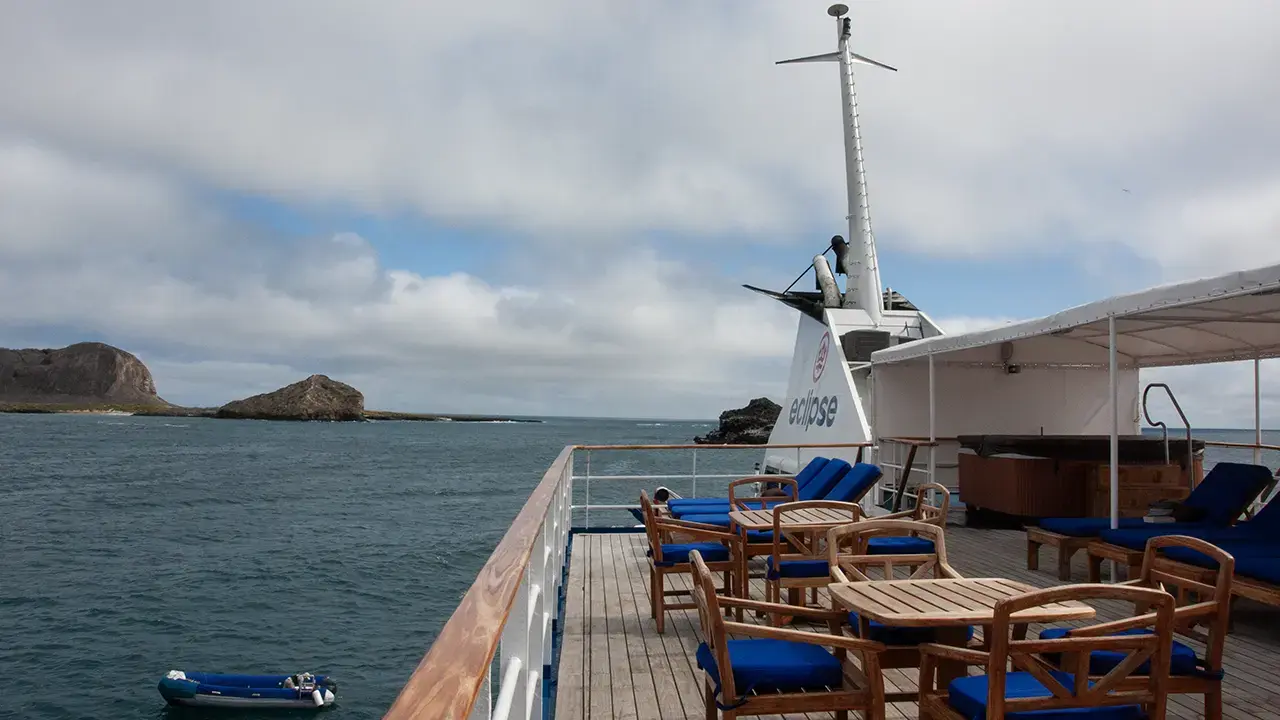
The deck was a wonderful place to relax after activities: open, breezy, and easy to linger on.
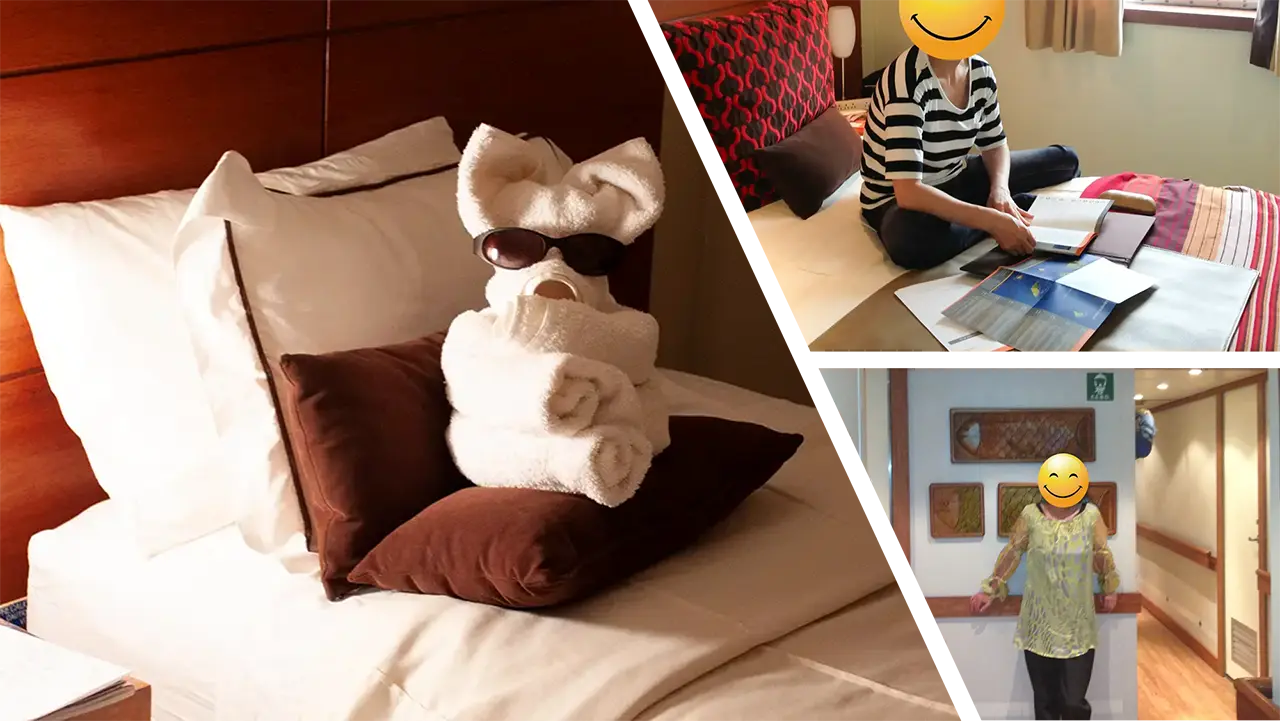
Our cabin, as mentioned earlier, was more spacious and comfortable than I had expected. I still remember how charmingly the bath towels were folded each time the bed was made. The staff were attentive and very friendly. The photograph at lower right shows the corridor outside our cabin. I had imagined corridors on a small ship as dark and rather intimidating, but this one was bright and clean.
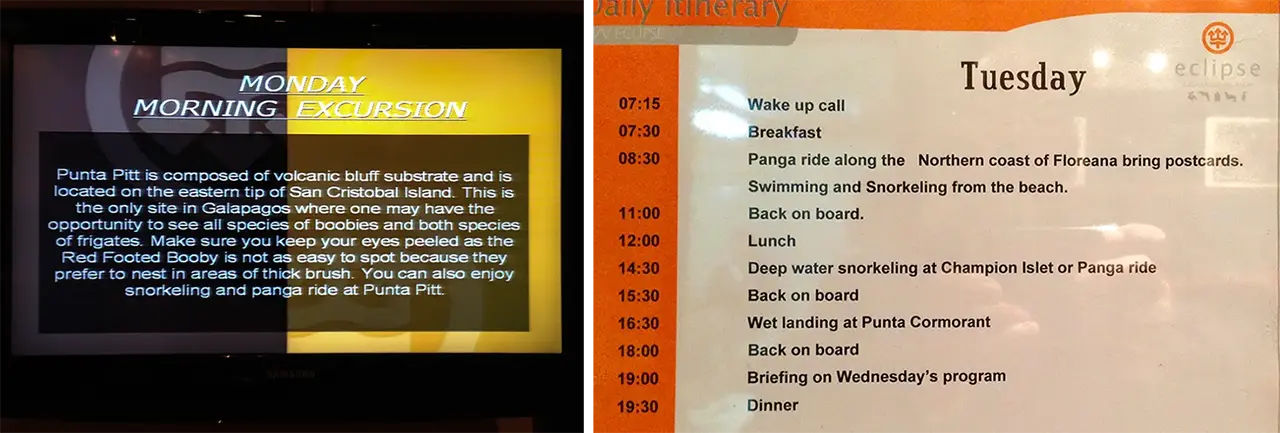
The notice board displayed information about the next day’s activities. It was also where passengers checked optional activities, made reservations, and asked questions.
San Cristobal Island
On San Cristobal, we landed at two places: Punta Pitt and Cerro Brujo.
Punta Pitt
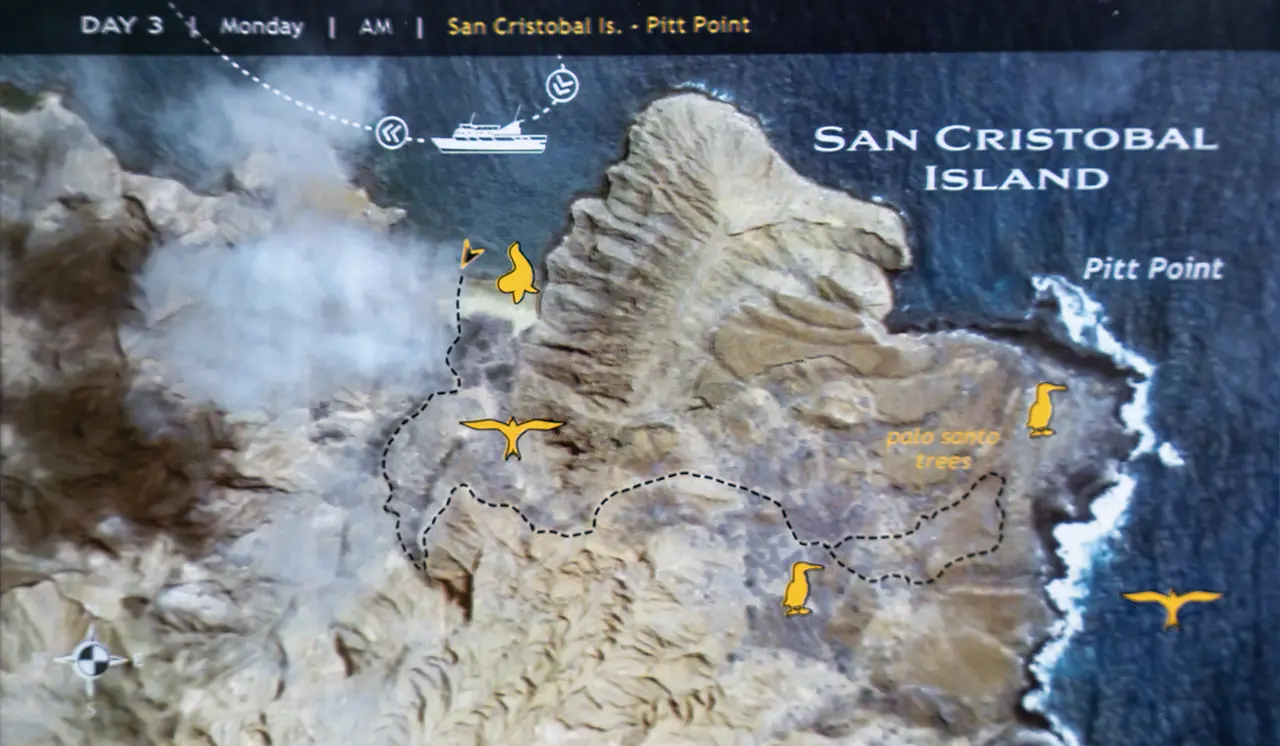
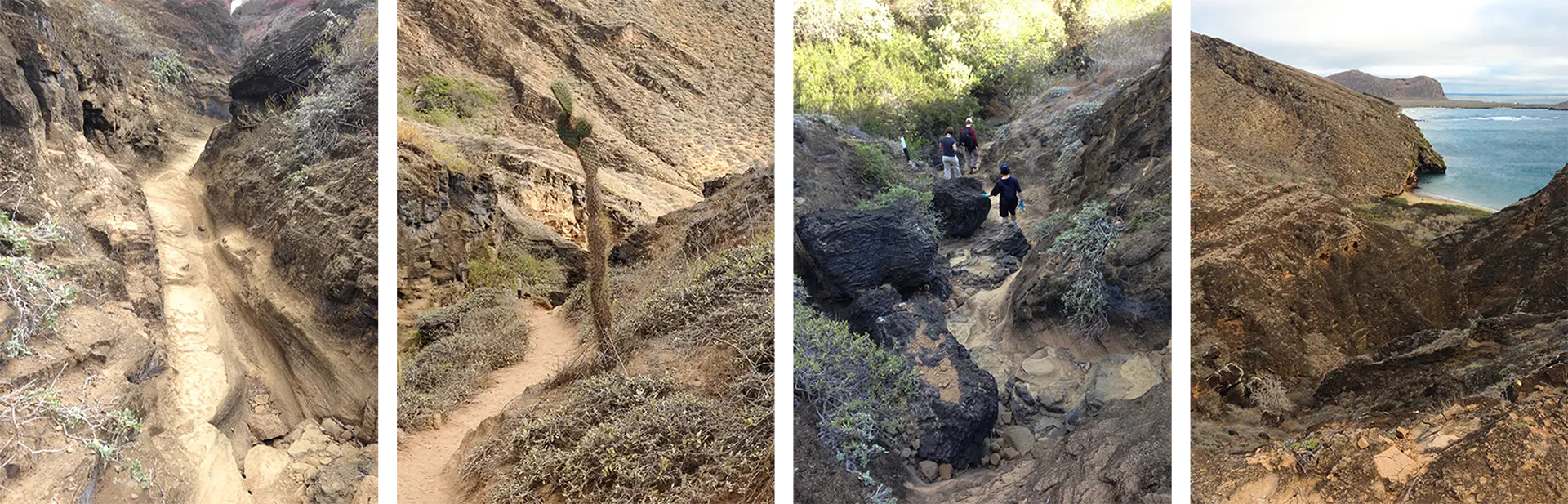
After moving from Santa Fe, the ship anchored off Punta Pitt on San Cristobal Island. Our first activity here was an optional early-morning walk. We took a panga to the beach for a wet landing, then climbed a trail that followed a dry watercourse eroded into the rocky slope. It was the dry season, so there was no water at all. The climb was probably less than 100 meters, but it was still a little demanding.
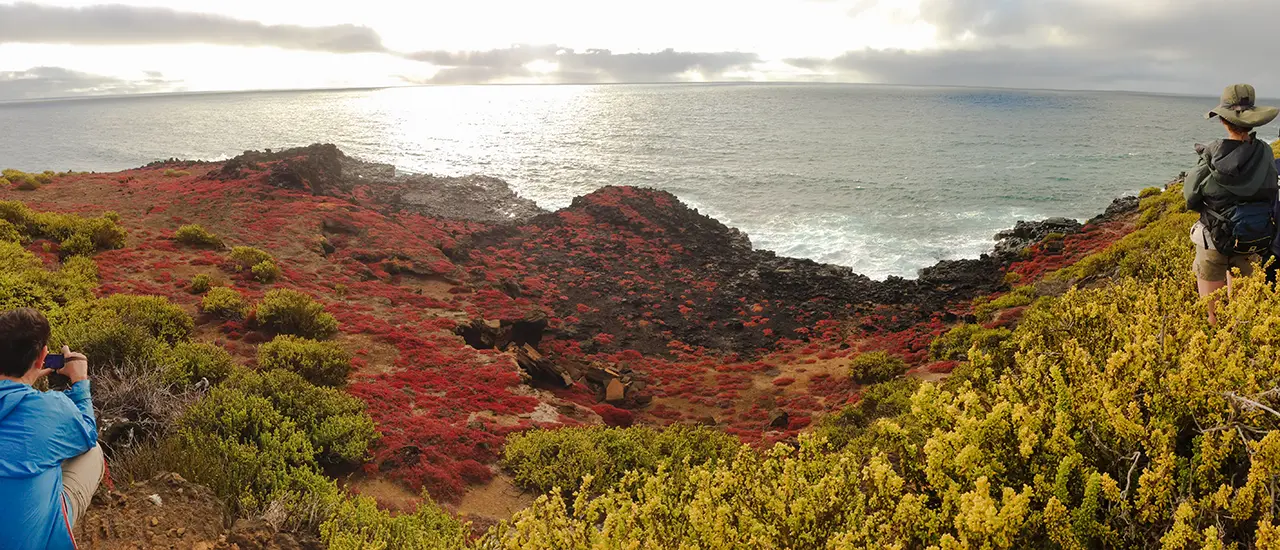
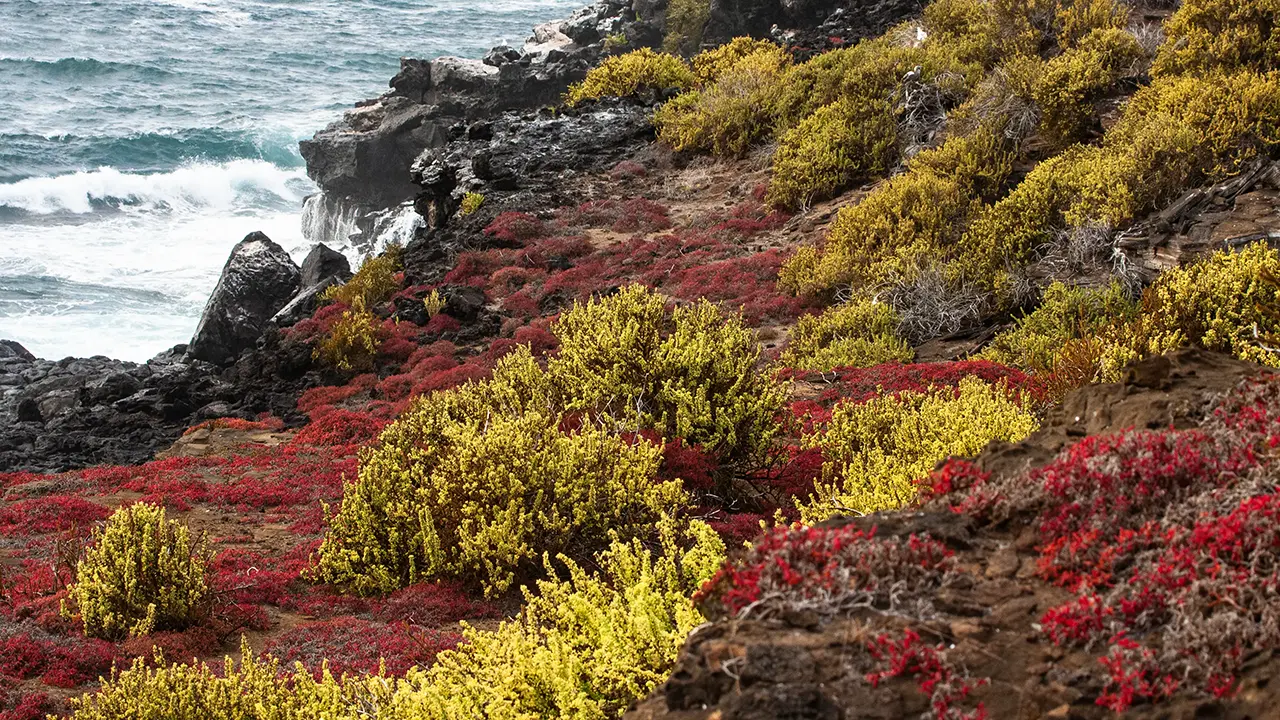
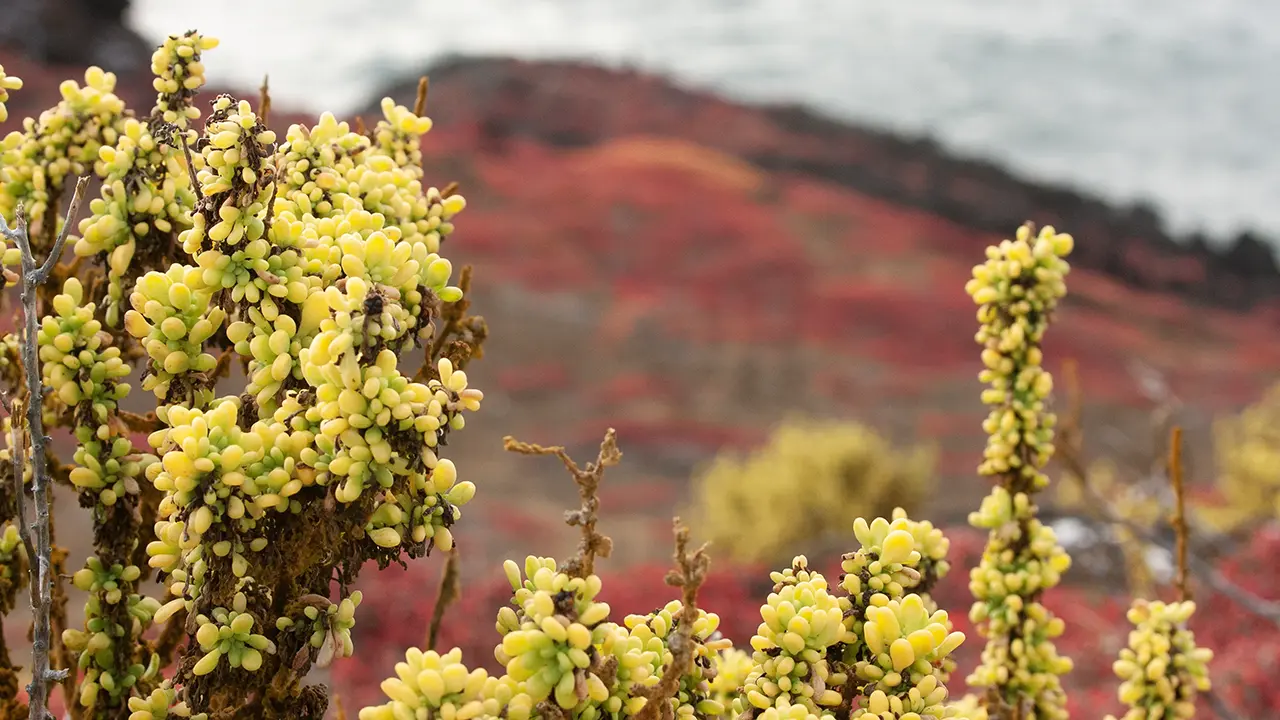
At the end of the trail, vivid red sesuvium and low green shrubs spread across the cliff top.
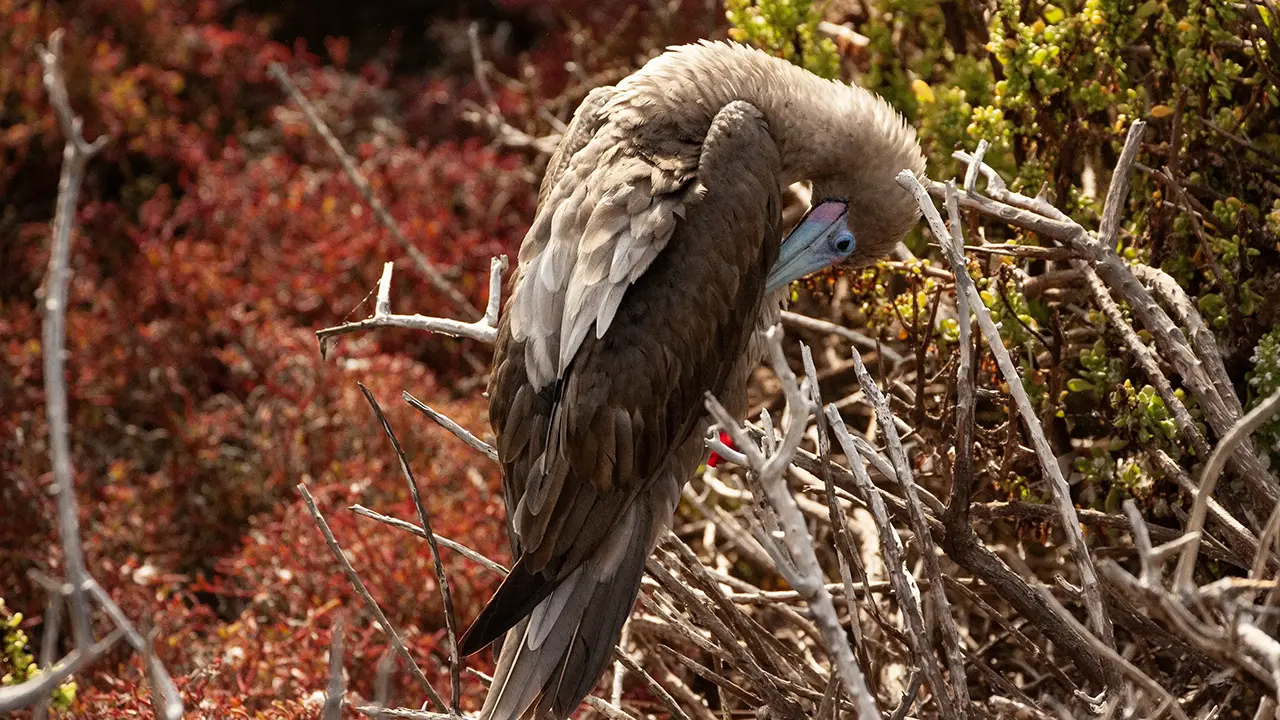
Three species of booby are said to be found around this area: Red-footed, Blue-footed, and Nazca. We could see Red-footed Booby nests, but the angle was poor, and I never managed to get a clear photograph of the red feet themselves. Still, the hour-long walk was refreshing, and the scenery, in its own way, was spectacular. It was well worth joining.
The yellow-green low shrubs appear to be Galápagos Purslane.
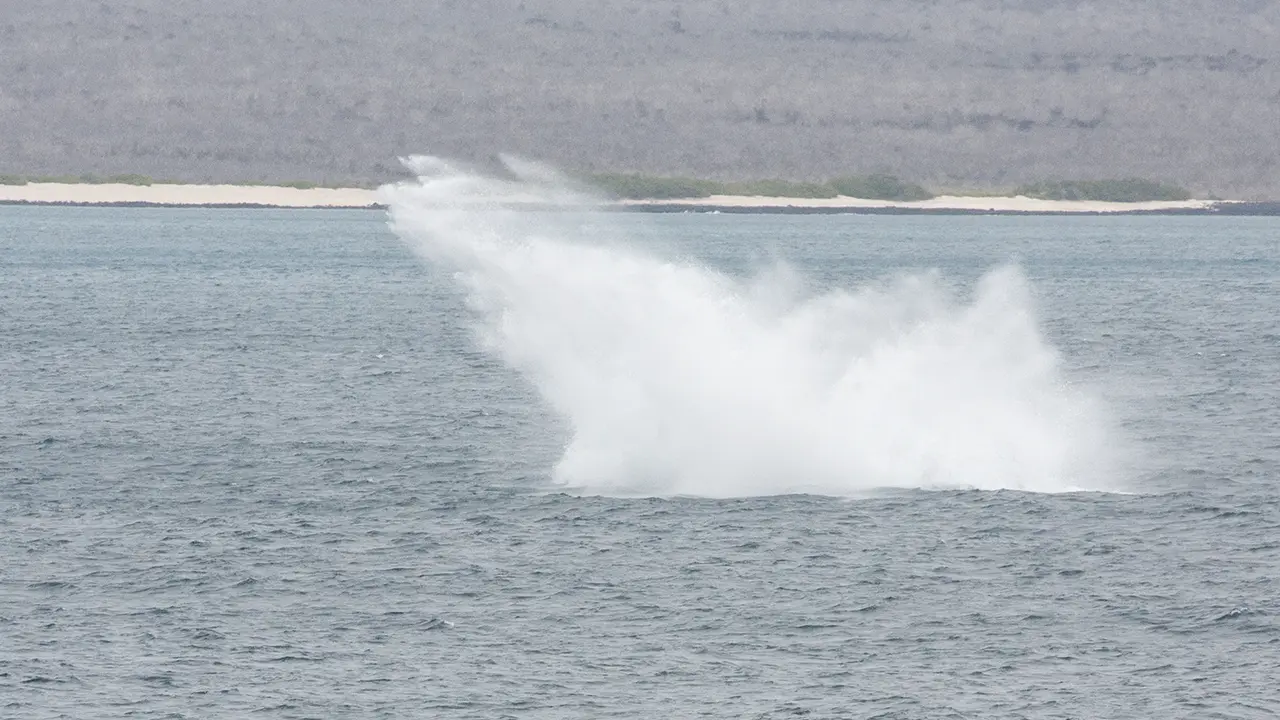
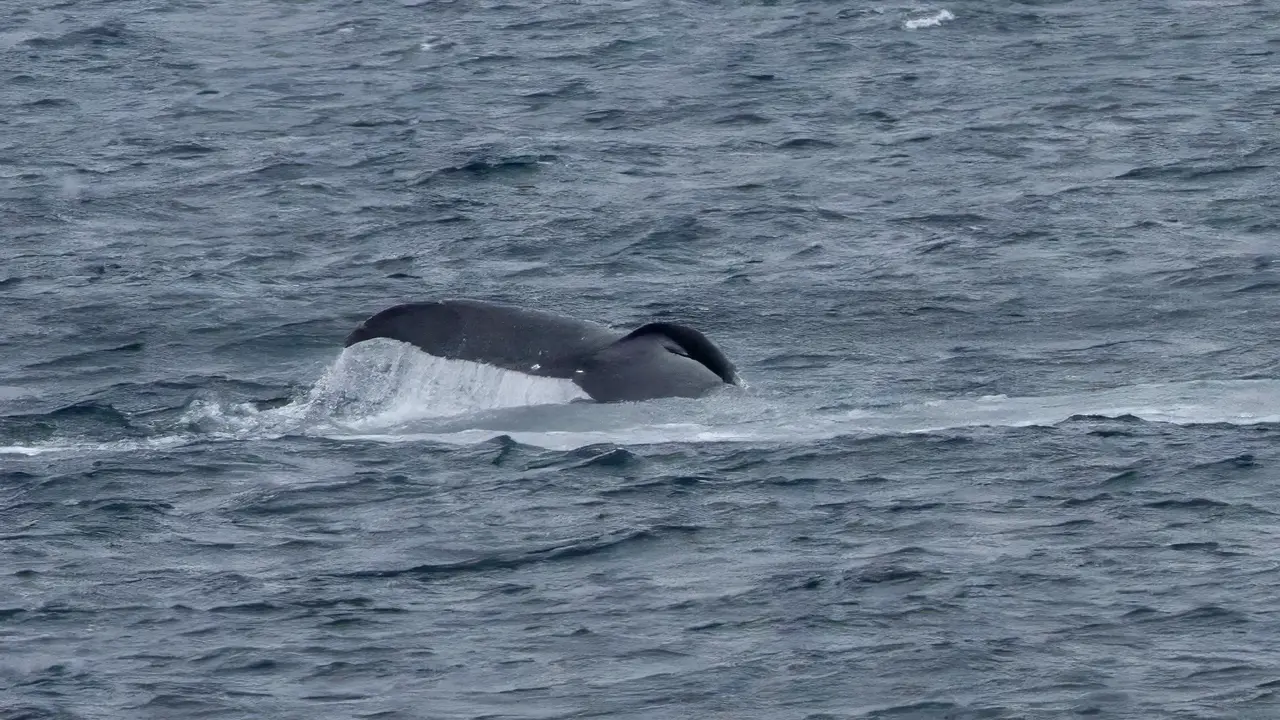
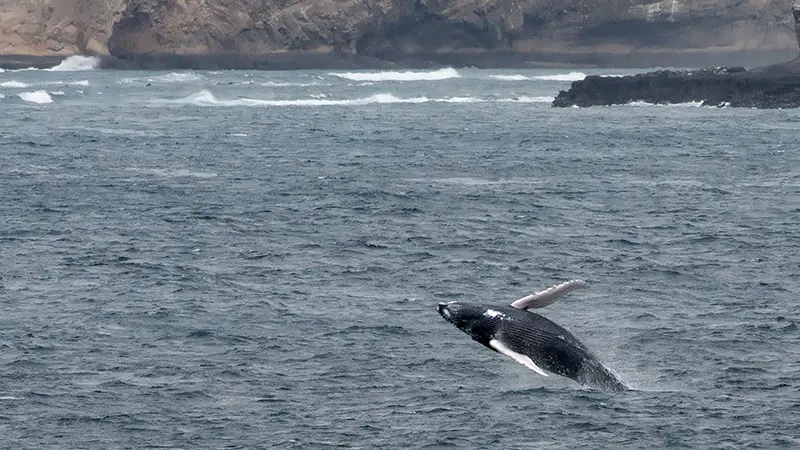
During the voyage from Punta Pitt to Cerro Brujo, we encountered a group of whales. At first I noticed a large splash, and while watching the surface, I saw a whale leap. The guide said they were Humpback Whales. I would have loved to see them a little closer, but that would be asking too much.
Cerro Brujo
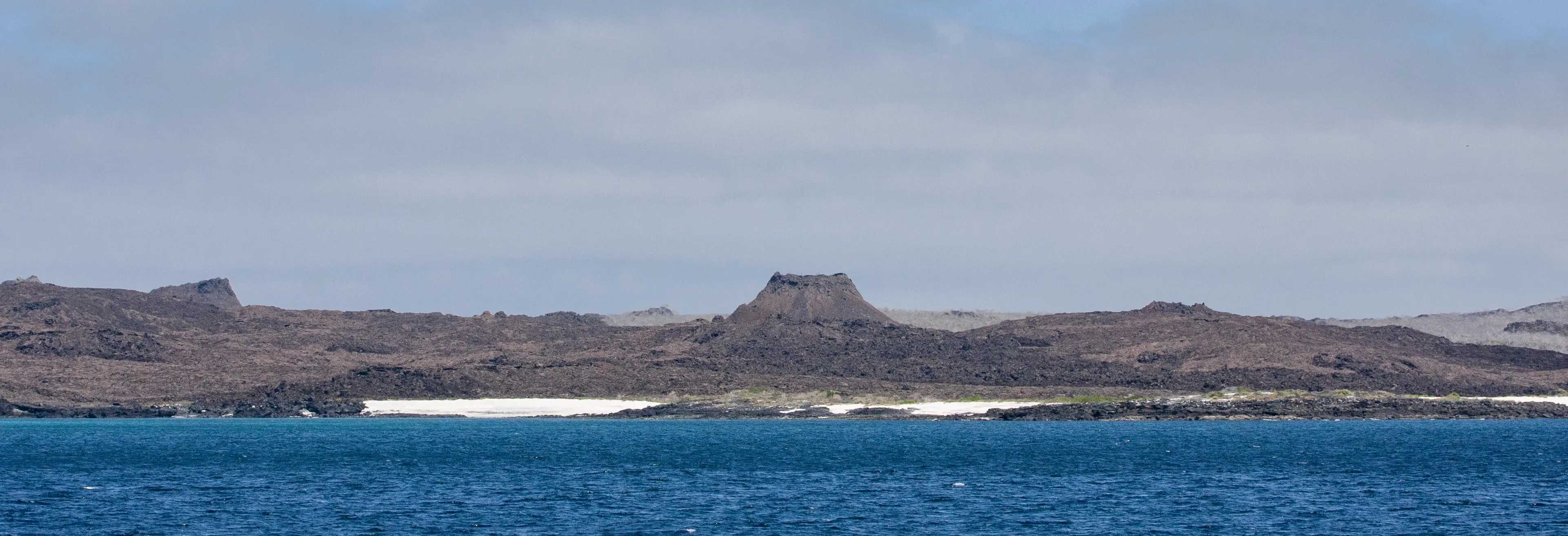
Cerro Brujo, whose English name is Witch Hill, is a cone-shaped hill formed from volcanic tuff. In front of it lies a dark field of hardened lava.
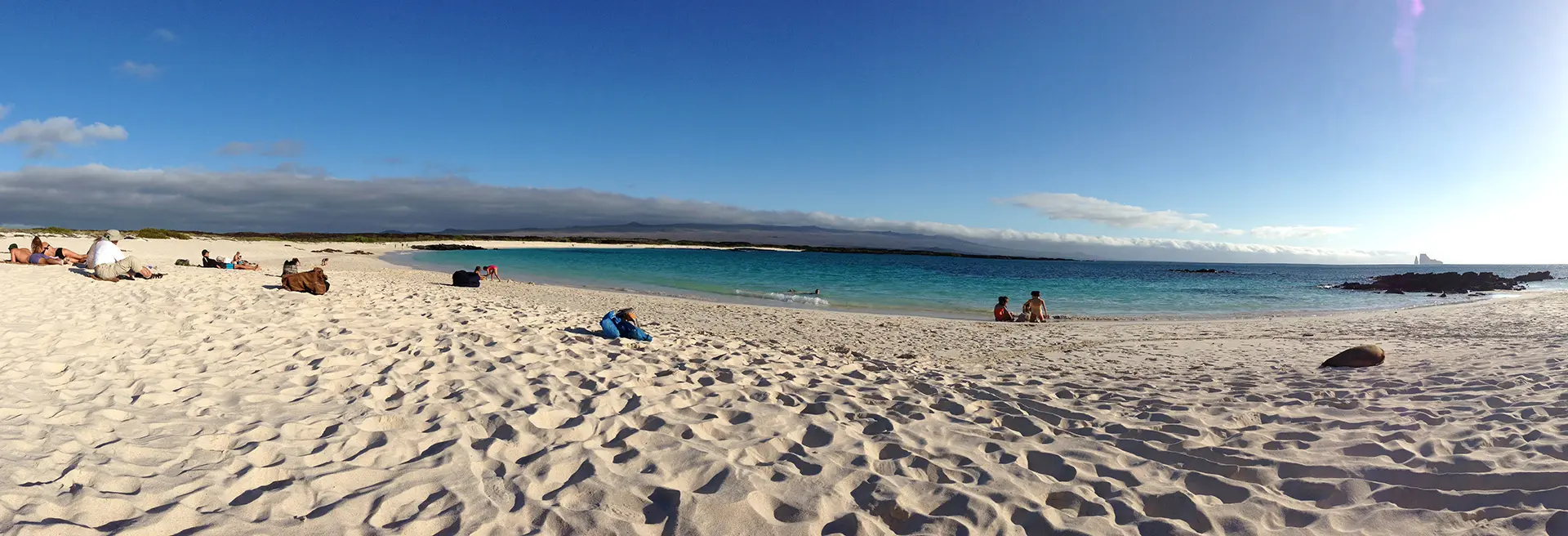
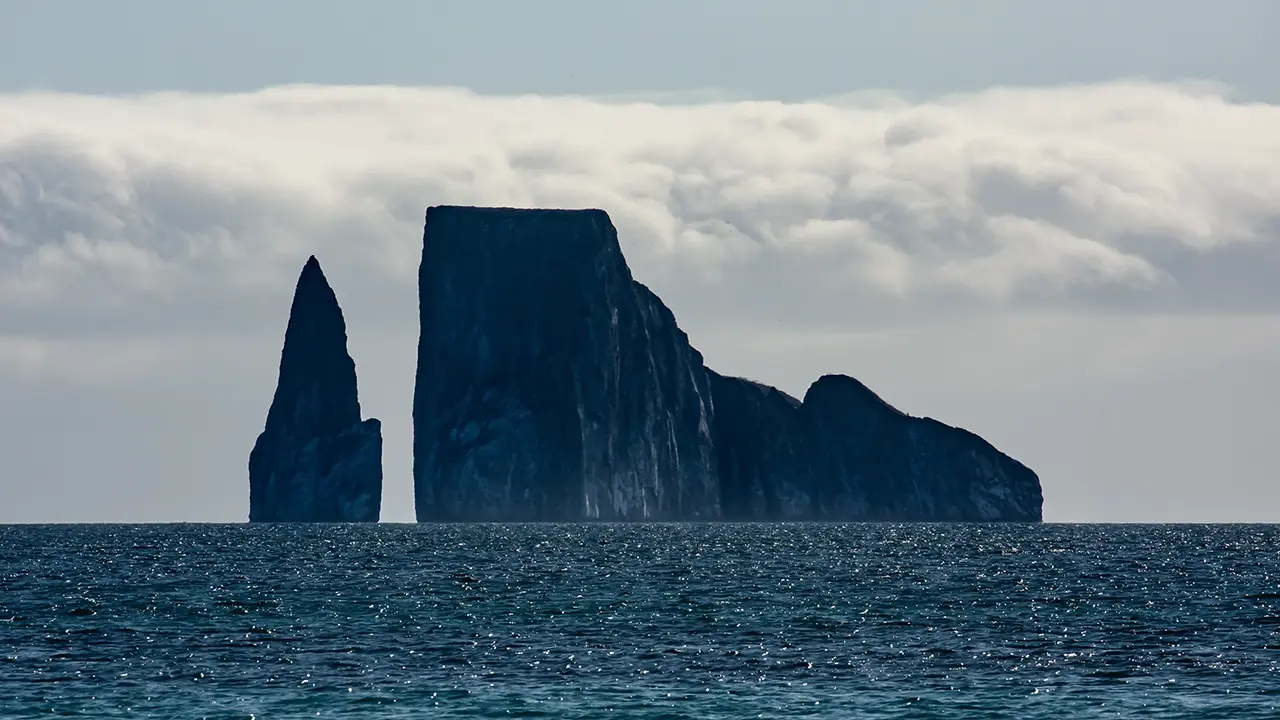
Nearby is a white coral-sand beach, Playa Cerro Brujo. On September 18, 1835, the Beagle, with Charles Darwin aboard, anchored in Stephen’s Bay, and this beach is recorded as the first place in the Galápagos where Darwin set foot. In the photograph of the beach, an island-like rock can be seen offshore to the right. This is León Dormido, or “Sleeping Lion,” a striking rock formation rising from the sea.
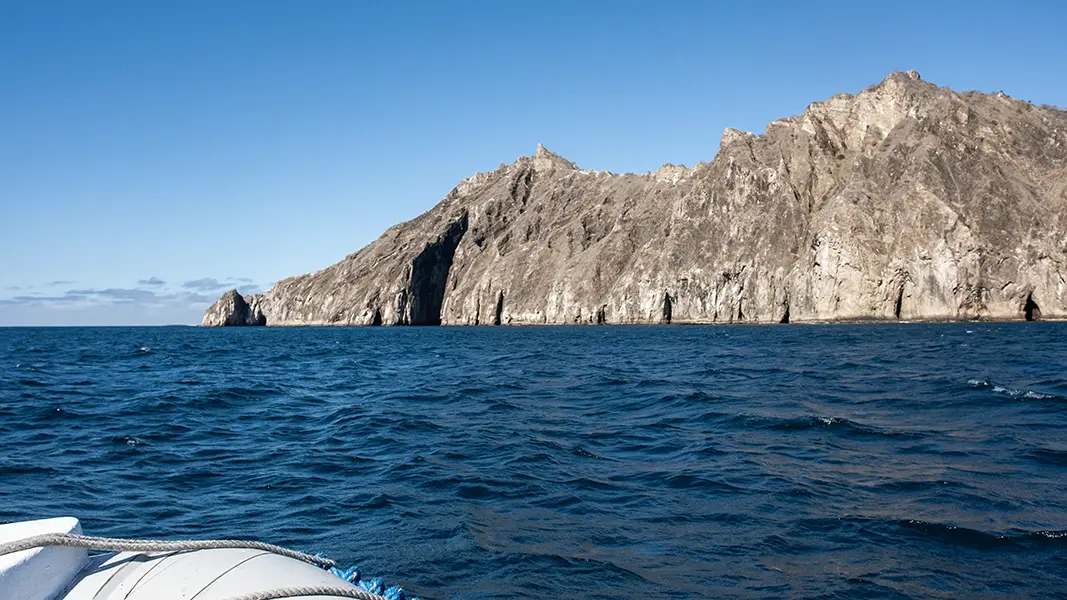
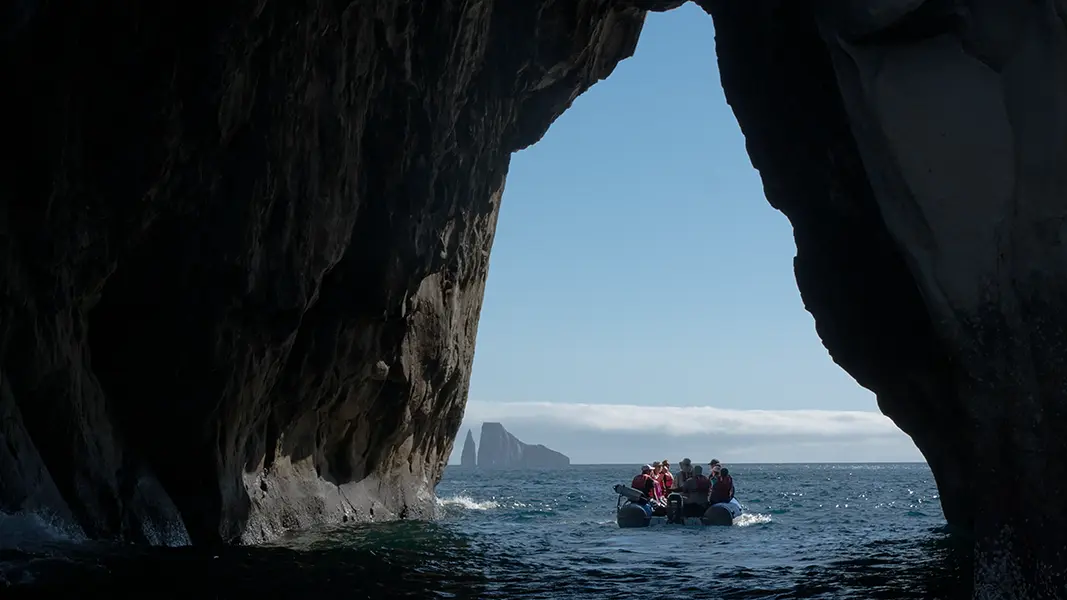
Before landing on the beach, we took a panga ride along the north side of the bay to the tip of Punta Dedo. Its cliffs, formed from fragile tuff and exposed to strong Galápagos currents, have been carved into steep sea cliffs. They look raw and rugged. There is also a sea arch, the Arco de Cerro Brujo, through which León Dormido can be seen. It is apparently a famous photo spot. I had, naturally, taken the same shot myself.
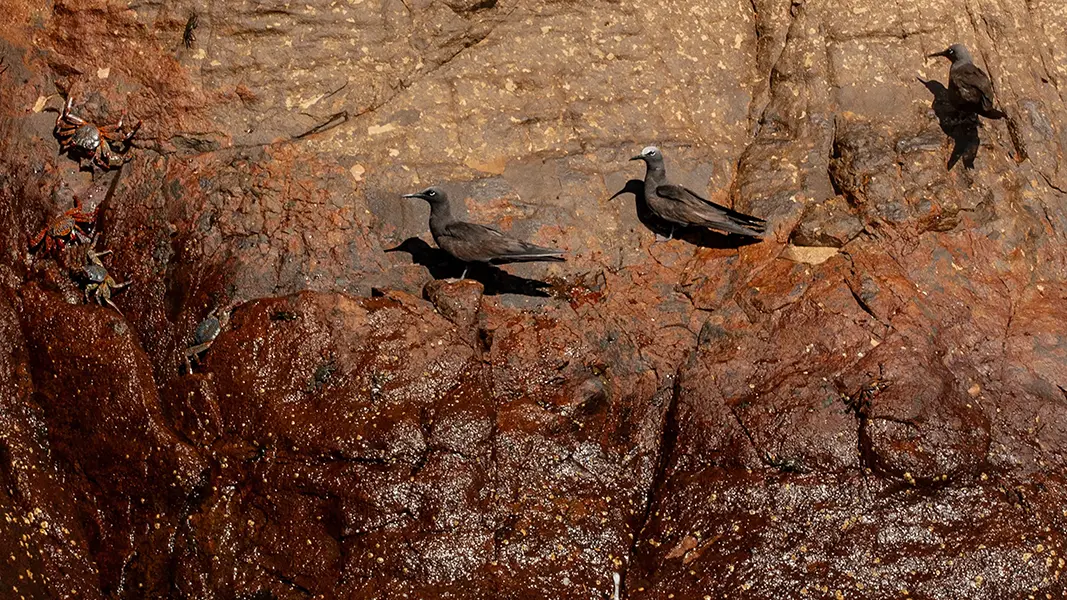
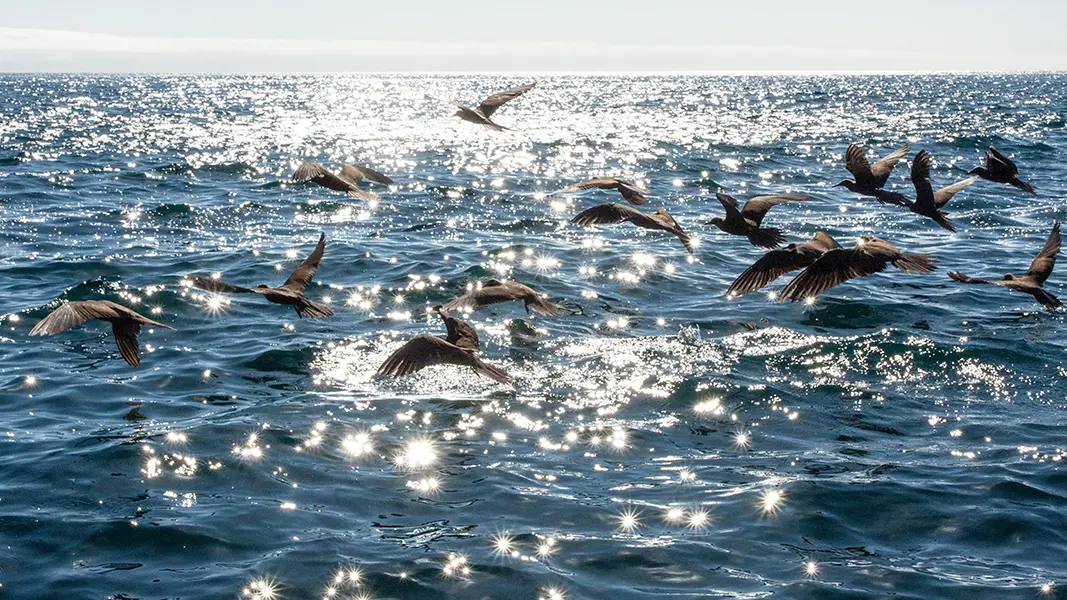
We saw many birds during this panga ride. The flock of Brown Noddies hunting in the reflected sunlight was especially picturesque.
After the panga ride, we made a wet landing on the white beach and spent about an hour there at a slow pace. It was a quiet place, with birds playing around the pools and sea lions resting nearby. Behind the beach was a salt lagoon, but it was off-limits because it is a nesting area for turtles.
Here, too, we saw bright little Galápagos Yellow Warblers, Darwin’s finches, sea lions, and other wildlife.
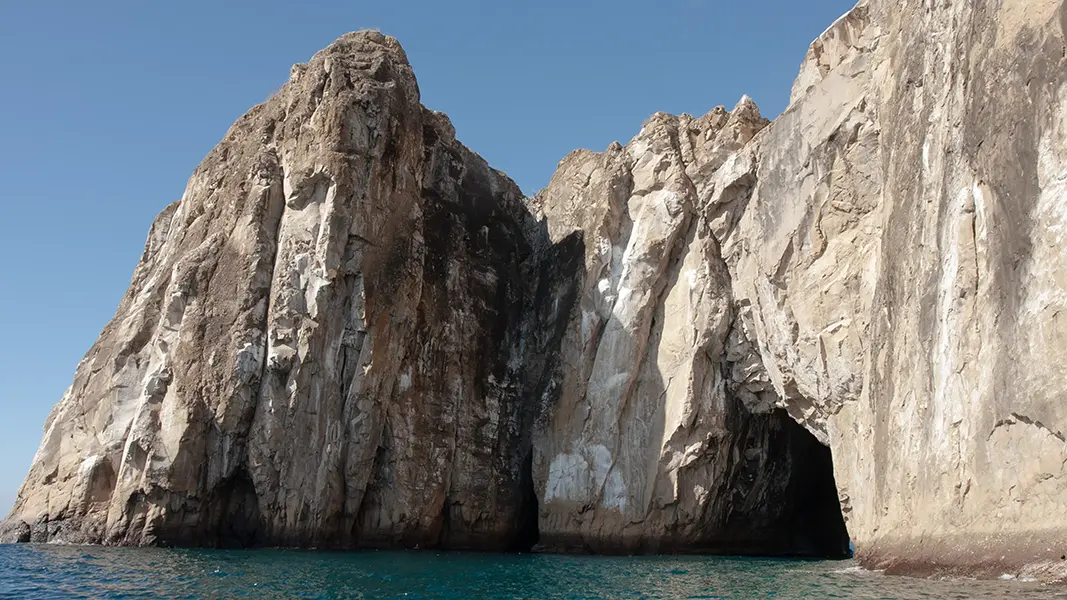
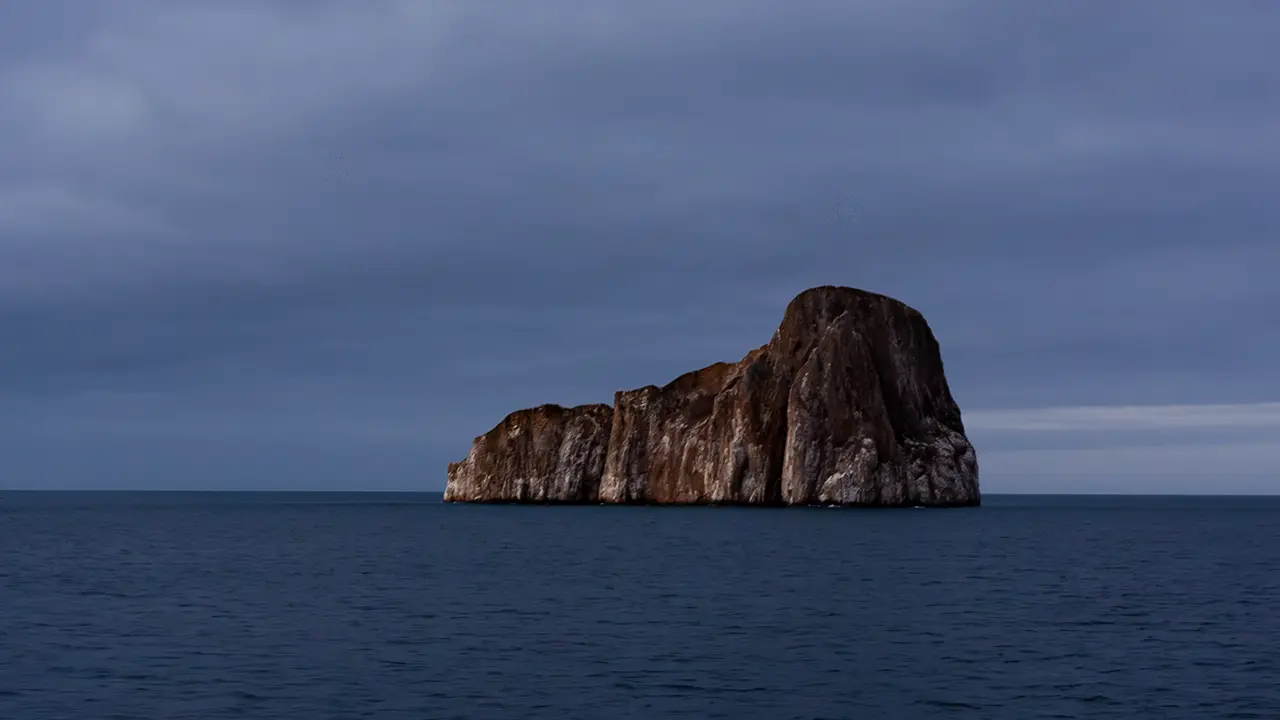
From some angles, León Dormido does look a little like a lion. In English, however, it is called Kicker Rock, apparently because from another direction it resembles a boot or shoe.
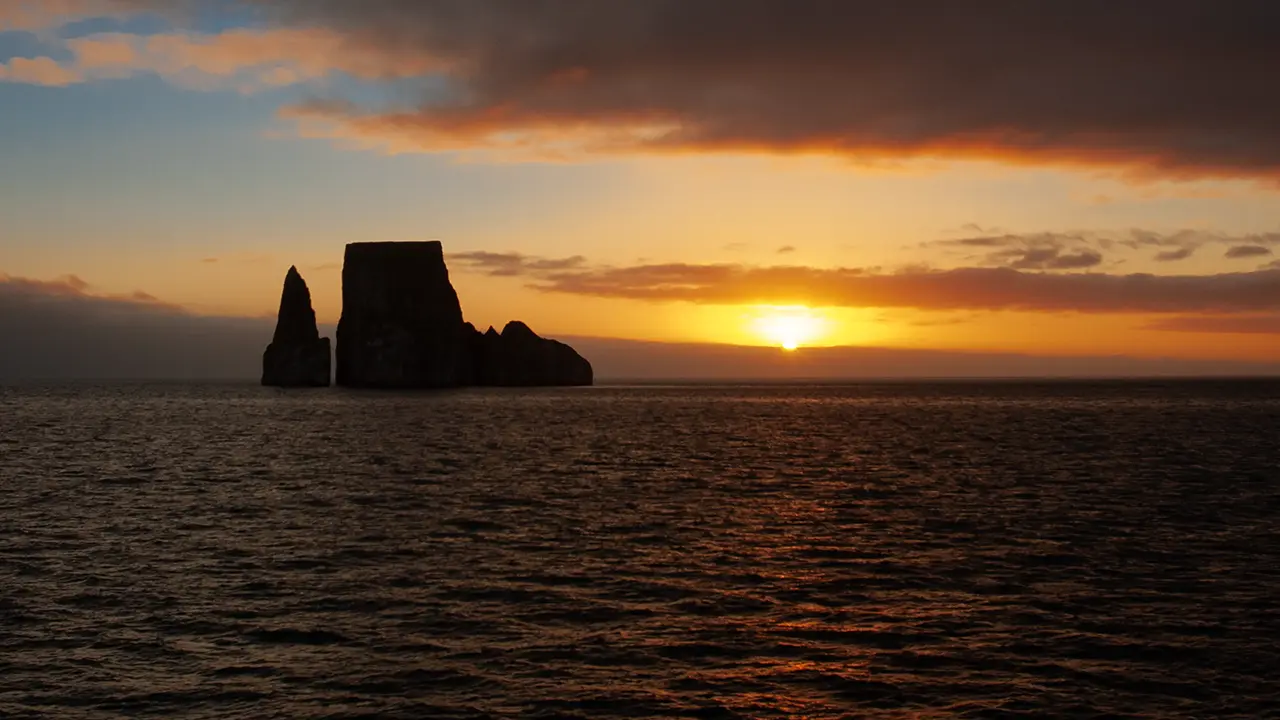
When we returned to the ship, the sun was just setting, and we ended the day with a view of León Dormido in the evening light.
The San Cristobal section of the Galápagos Photo Gallery contains additional photographs and notes on the island.
Floreana Island
Floreana was the first island in the Galápagos to be settled by people, and a small population still lives there today. During our visit, we stopped at three different sites, each with a very different character.
La Olla Bay
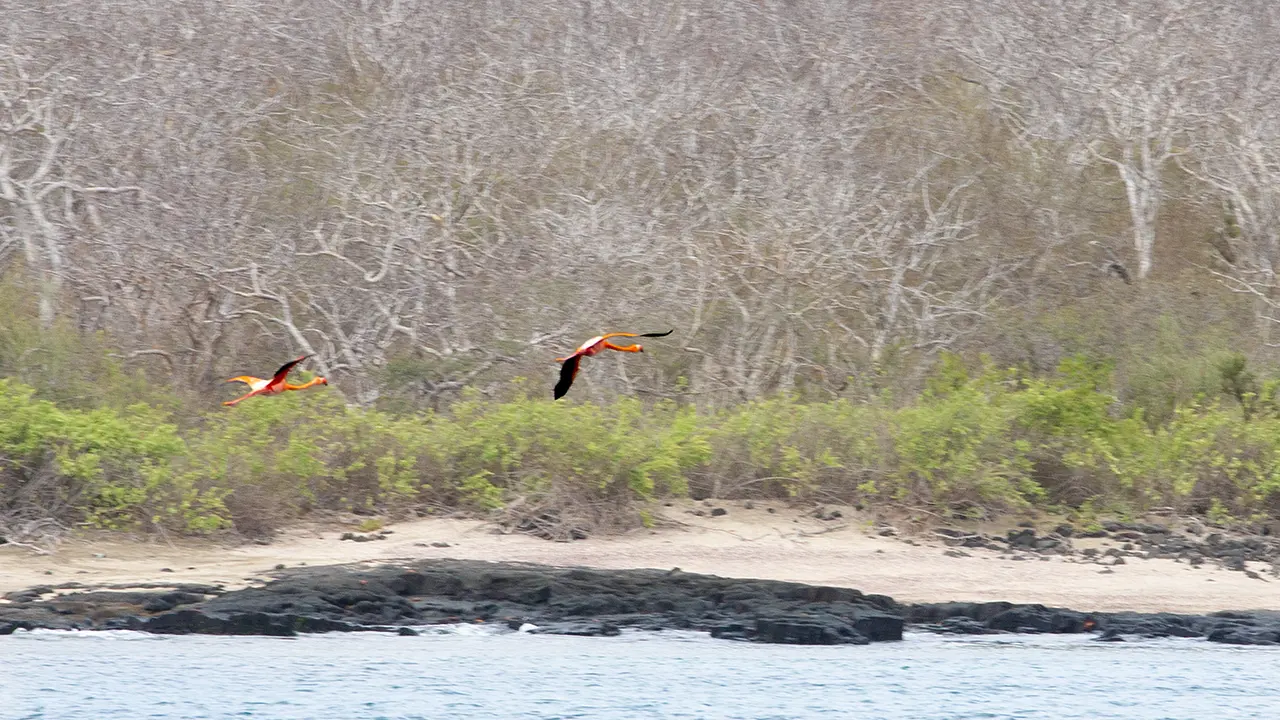
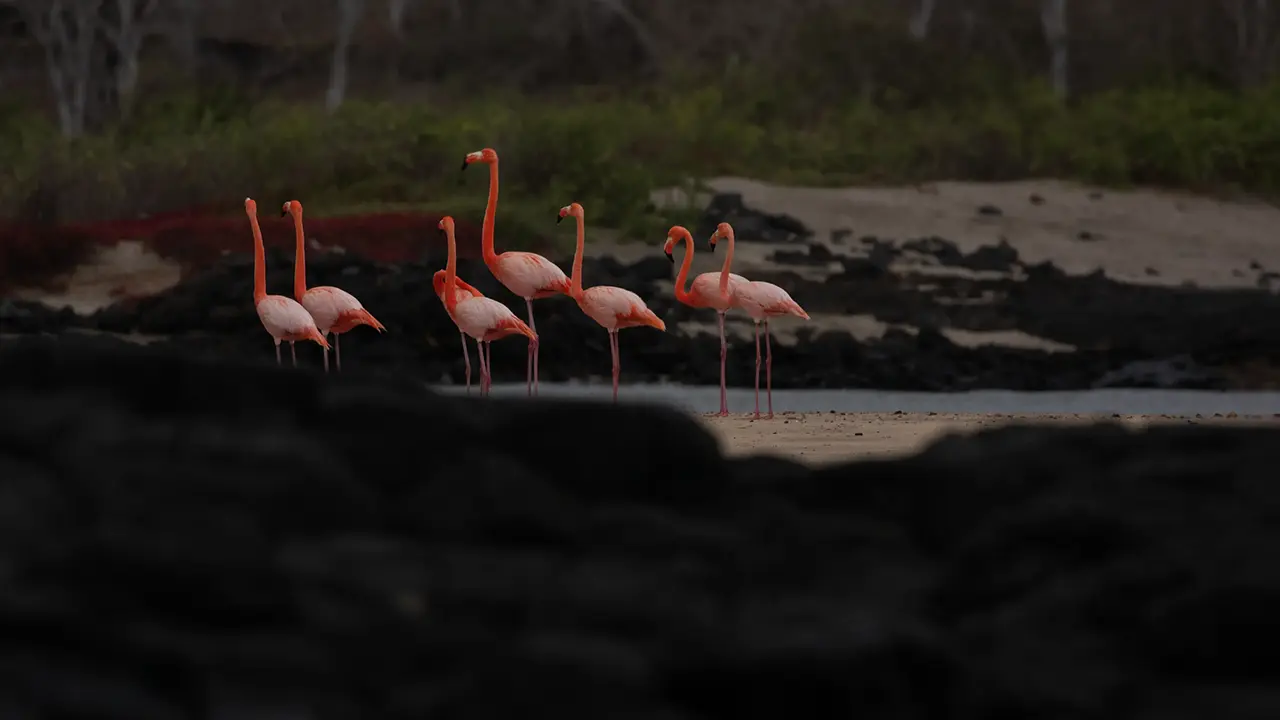
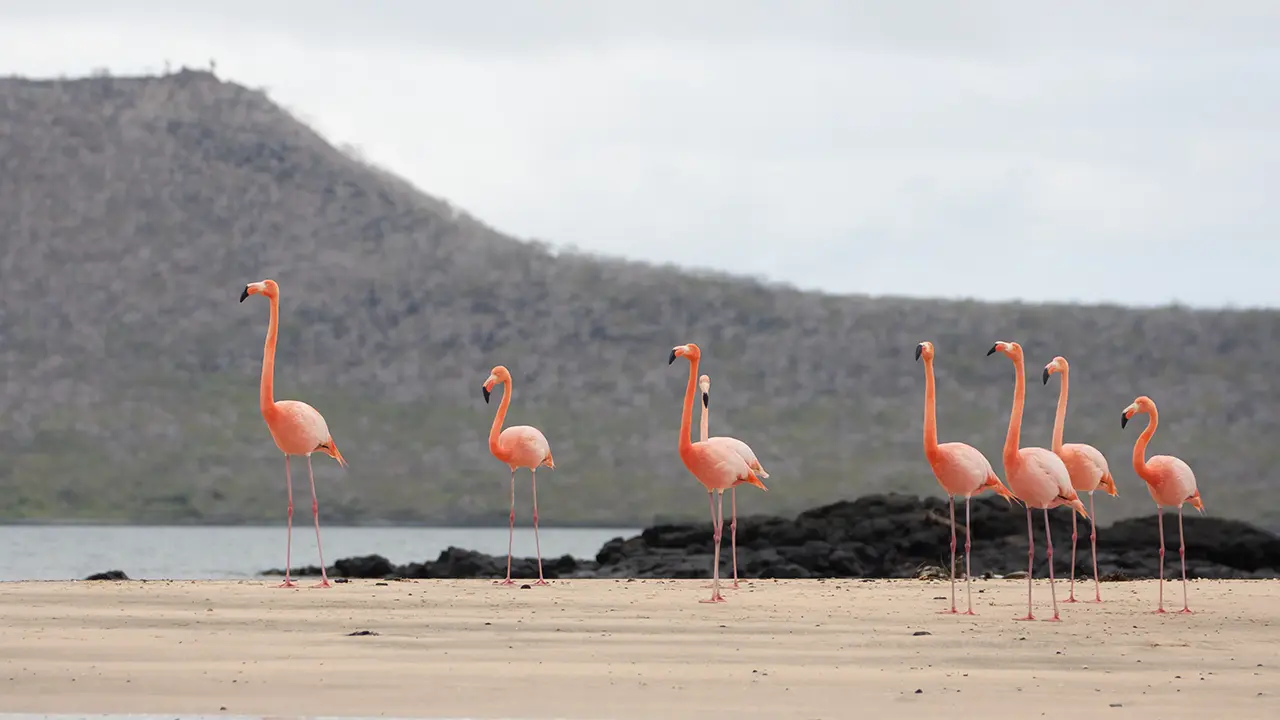
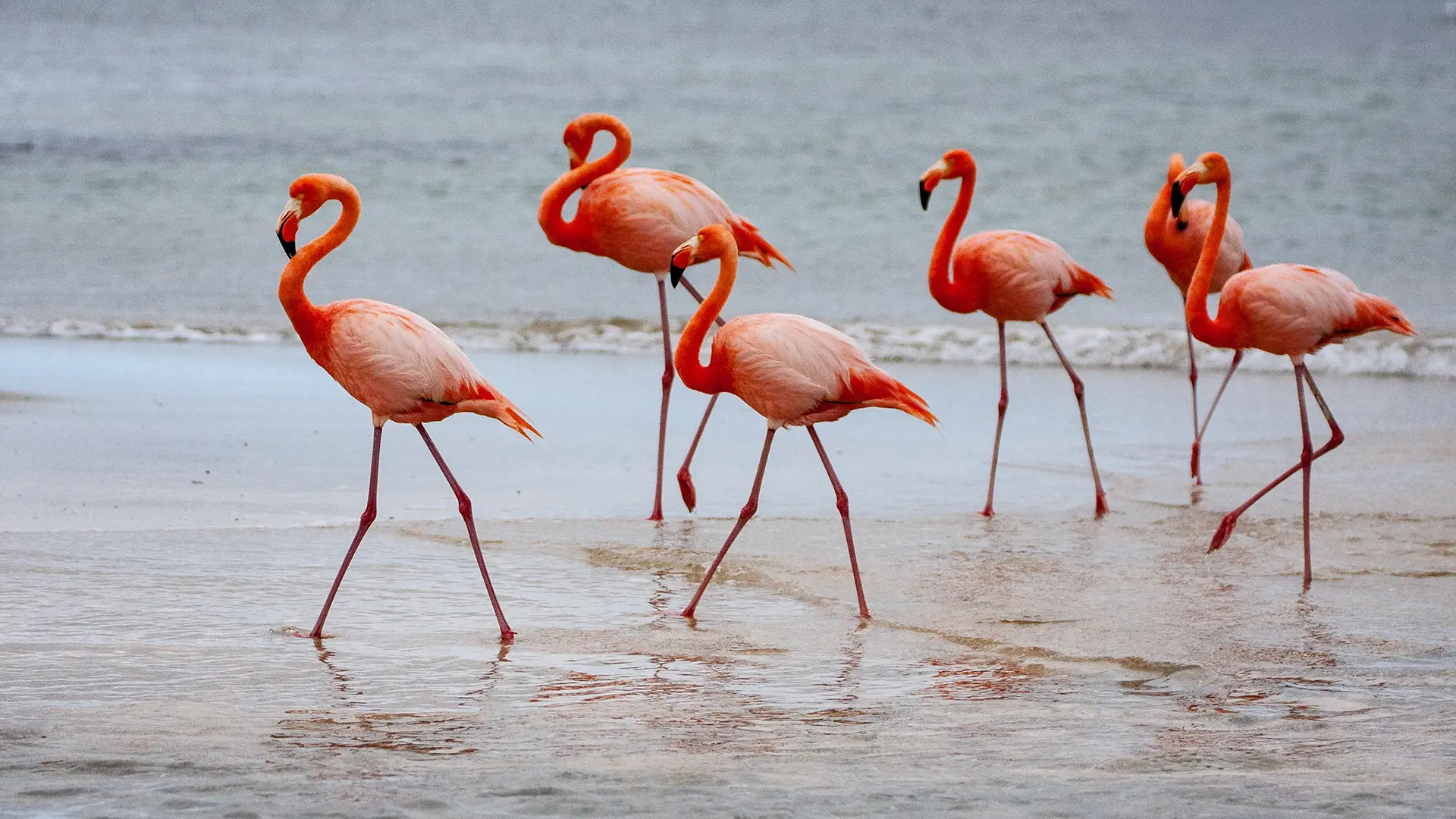
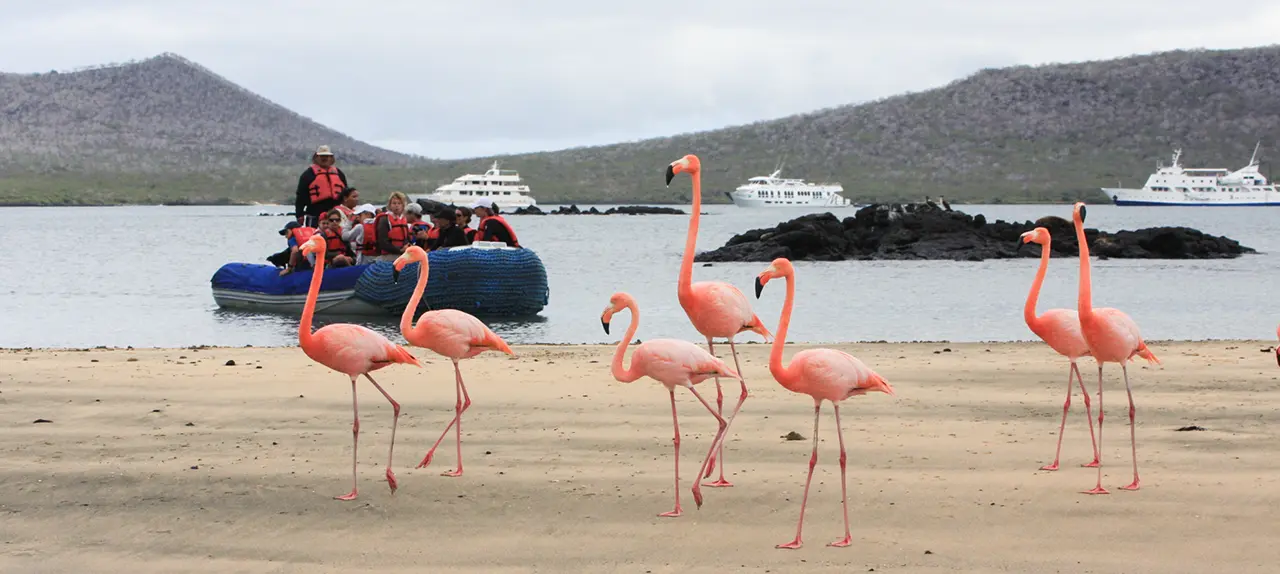
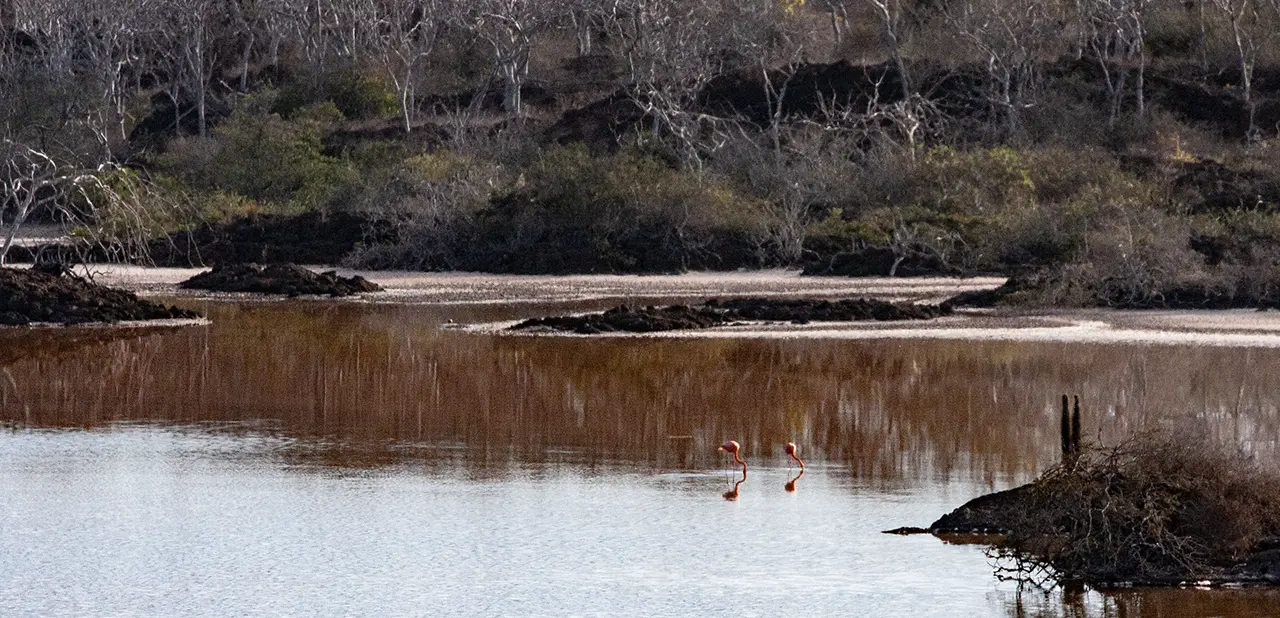
La Olla Bay may have been the biggest surprise of the cruise. We were on our way by panga to Post Office Bay, the site of the famous mail barrel, when Galápagos Flamingos suddenly flew across our path. Following them into a sheltered, lagoon-like bay, we found a small group feeding and moving with that unmistakable, unhurried elegance.
We were lucky enough to photograph them at close range. They are not always present, but when they do appear, the guides seem to give this stop priority. It was easy to understand why.
The bay is called La Olla Bay, and nearby is a lookout known as Baroness Point. We were apparently never scheduled to climb to the viewpoint, but the story behind the name is hard to ignore. An Austrian baroness is said to have lived there with three men until, one day, she simply vanished. How much of the tale is true, I do not know, but it certainly belongs to Floreana.
After a while, other pangas began to approach as well. The guides were probably sharing the news by radio: flamingos were here.
Post Office Bay
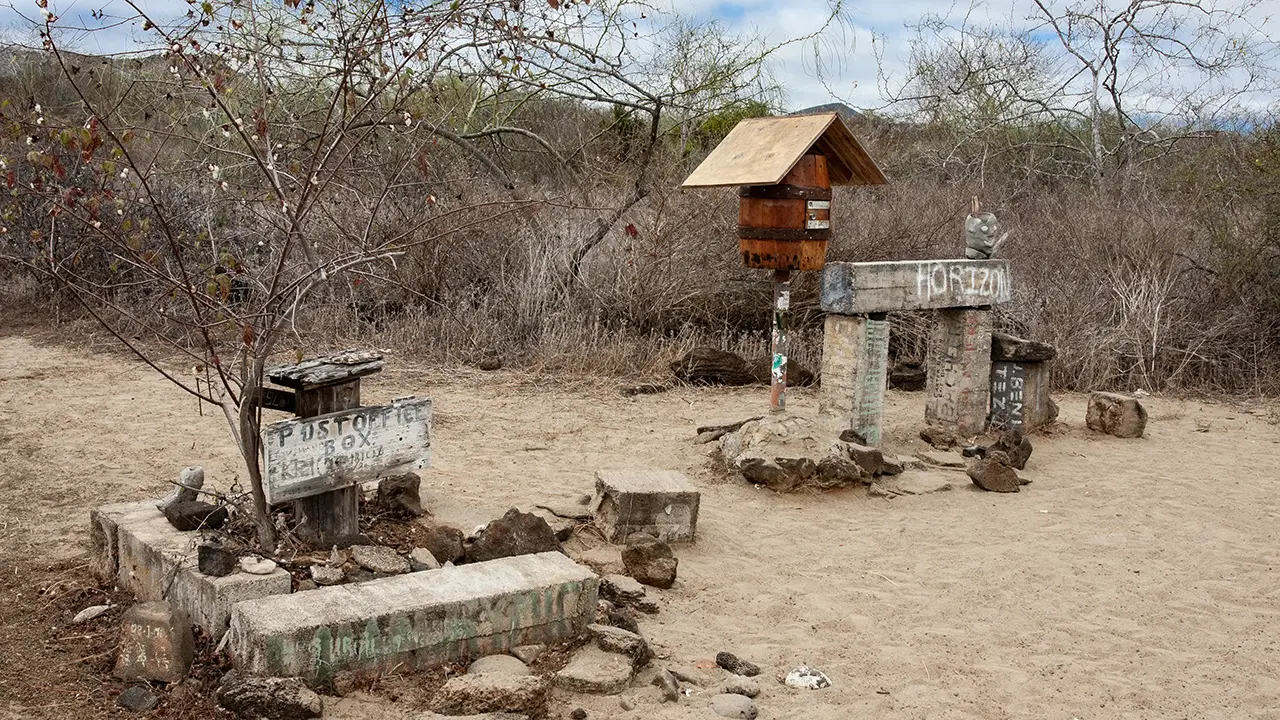
We then stopped at Post Office Bay, named for the mail barrel that still stands there. In the whaling era, ships used this bay as an anchorage, and letters placed in the barrel were carried away by sailors bound for ports where they could be mailed. Visitors continue the tradition today. For most travelers it is more ceremony than practical postal service, but as a ritual of the islands, it is a memorable one.
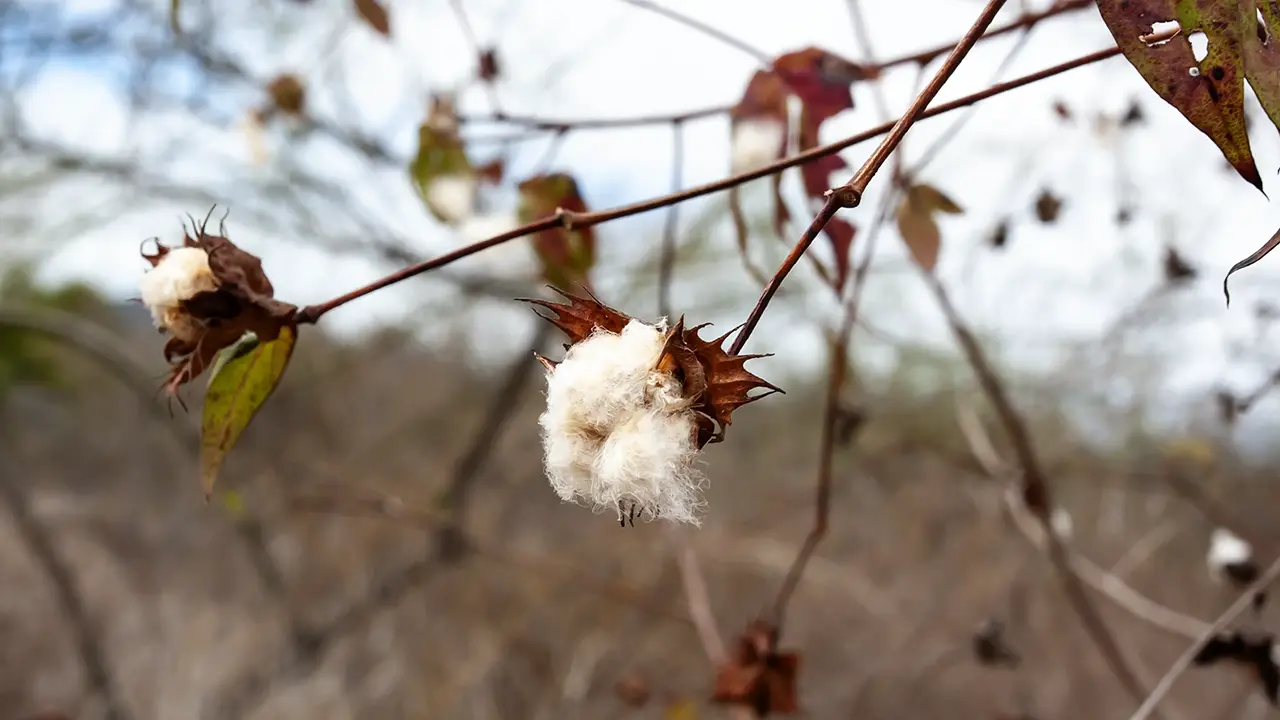
At Post Office Bay, we also had a short time to walk an observation trail. Endemic plants such as Galápagos Cotton, also known as Darwin’s Cotton, grow in the area.
Champion Islet
In the early afternoon, while many passengers went snorkeling, we took a panga ride around Champion Islet. The stated mission was to look for an endangered bird. I am not entirely certain of the name, but it was probably the Floreana Mockingbird. It is rare, so failing to find it was no surprise. Still, the islands have a way of keeping possibilities alive: in 2025, the Galápagos Rail, long thought extinct on Floreana, was rediscovered there after 190 years. No such miracle occurred during our visit.
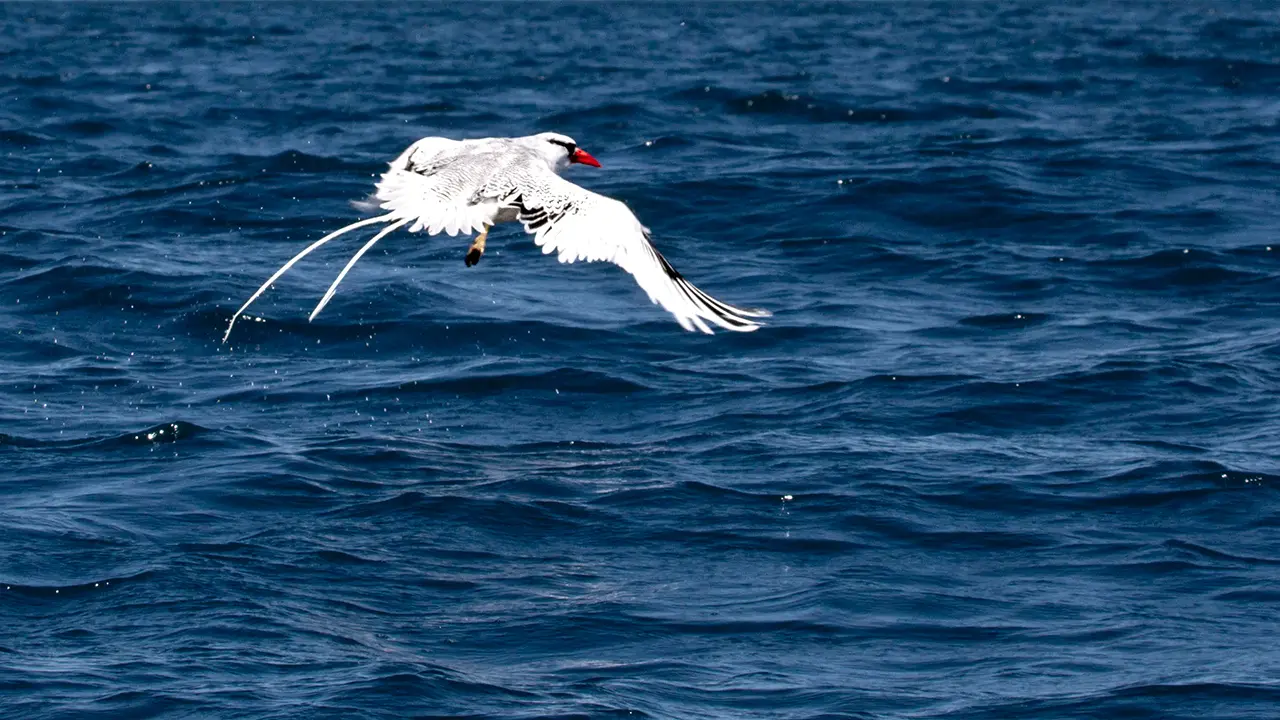
Red-billed Tropicbird
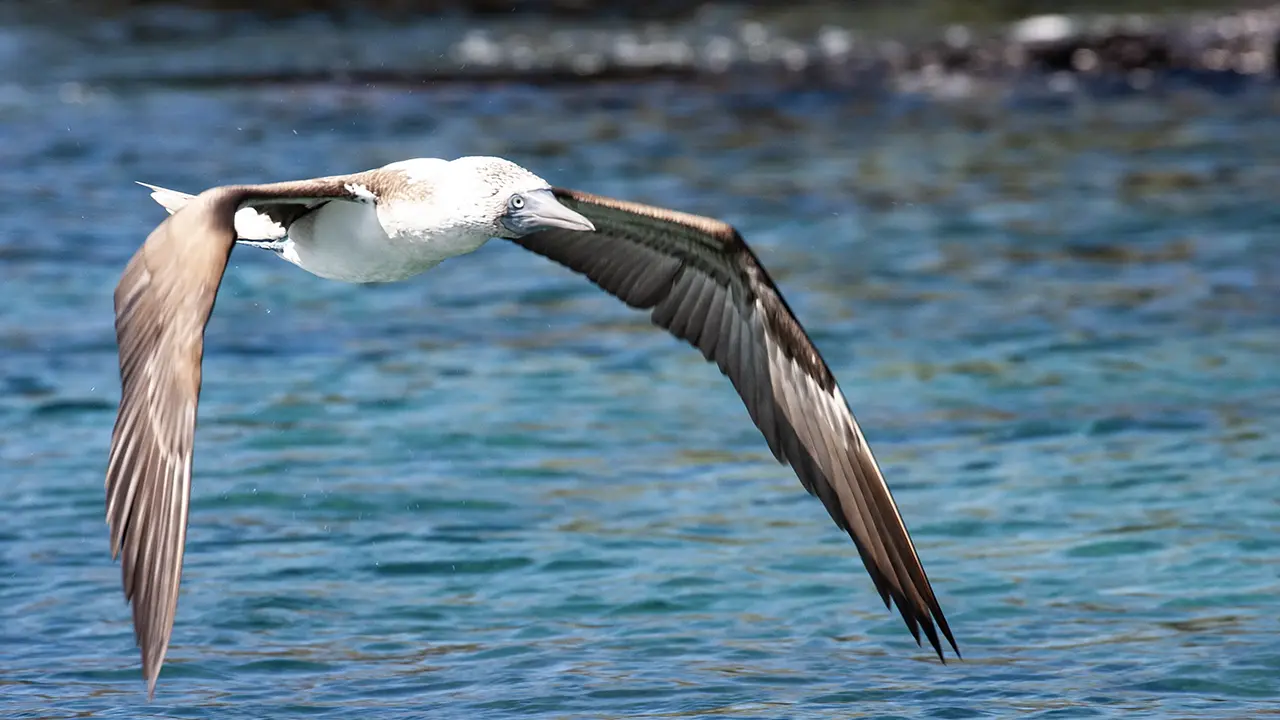
Blue-footed Booby
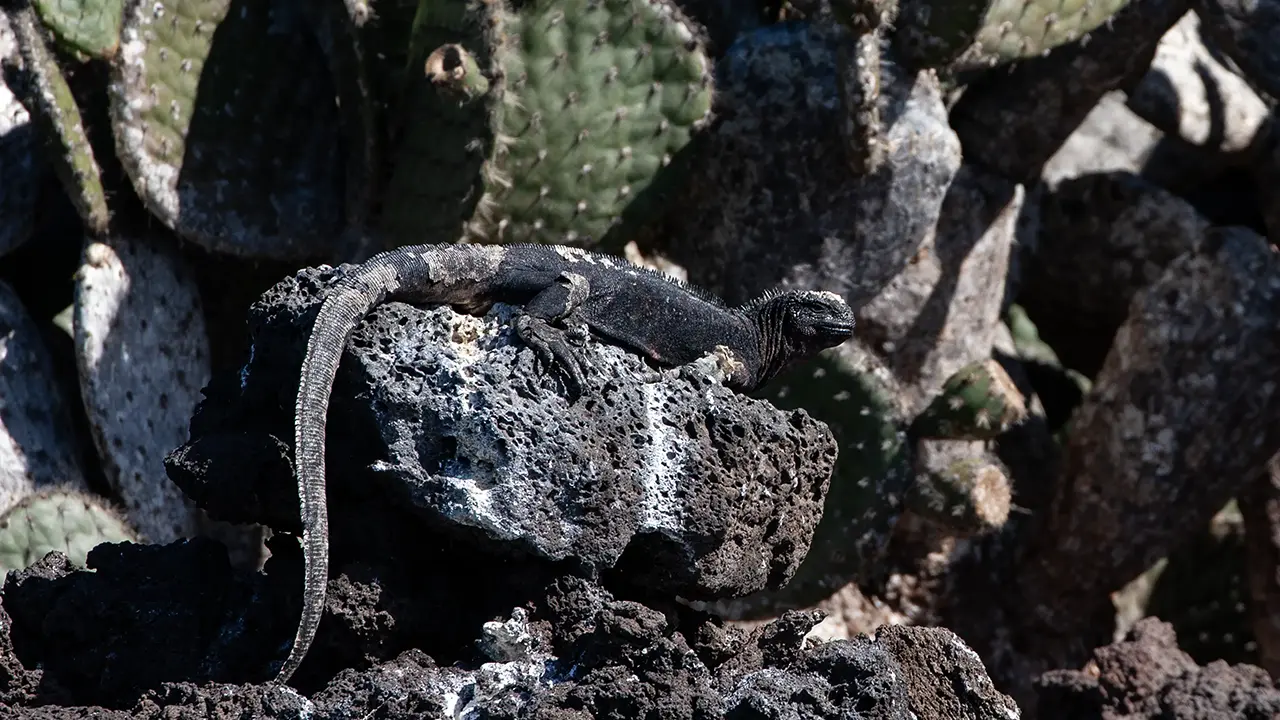
Marine Iguana
In place of a miraculous discovery, we had Red-billed Tropicbirds and other birds to photograph. Birds in flight are unforgiving subjects. So many frames end up soft, blurred, or just slightly wrong, and the number of usable images is painfully small. If I had not been able to shoot freely with a digital camera and choose later, the result would have been almost hopeless. It made me think, with renewed respect, of photographers who worked in the film era.
Punta Cormorant
Punta Cormorant sounds as if it should be a point where cormorants gather, but apparently cormorants are not seen there. The name is said to come instead from a well-known American minesweeper. An odd origin, but apparently a true one.
On the visitor map, Champion Islet appears after Punta Cormorant, but in reality our itinerary was the reverse.
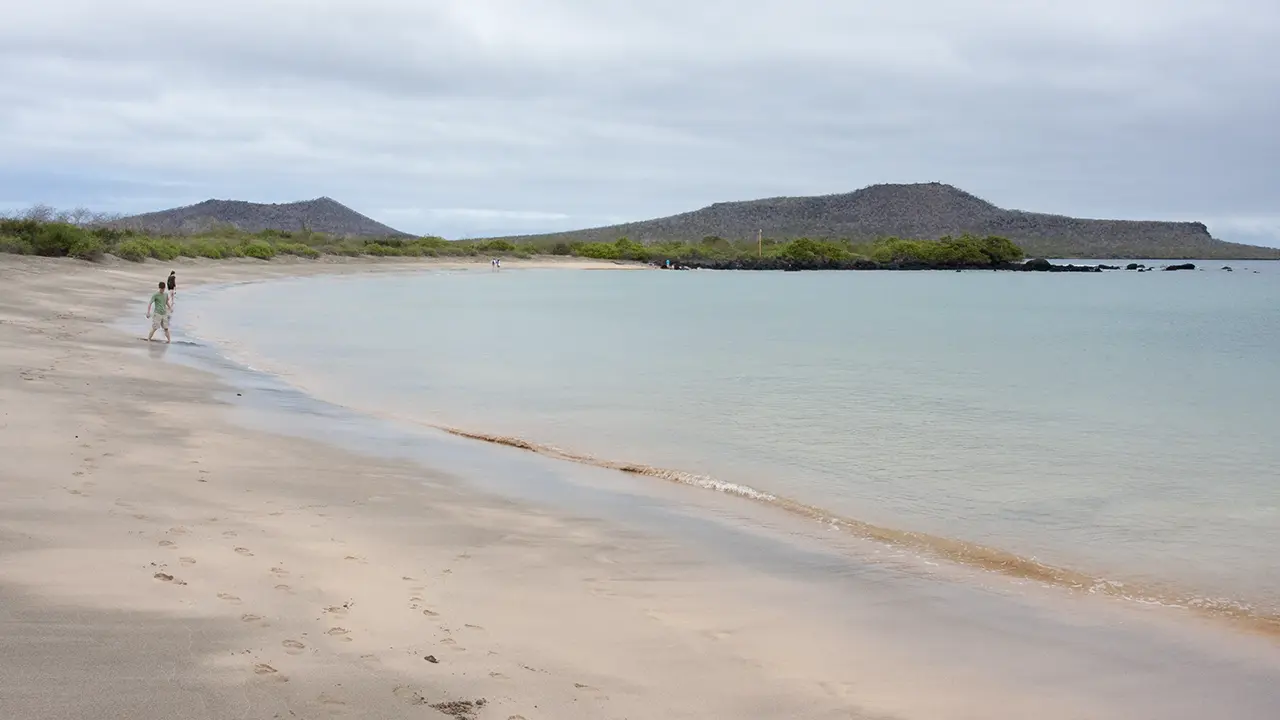
We made a wet landing on Playa Verde, a greenish beach colored, we were told, by accumulated volcanic olivine. From the beach, the trail crossed the base of the point. Soon we reached a brackish lagoon known as one of the best places to see flamingos. This time there were only two or so, tiny in the distance. After the morning’s encounter at La Olla Bay, I could hardly complain, though I had secretly hoped for a larger flock.
Continuing along the trail, we reached an east-facing beach called Playa Blanca, its white sand apparently derived from coral. It was an exhilarating place. Frigatebirds circled overhead, while penguins and Blue-footed Boobies plunged into the water in pursuit of fish. Watching all of this at such close range was unforgettable. Evening had already begun; the sun was low in the west, and the beach itself was slipping into shadow, while the birds overhead seemed to catch the remaining light like a spotlight.
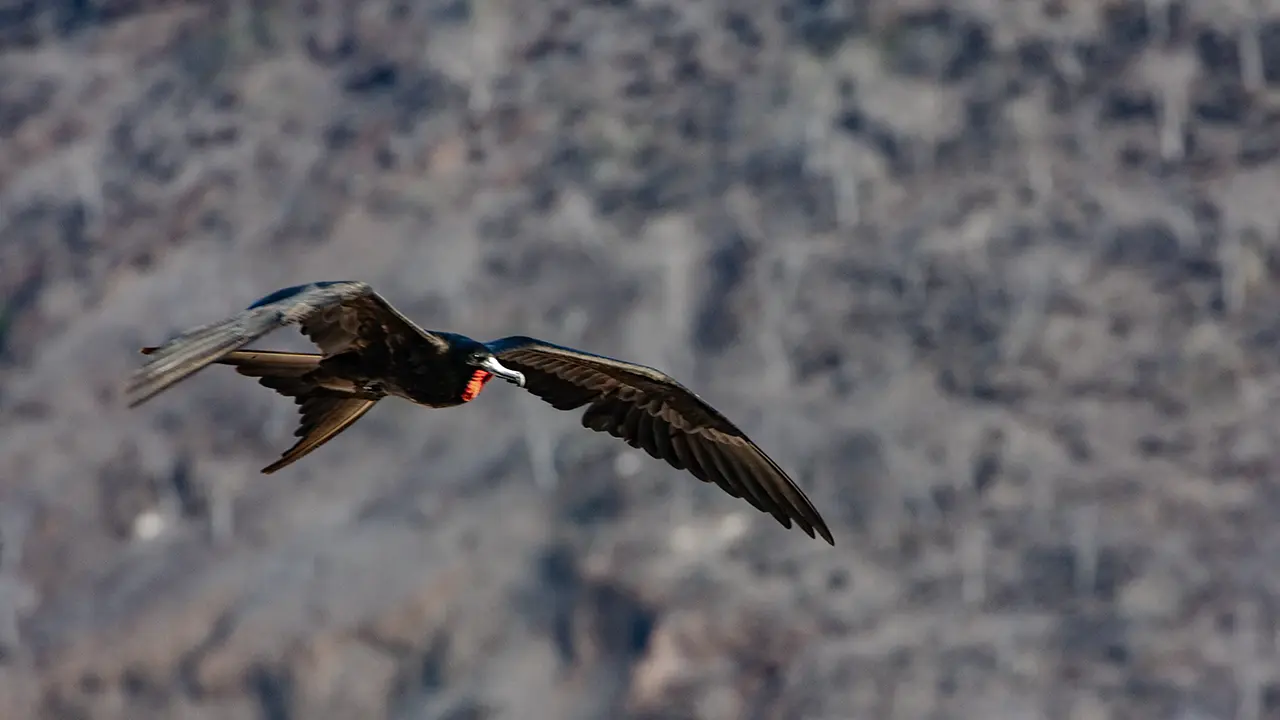
Frigatebird
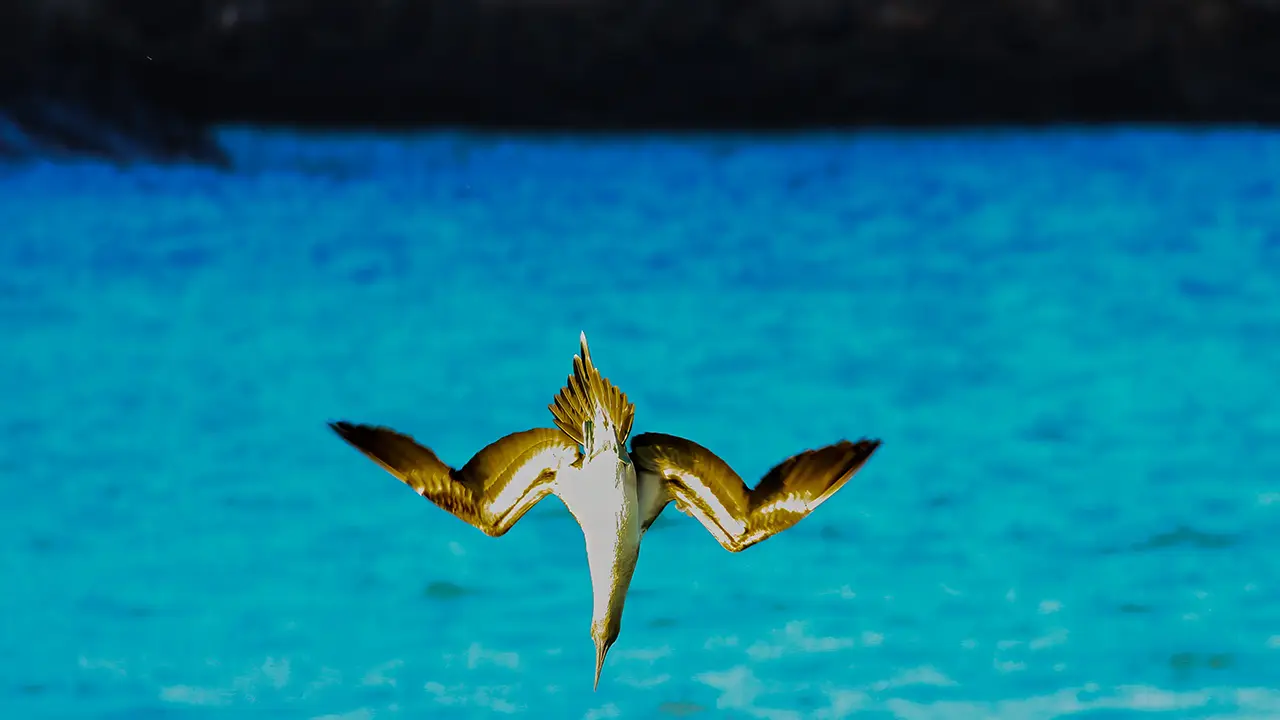
Diving Blue-footed Booby
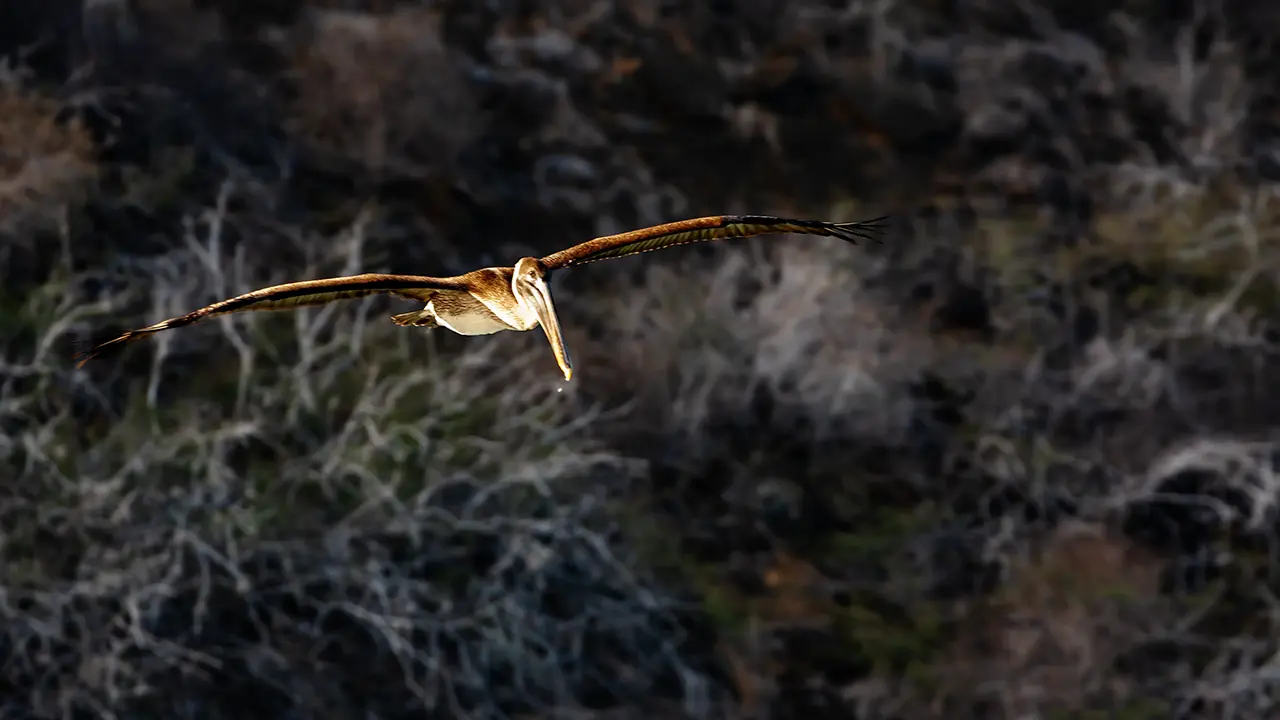
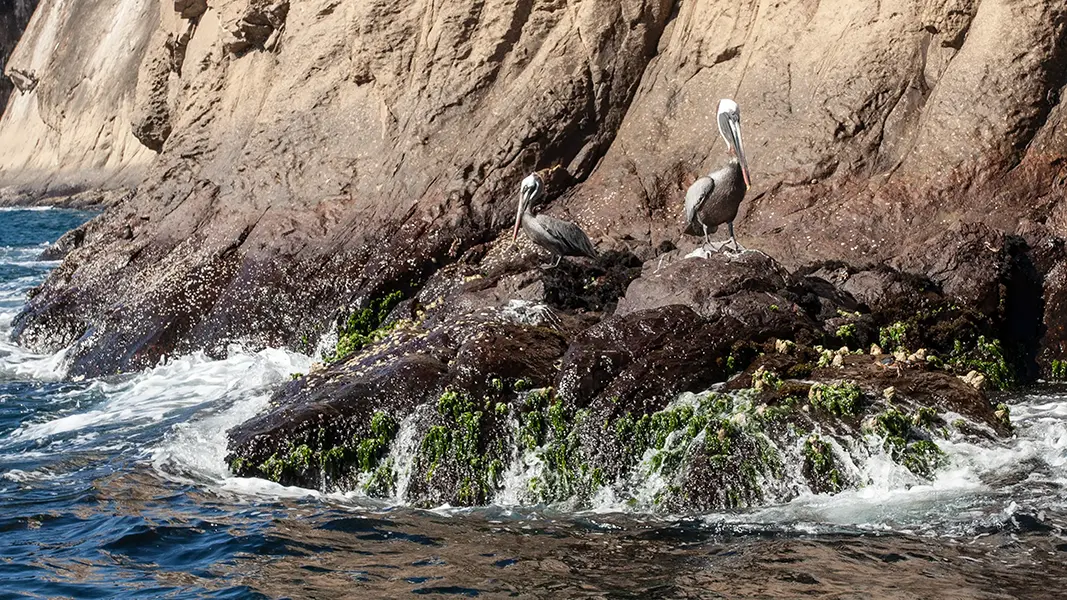
Galápagos Brown Pelican
After about an hour, we returned to the green sand of Playa Verde just as the sun was setting. Plants and animals alike were flushed red in the evening light, a quiet ending that stayed with me.
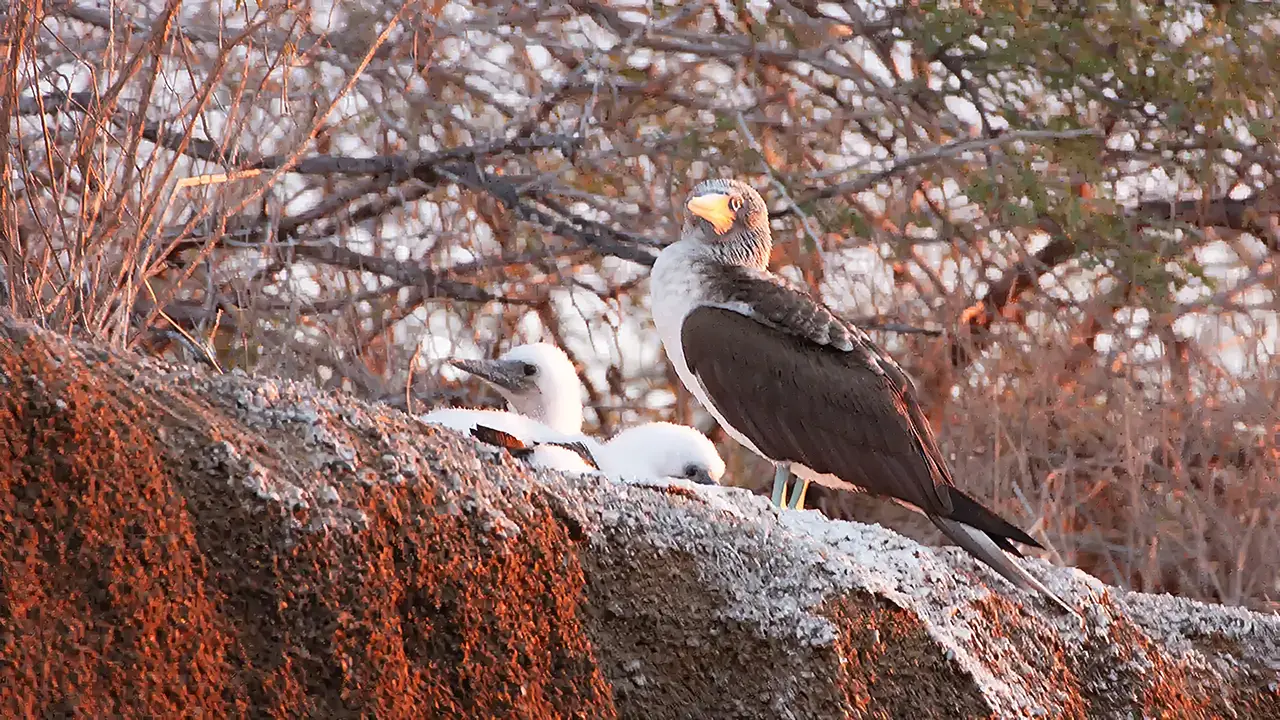
Nazca Booby and chick
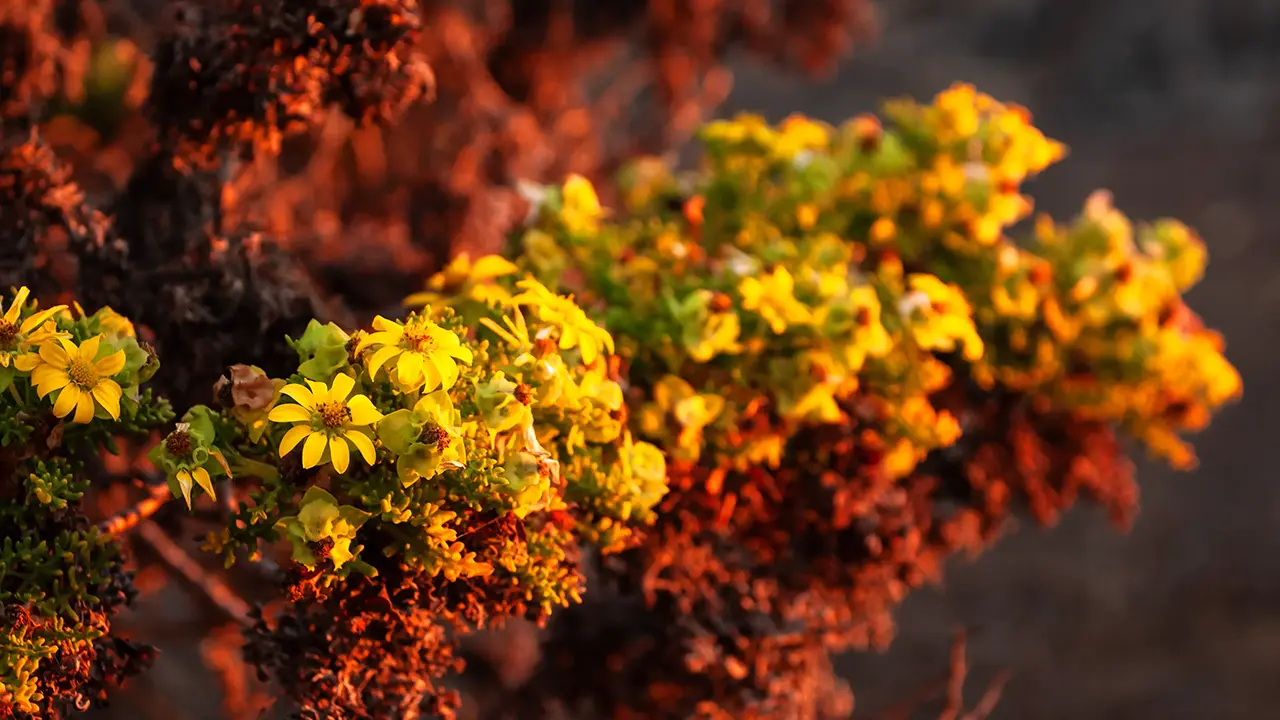
Floreana Daisy
The Floreana section of the Galápagos Photo Gallery contains additional photographs and notes on the island.
Isabela Island
Isabela is the largest island in the archipelago, and it feels volcanic in every sense. Five active volcanoes rise on the island, and Wolf Volcano has erupted even in recent years.
Elizabeth Bay
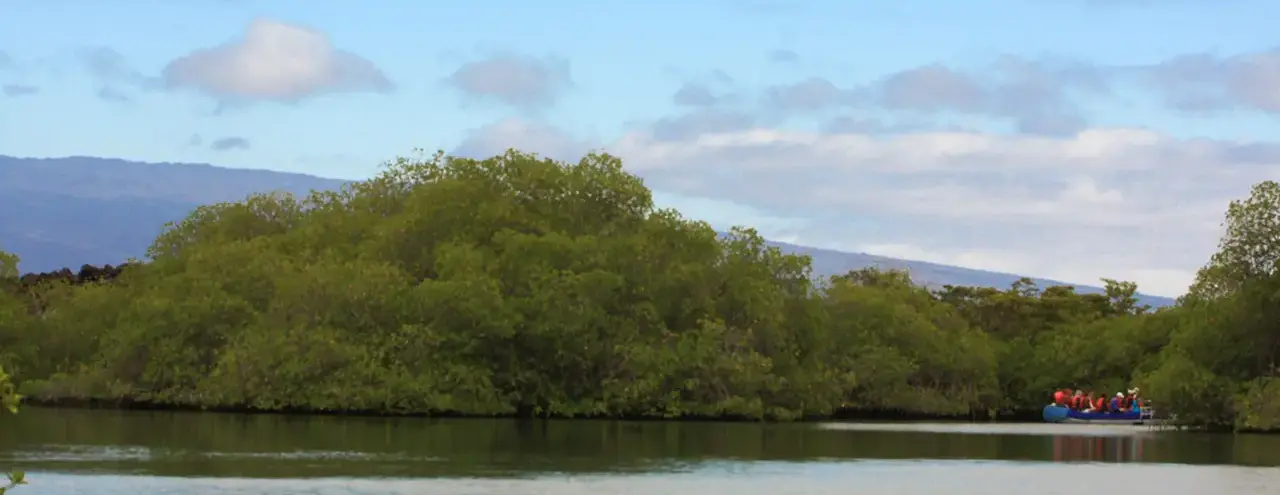
Our first stop on Isabela was Elizabeth Bay. There was no landing here; the visit was entirely by panga.
The panga slipped into a quiet inlet lined with mangroves. The water was calm, and the mood changed completely from the open coast.
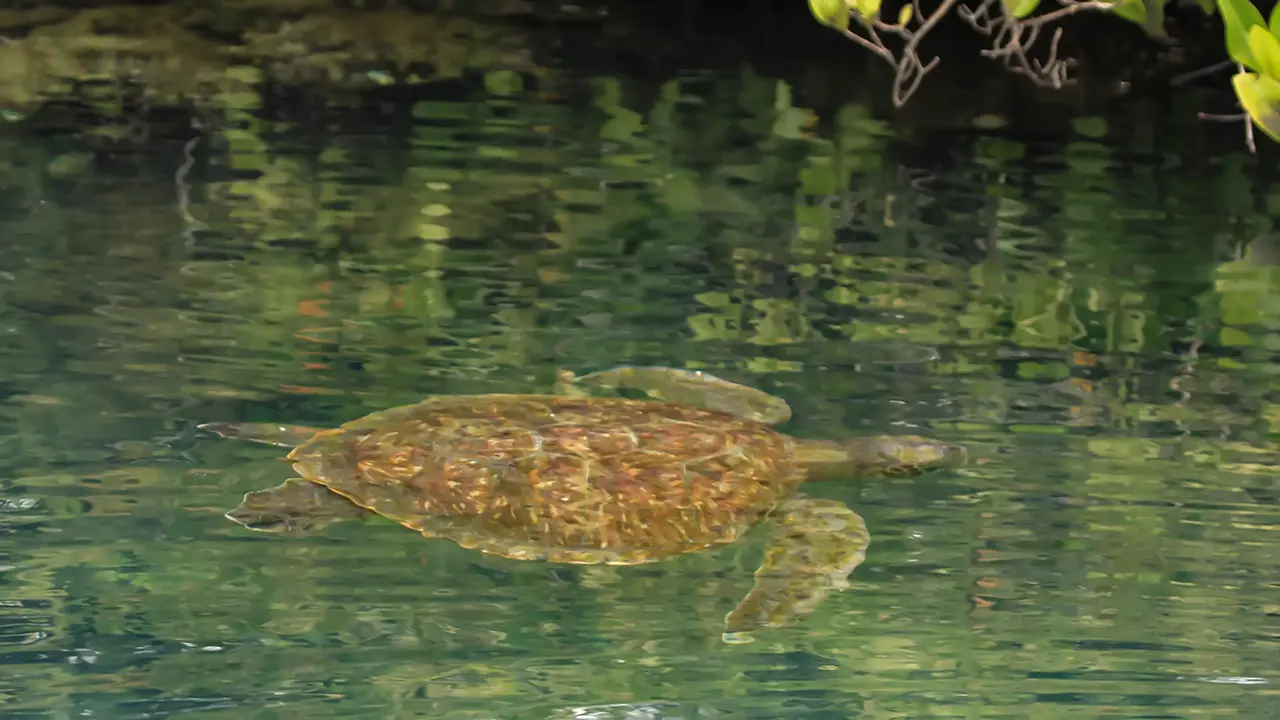
Pacific Green Turtle
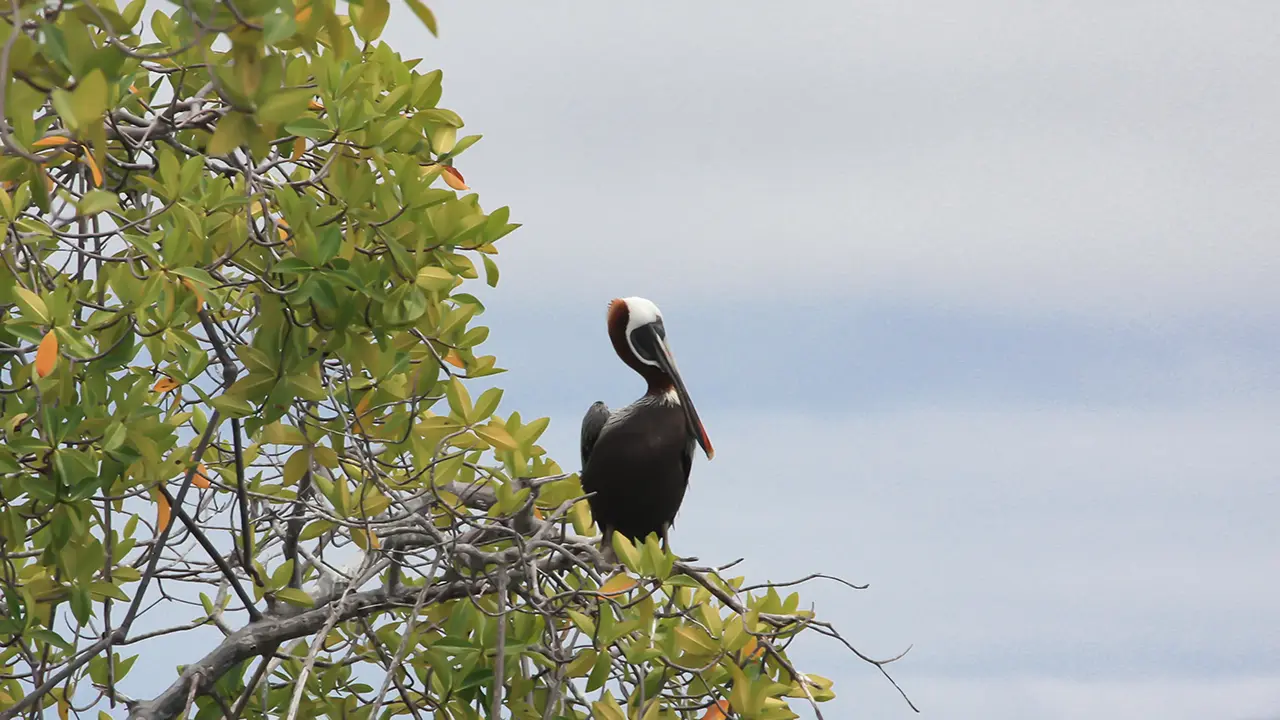
Galápagos Brown Pelican
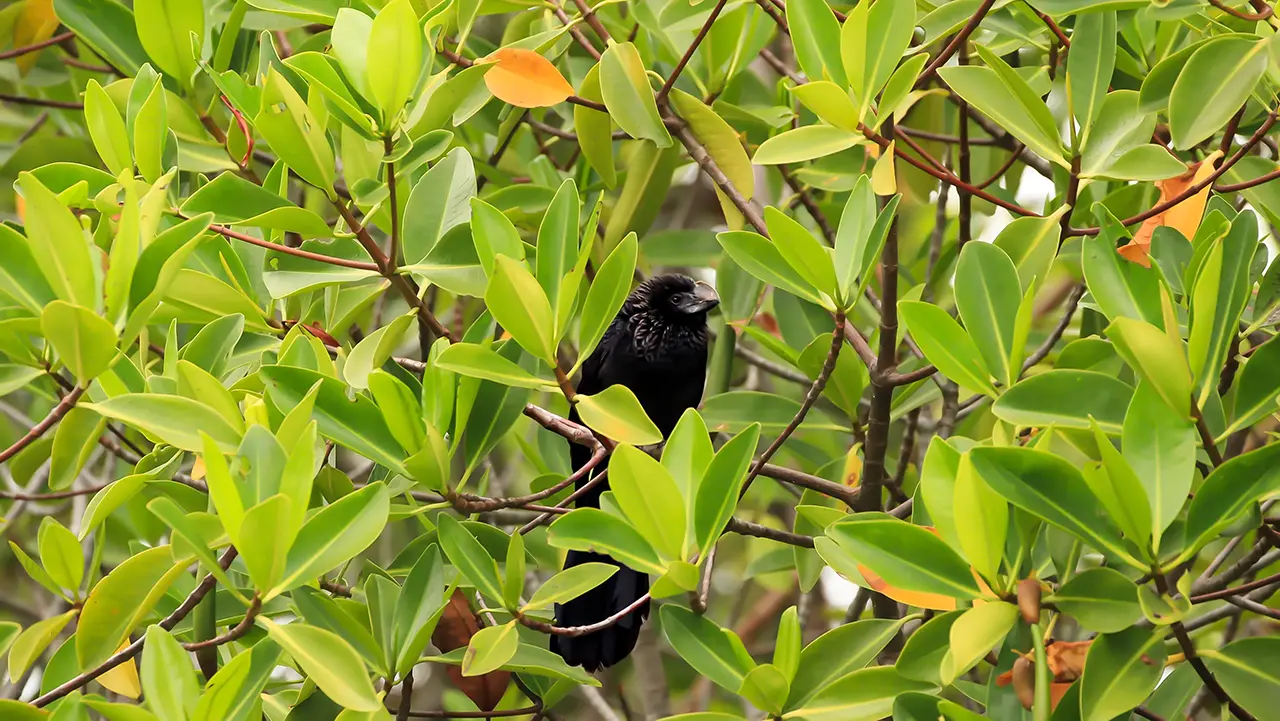
Smooth-billed Ani
Pacific Green Turtles, rays, pelicans, Smooth-billed Anis, and the tangled roots of mangroves appeared one after another. It was the kind of place where the boat seemed to slow down of its own accord.
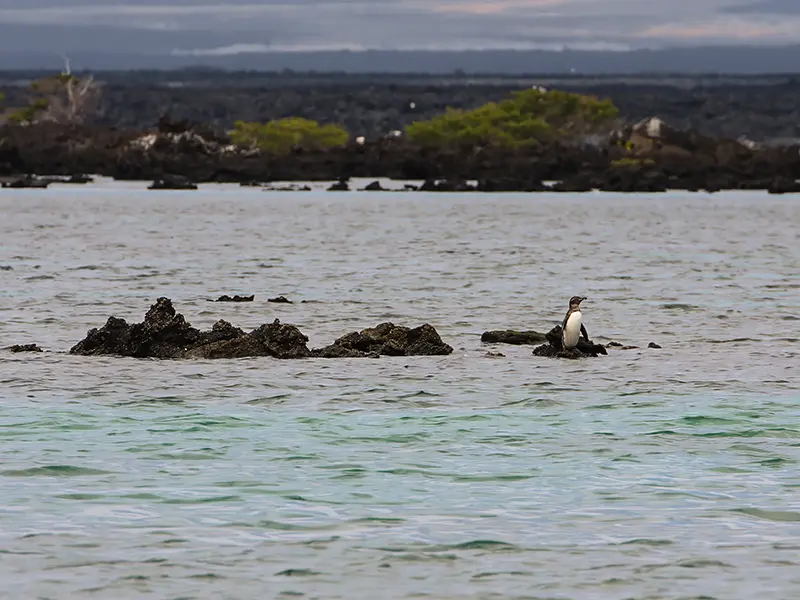
Elizabeth Bay
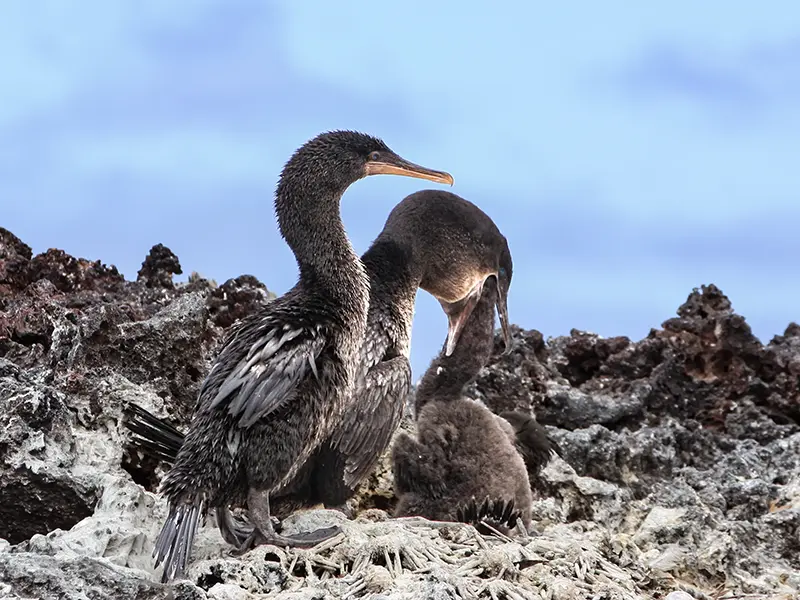
Flightless Cormorant
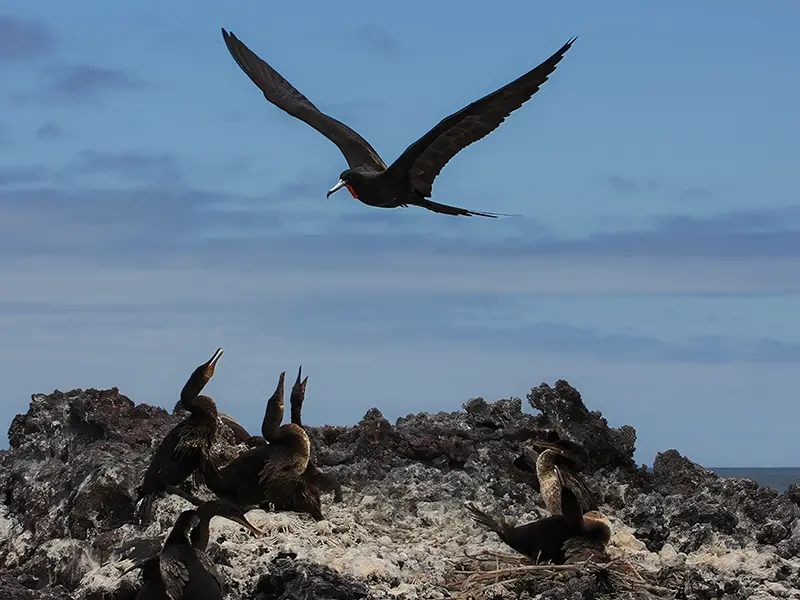
Magnificent Frigatebird
On nearby lava rocks, we also saw Flightless Cormorants, frigatebirds, and Galápagos Penguins. Black lava, green water, and wildlife packed close together: this, more than anything, felt like Isabela.
There was a person in the foreground of the image below. I removed him using Photoshop.
Punta Moreno
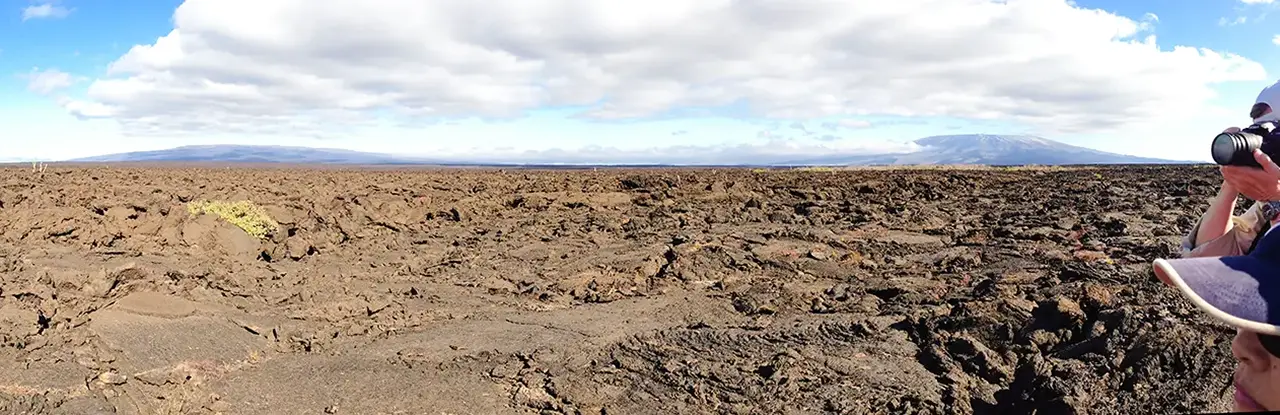
At Punta Moreno, we made a dry landing on a broad lava field. A desolate landscape of black lava stretched out before us. Some of the lava had smooth, rope-like patterns on its surface. I learned that this was called pahoehoe lava, formed by relatively fluid lava flows. In contrast, the rough, broken lava was known as aa lava, created by more viscous flows.
I had a vague memory that this explanation had already been given somewhere around Cerro Brujo, though I was not entirely sure.
Later, when I checked my notes, it turned out that my memory had been right after all. Perhaps I should give it a little more credit.
The trail crossed the lava field, where pioneer plants had begun to take hold. Lava Cactus and other hardy plants stood out sharply against ground that otherwise looked almost lifeless.
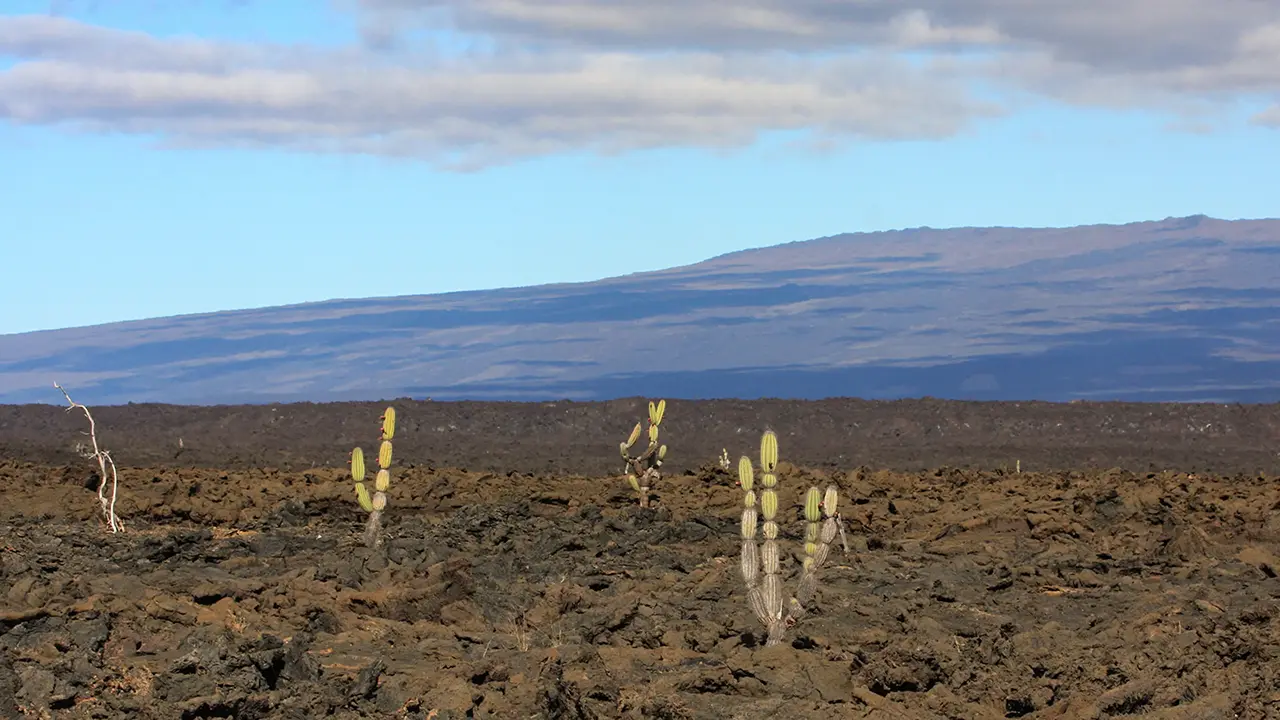
Lava field
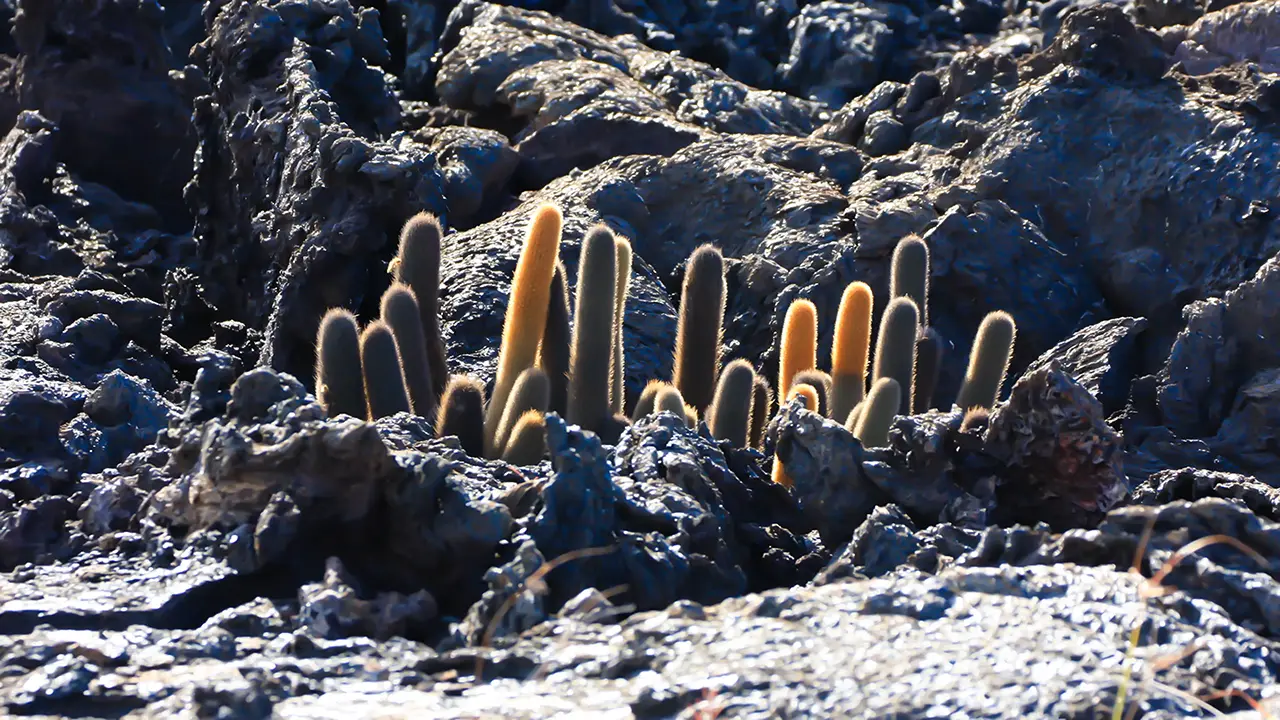
Lava Cactus
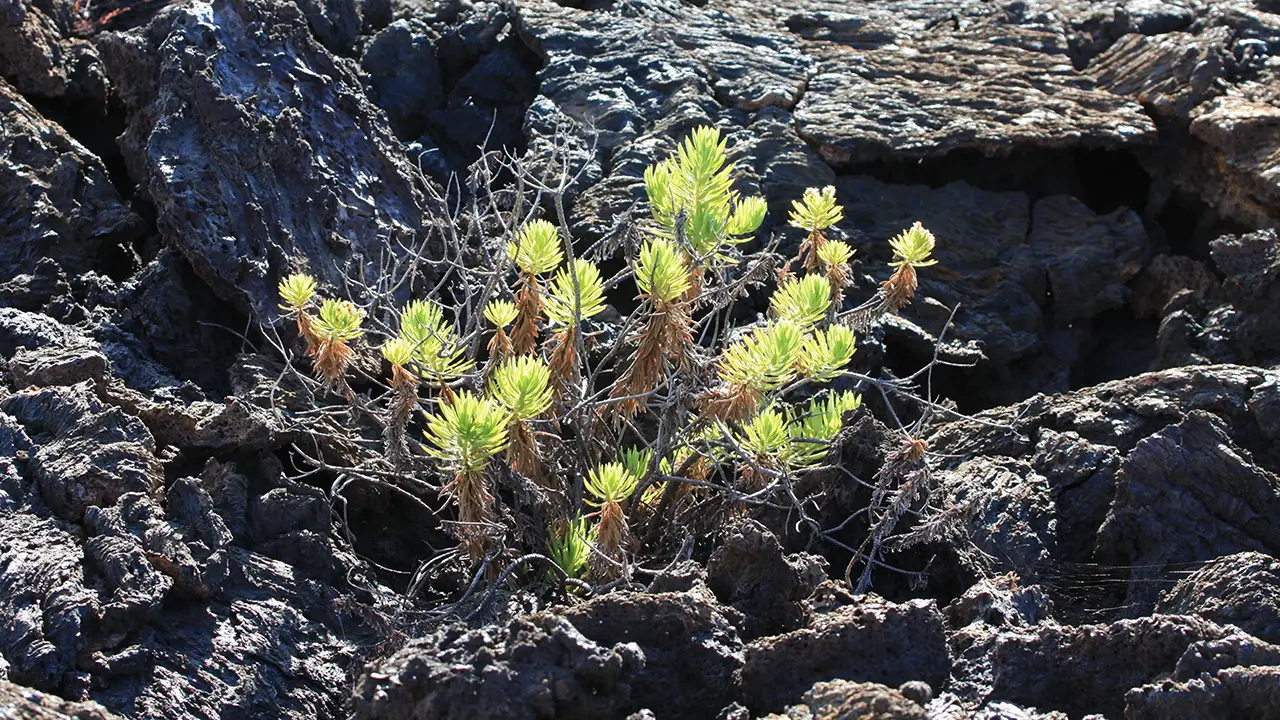
Grey Matplant?
Small pools appeared here and there in the lava. Around them we saw finches, mockingbirds, and even flamingos: a reminder that life can find surprisingly small footholds in this harsh landscape.
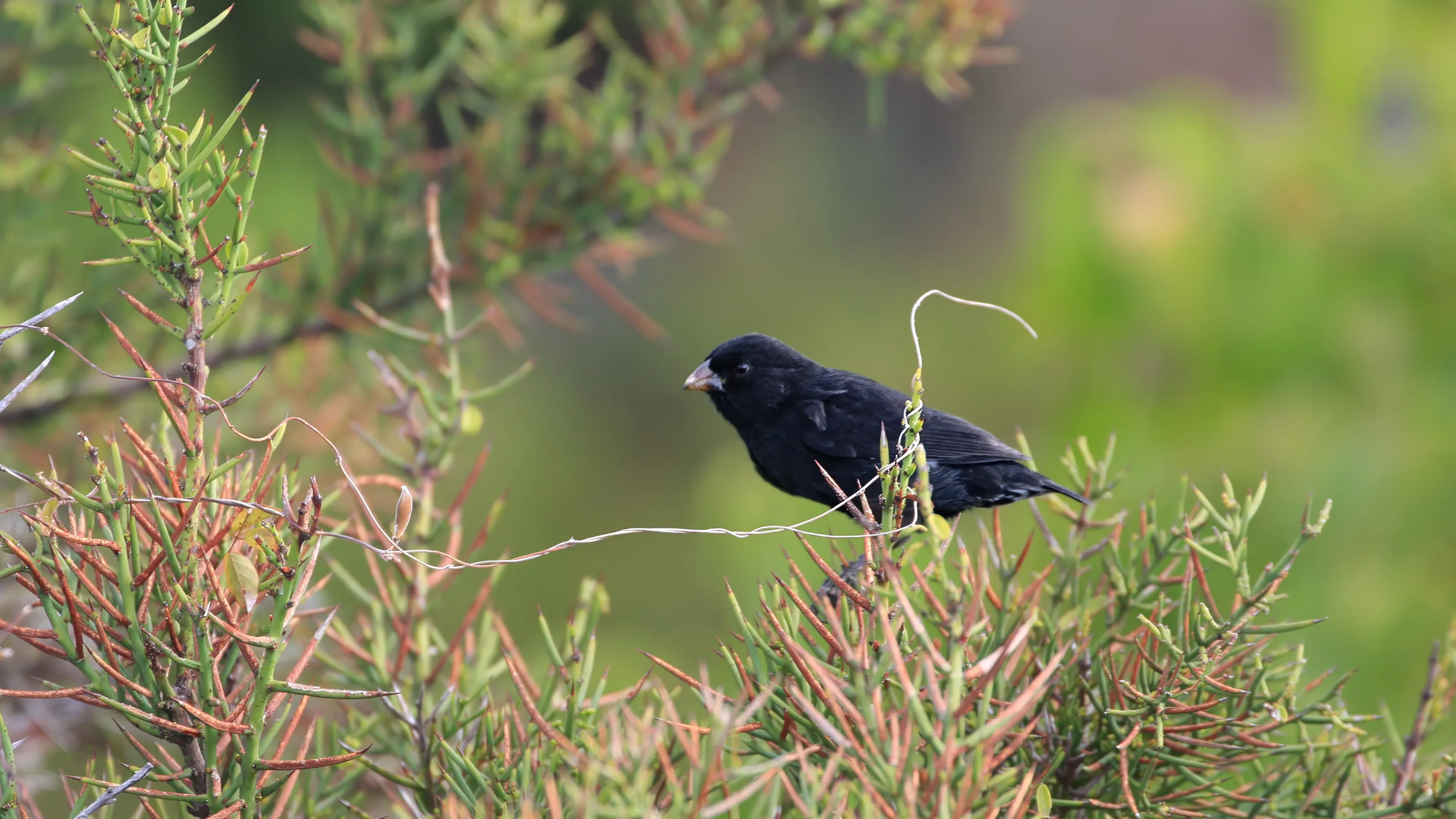
Small Ground Finch
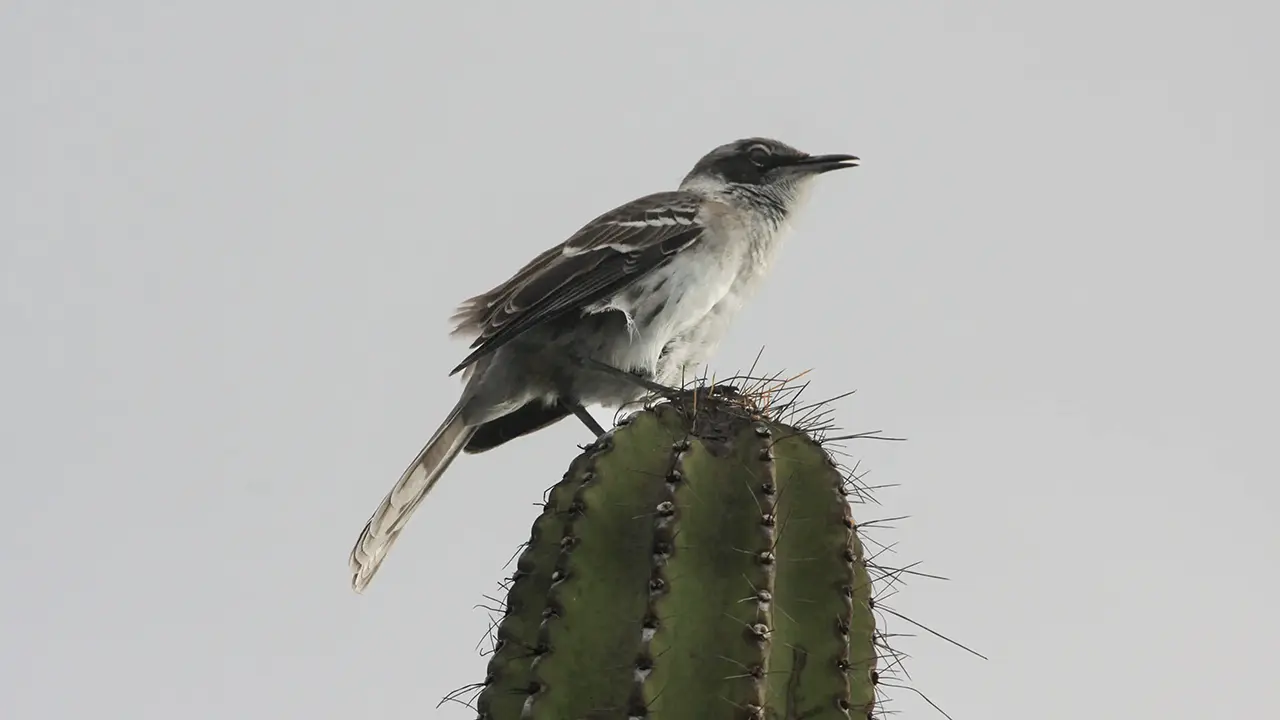
Galápagos Mockingbird
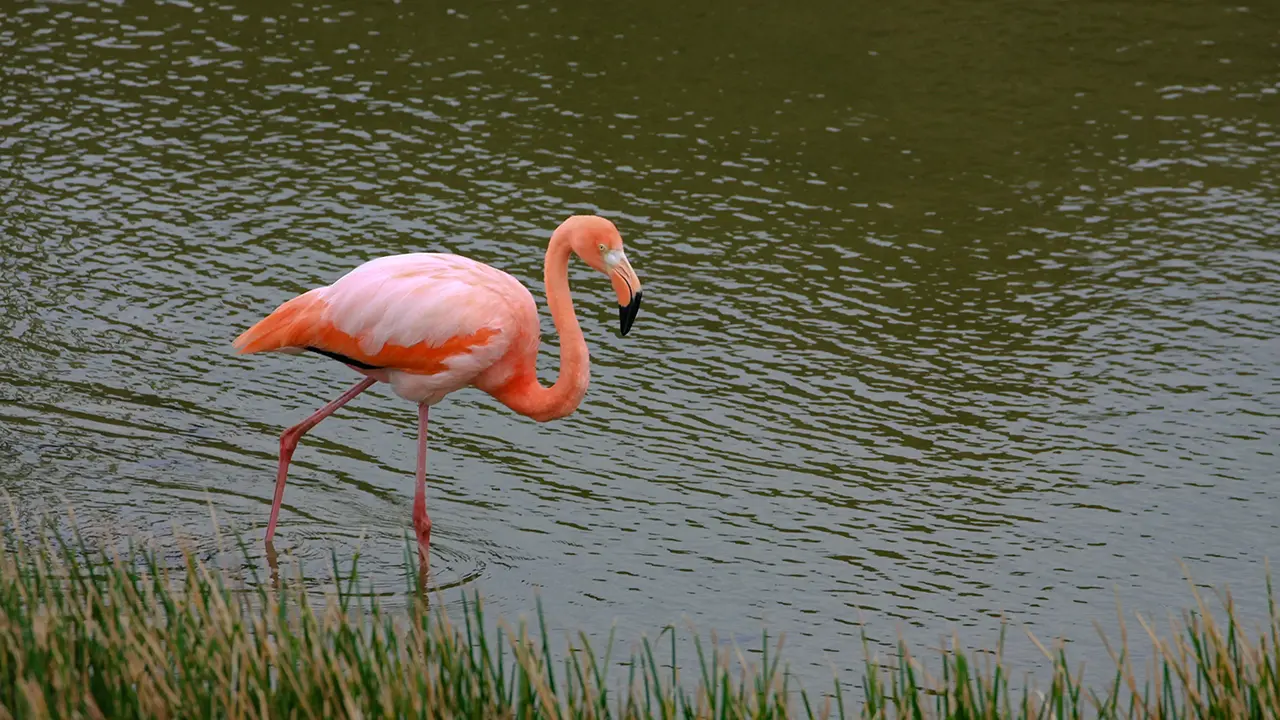
Galápagos Flamingo
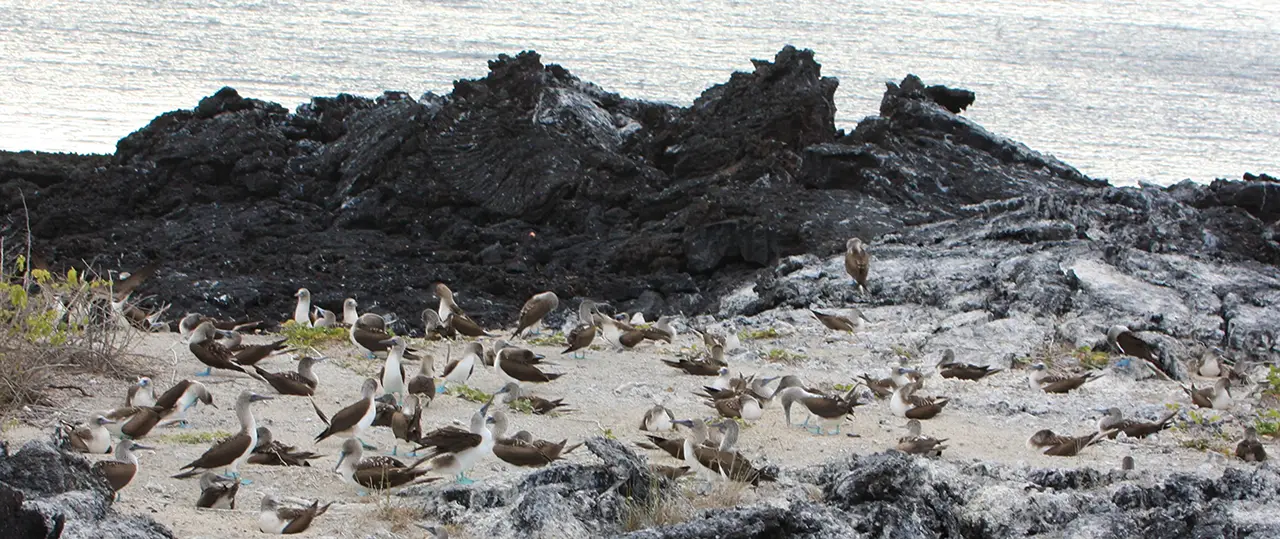
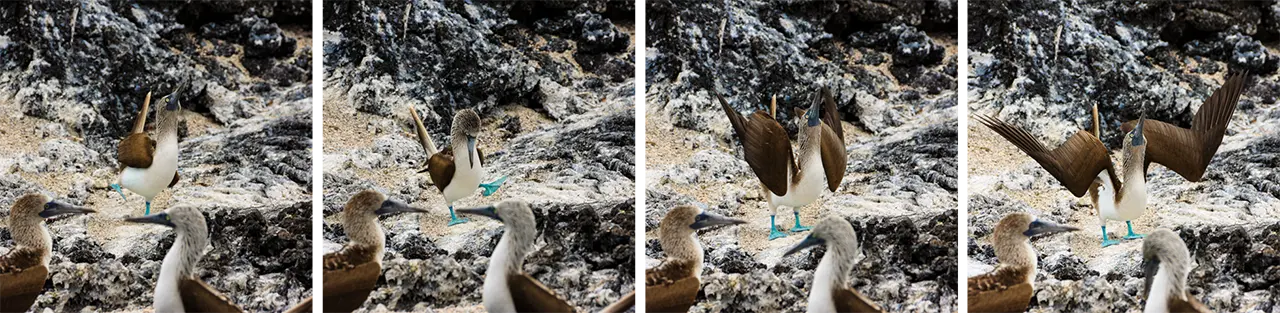
Farther along, we came upon a Blue-footed Booby colony.
We were able to watch their courtship dance, the birds lifting one blue foot after the other in that famously awkward, endearing rhythm.
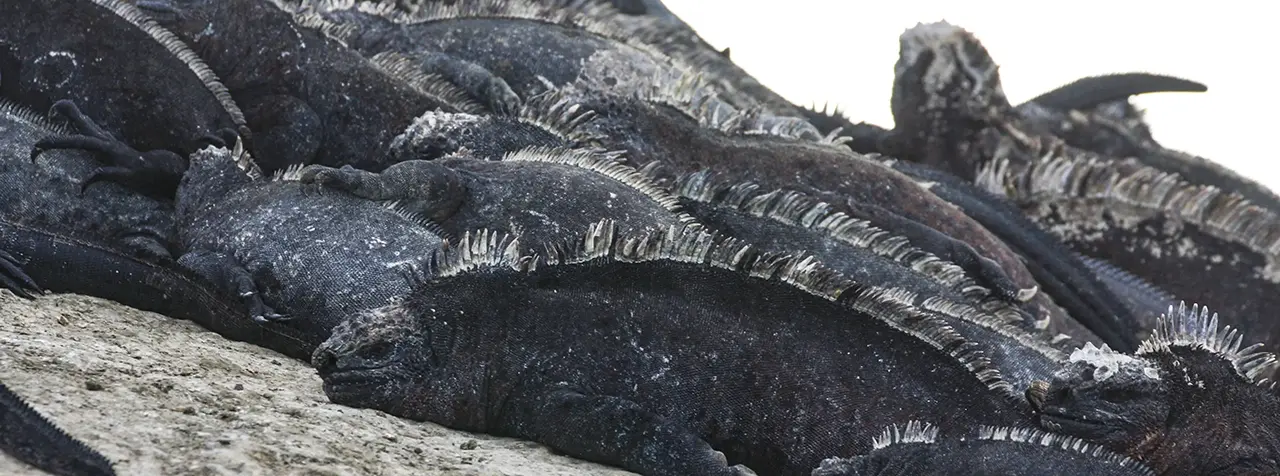
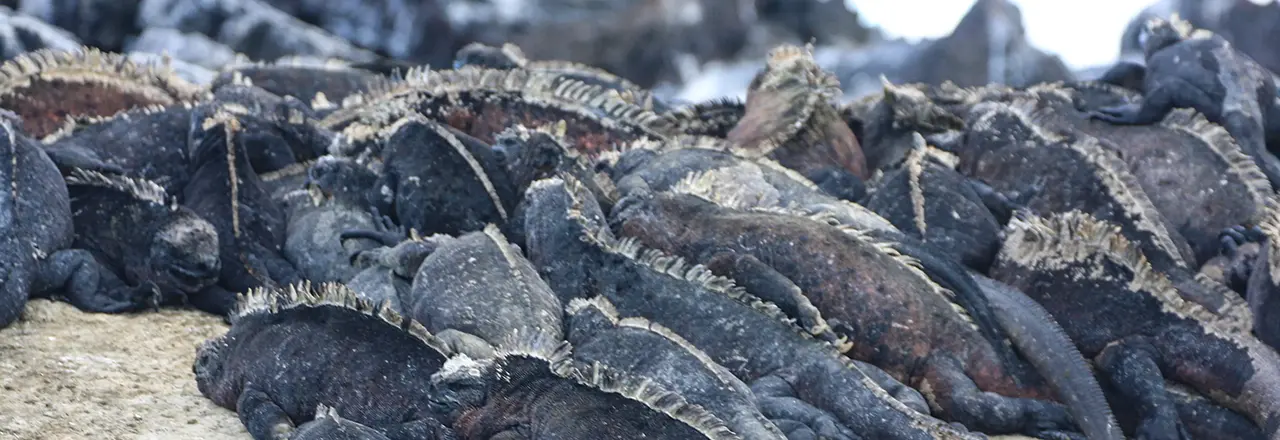
Marine Iguanas lay piled together in large numbers, soaking up heat from the dark lava.
Back on the ship, we watched what would be the last sunset of the cruise.
By this point, however, I had begun to feel unwell. Needing to stay close to a toilet, and the medical checkup that followed after returning home, would later connect this journey to the story told in resilience.
That evening also brought the briefing for the next day’s disembarkation and the optional activities on Santa Cruz. We chose Rancho El Chato.
The Isabela section of the Galápagos Photo Gallery contains additional photographs and notes on the island.
Santa Cruz Island
Santa Cruz was the final island of the trip.
Rancho El Chato / Highland
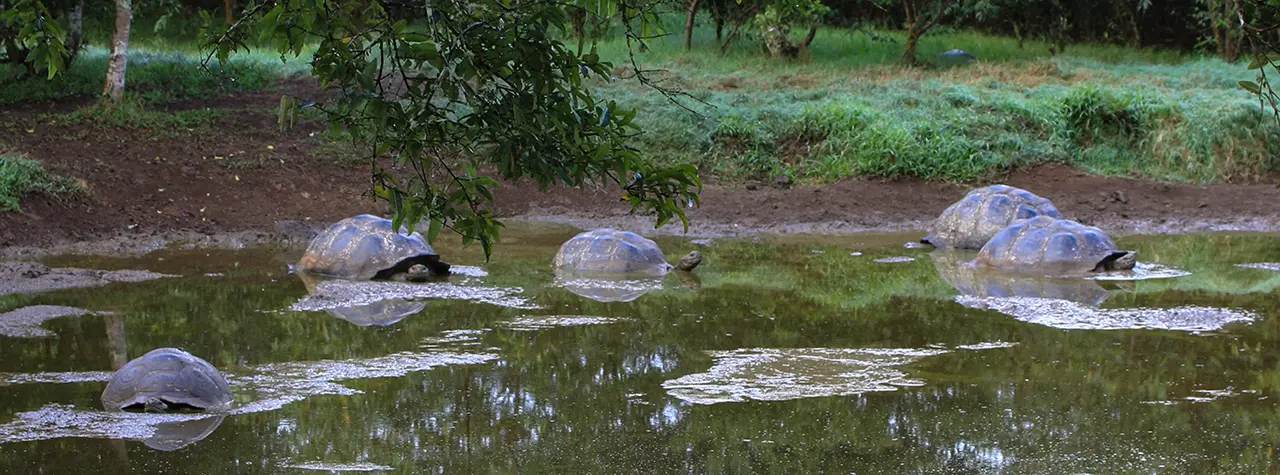
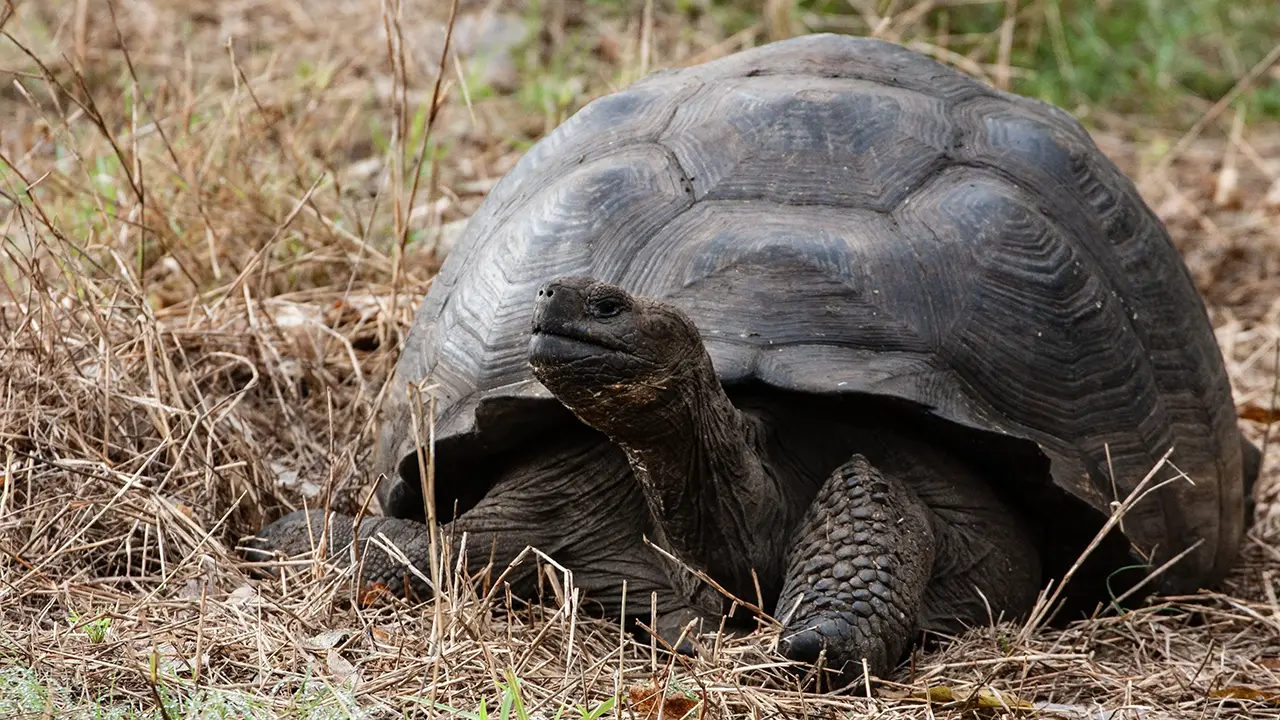
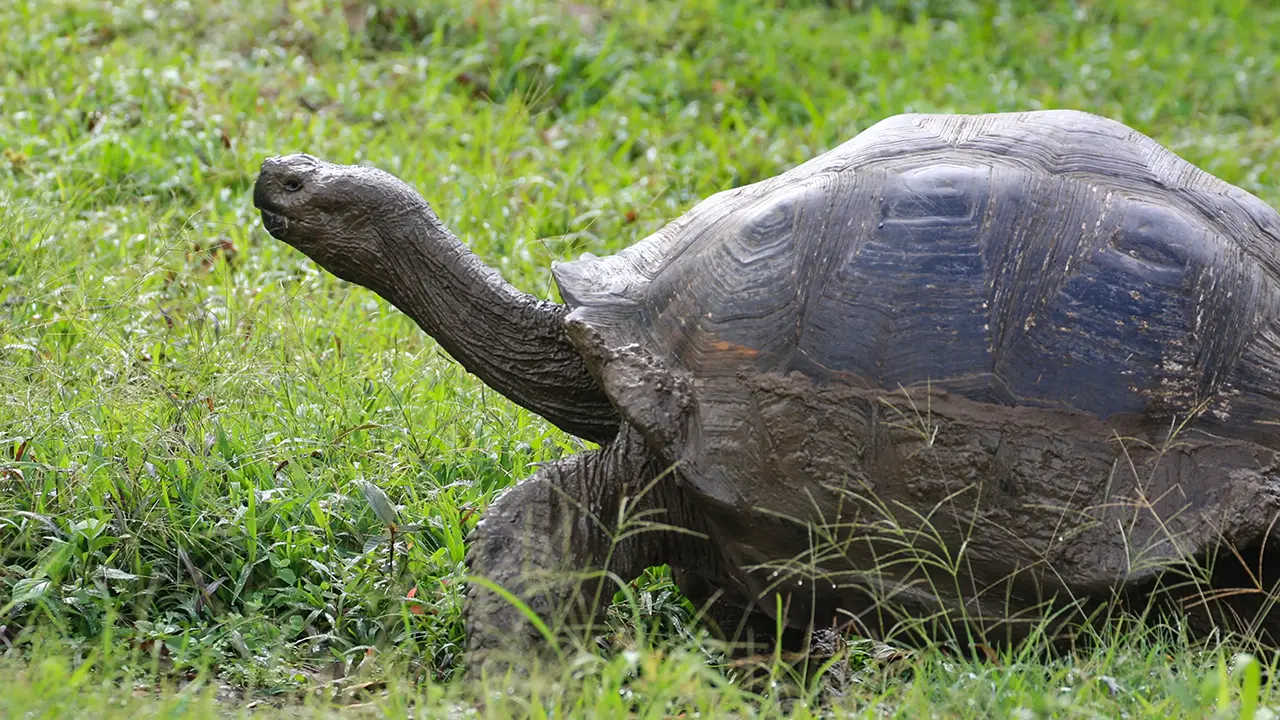
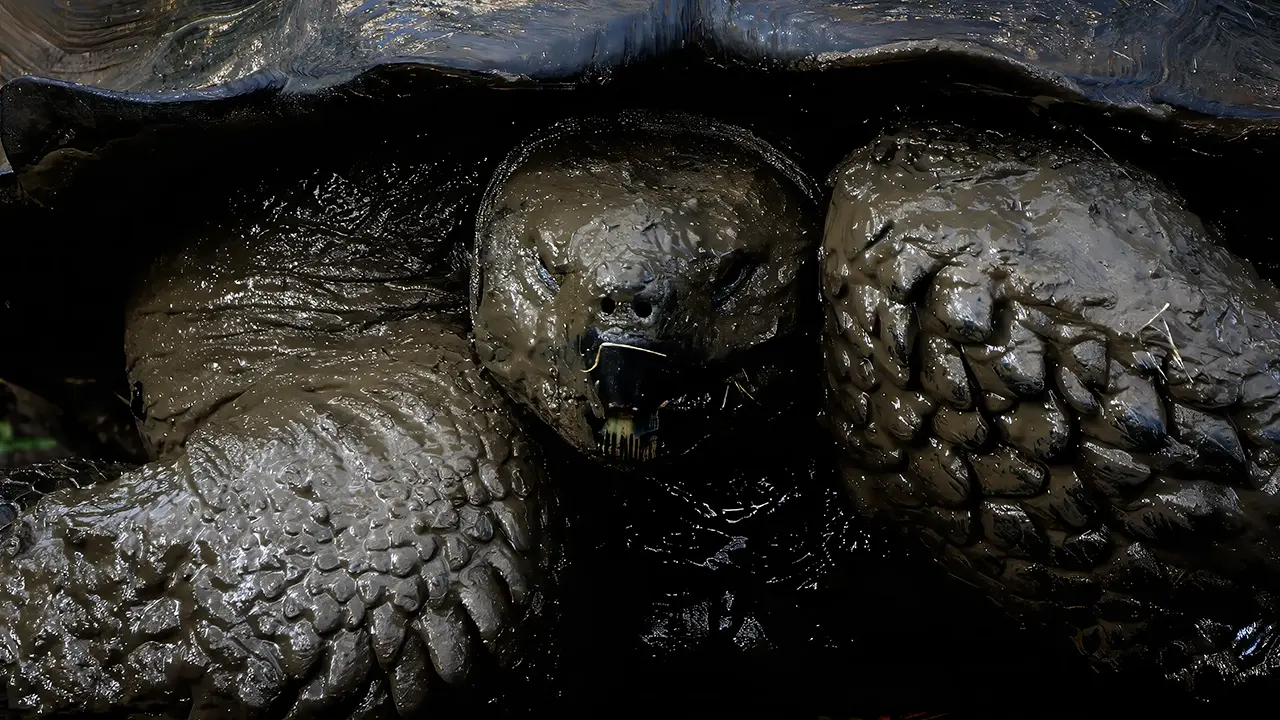
After disembarking, we drove up into the highlands to visit Rancho El Chato, where giant tortoises can be seen in a semi-natural setting. Galápagos tortoises differ from island to island, and these highland tortoises had the domed shells I had imagined before coming here.
The tortoises did not seem especially afraid of people. They moved slowly through grass and mud, as if humans were merely another part of the scenery.
From there, we continued to the airport and began the long journey home.
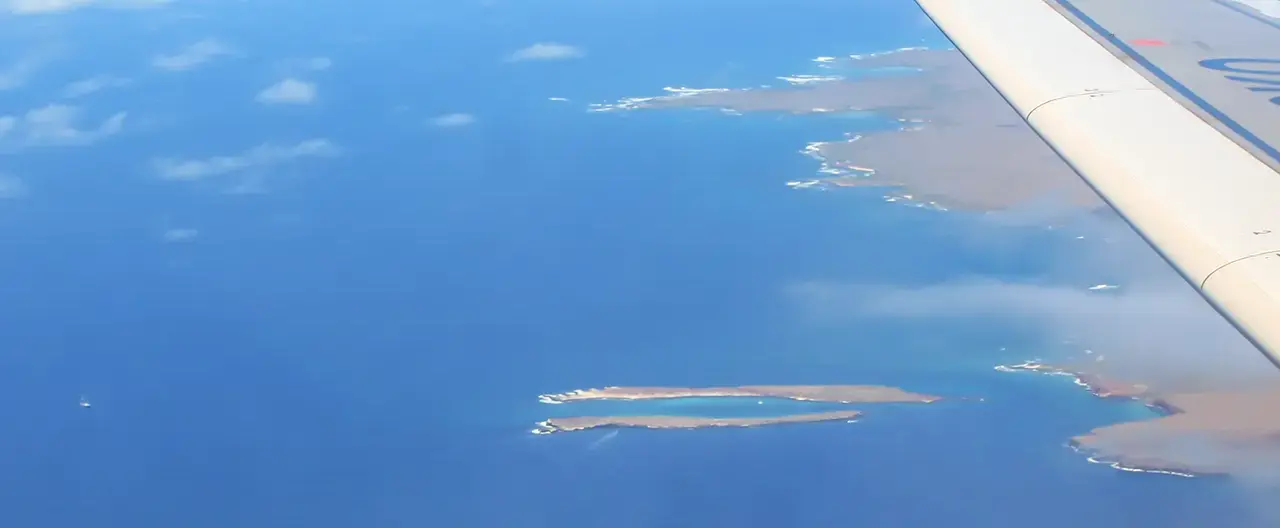
From the plane, I could see South Plaza below: a small farewell gift from the islands.
Additional photographs are available in the Galápagos Photo Gallery.
Postscript
After returning home, I was diagnosed with pancreatic cancer. In that sense, this journey became connected to the later story told in resilience. The Galápagos remains bright in my memory, but it also became the last journey before my life changed abruptly.