I once came across a photograph of red ground dotted with strange-looking cacti and trees. It was unlike anything I had ever seen. When I looked into it, I learned that the place was the Galápagos. I wanted to see it with my own eyes. That wish came true in the summer of 2013.
This gallery presents photographs from the journey, grouped by island.
North Seymour lies next to Baltra, the island with the airport, and is one of the most frequently visited islands. It offers broad nesting grounds for Blue-footed Boobies and one of the largest colonies of frigatebirds in the archipelago. Sea lions and Swallow-tailed Gulls can also be seen here. Palo santo and gray saltbushes grow among pale, spotted rocks, and nests of Blue-footed Boobies and other birds may appear right beside the trail.
South Plaza Island (Isla Plaza Sur)
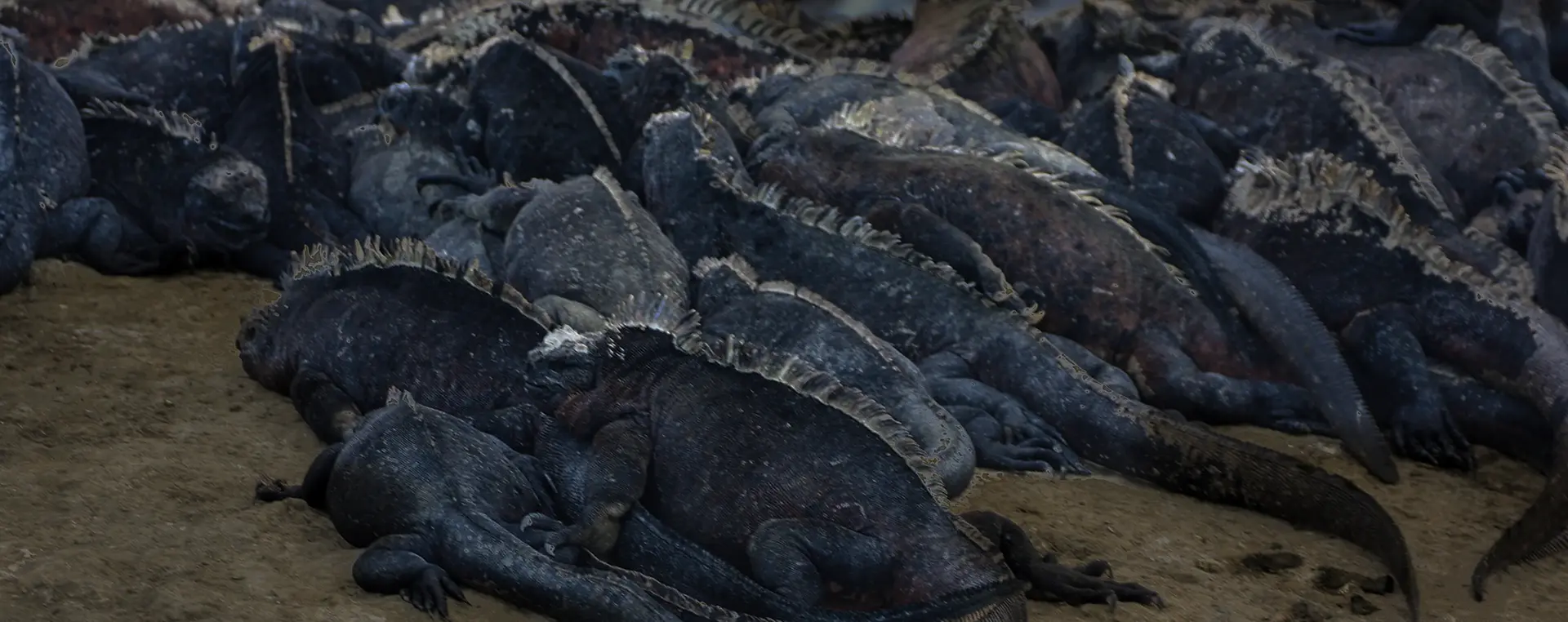
South Plaza is unusual among the volcanic Galápagos islands: it was formed by the uplift of volcanic rock from the seabed. Red sesuvium spreads over the rugged ground, dotted with green cacti. Land iguanas and marine iguanas are common here, and rare hybrid iguanas are sometimes reported where the ranges of the two species overlap. Sea lions, Blue-footed Boobies, and many other birds can also be seen.
Santa Fe Island (Isla Santa Fe)
Santa Fe was formed by the uplift of folded geological strata. Its bay holds a beautiful turquoise lagoon and was once used as a historical anchorage by many vessels. Perhaps because it is one of the older islands in the Galápagos, Santa Fe has an especially high proportion of endemic species, including the Santa Fe Land Iguana, mockingbird, rice rat, and lava lizard. Frigatebirds, Blue-footed Boobies, sea lions, marine iguanas, Swallow-tailed Gulls, herons, hawks, sharks, rays, and many other creatures can also be seen. Among its plants is the tall Santa Fe Prickly Pear Cactus, whose trunk becomes hard and tree-like.
Darwin is said to have gained some of the insights that later led to his theory of evolution from observing how life differed from island to island. The finches are among the best-known examples. Cactus finches use long beaks to feed on flowers and fruit while avoiding sharp cactus spines, while ground-dwelling finches feed on fallen seeds and other food. Their beak shapes and roles seem to have developed as a way of sharing limited resources within small island habitats.
San Cristobal Island (Isla de San Cristobal)
San Cristobal lies in the eastern part of the Galápagos and is the fifth-largest island in the archipelago. The provincial capital, Puerto Baquerizo Moreno, is located here.
Punta Pitt
From a small beach in a northern cove, a trail climbs along a rain-carved channel in the rock. After roughly a hundred meters of ascent, it opens to a view over Punta Pitt. The cliffs were vivid with red sesuvium and green shrubs. Three species of boobies are said to nest here: Red-footed, Blue-footed, and Nazca.
Cerro Brujo
Cerro Brujo is a cone-shaped hill formed of volcanic tuff, near a white coral-sand beach called Playa Cerro Brujo. On September 18, 1835, the Beagle, carrying Charles Darwin, anchored in Stephens Bay. This beach is recorded as the first place where Darwin set foot in the Galápagos. Off the beach rises Leon Dormido, a rock formation also known in English as Kicker Rock. From some angles it resembles a sleeping lion; the English name is said to come from its boot-like profile. To the right of the beach is Punta Dedo, where a sea arch cuts through the rock. Boats can pass beneath it, and from some angles Leon Dormido appears beyond the arch.
Floreana Island (Isla Floreana)
Floreana lies in the southern part of the Galápagos. The island is of volcanic origin, formed by a single large shield volcano, though unlike the active volcanoes of western Isabela, it is now dormant. It was also one of the first islands in the archipelago to be settled by people; its current population is under one hundred.
La Olla Bay
A quiet bay with a lookout called Baroness Point. The name is said to come from the story of an Austrian baroness who lived here with three men and then disappeared under mysterious circumstances.
Post Office Bay
This bay was once used as an anchorage by whaling ships. Mail left in the barrel here would be carried home and posted by travelers heading sooner to a town with postal service. Visitors still leave cards and take others with them to mail in the same spirit.
Punta Cormorant
The name comes from the U.S. minesweeper USS Cormorant, not from an abundance of cormorants. The landing beach has a distinctive greenish color caused by accumulated volcanic olivine. From there, a trail crosses the base of the point. A short walk inland lies a brackish lagoon frequented by Galápagos Flamingos and other shorebirds. Farther on, the trail reaches a white-sand beach used as a nesting site by Pacific green turtles. From the beach, turtles, diving Blue-footed Boobies, and small sharks cruising along the shore can be seen.
Champion Islet
This small islet off Floreana is named after the whaler Andrew Champion. It is home to many seabirds, including Blue-footed Boobies, Nazca Boobies, Swallow-tailed Gulls, herons, frigatebirds, pelicans, and the beautiful Red-billed Tropicbird. It is also known as a refuge for the endemic Floreana Mockingbird, which survived here after introduced animals damaged its habitat on other islands.
Isabela Island (Isla Isabela)
Isabela is the largest island in the Galápagos. It was formed when six volcanoes, once separate islands, merged into one long island; five of them are still active. Sierra Negra has one of the largest calderas in the world, and Wolf Volcano has erupted in recent times. Because Isabela lies in the western archipelago where the Cromwell Current brings nutrient-rich water, its marine ecosystem is especially rich. The cold current also supports many Galápagos Penguins despite the equatorial location. Each volcano is also associated with distinct populations of giant tortoises, a reminder that they once lived on separate islands.
Elizabeth Bay
The coast is enclosed by lava and mangrove forest. From the water, Galápagos Penguins and many seabirds can be seen, along with Pacific Green Turtles, rays, and other marine life. Landing is not permitted, so the area is visited only by boat.
Punta Moreno
A trail crosses the lava field, and snorkeling is also possible. Pioneer plants—the first species to colonize new lava—grow here, including the lava cactus. Columnar cactus and prickly pear cactus can also be seen. Along the trail, pools formed in depressions in the lava field sometimes hold flamingos.
Santa Cruz Island (Isla Santa Cruz)
Santa Cruz lies near the center of the Galápagos and has the largest population and the most visitors. Puerto Ayora and the Charles Darwin Research Station are located here, making it a major base for tourism. In the humid highlands, wild Galápagos Giant Tortoises can be seen.
Rancho El Chato / Highland
Rancho El Chato is a reserve in the highlands near the center of Santa Cruz, at around 600 meters above sea level. Both saddleback and dome-shaped giant tortoises live here in a natural setting. The tortoises are said to walk all the way from the coast into these highlands.
Wildlife of the Galápagos
Representative animals photographed during this journey
English Name
Plants of the Galápagos
Representative plants photographed during this journey
English Name
The journey behind these photographs is described separately in Galápagos Travelogue.