In Yellowknife
Powered by Google Translate
A Journey Marking One Year Since Surgery
On September 20, 2014, I was in Yellowknife. It was a trip to mark the first anniversary of my surgery.
The year had been an attempt to live by the principle to put quality of life first and live whatever time remained to me accordingly. I was still receiving anticancer treatment and had many restrictions, but I was enjoying each day.
At work, my role had changed from representative director and executive vice president to director and adviser. I continued to support the company. In September we made a major change to the executive officer system, and there were still many occasions when my support was useful.
Some of my long-standing interests were beginning to grow into something more serious. One was "the challenge toward the future." Since childhood I had loved science fiction, and I had always felt that the future worlds in those stories were worlds that humanity would eventually make real. Arthur C. Clarke's story about geostationary satellites fascinated me. The space elevator described in The Fountains of Paradise became one of my interests. I joined the Japanese space elevator association when it was established in 2008, though I had not been active. This year I found a chance to participate. If I can use my experience in some way, it will be interesting. After all, there is a certain satisfaction simply in feeling that I am taking part in Japan’s space development.
Another interest is travel. Early in the year, two months after discharge, I saw news that the keep of Himeji Castle could be climbed only until around the tenth because of renovation work, and I set off on impulse. Together with the Hakone trip at the end of the previous year, those trips awakened my desire to move. I decided to visit places I had long been unable to reach at a pace of about once a month: Ise-Shima, Kurume, the Yamanami Highway, Miyakojima, Aomori, and Hokkaido. In September I tried an overseas trip to experience the aurora. On the first anniversary of surgery, I made it happen. I am alive, and I am here.
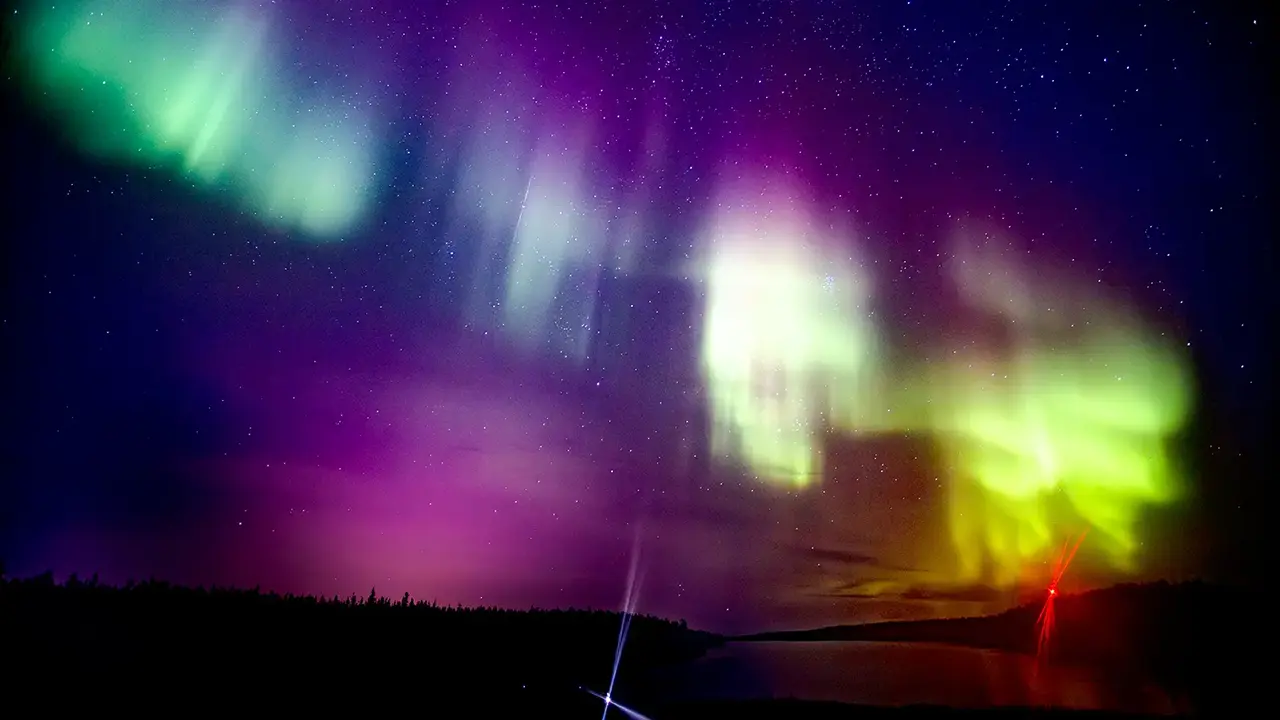
Aurora photographed in Yellowknife. Long exposure also captured the red tones.
As an additional pleasure, I registered the trade name Fukudoya and opened a website under that name. I had wanted to do this for a long time, but never had time to code it. Over the past half year or so, I opened a blog and a gallery. Why go that far? Let us just call it an outlet for my vanity.
Gratitude
I am grateful to everyone who worries about my condition. My physical recovery is very good. There is still some pain around the abdominal incision, but it is not serious. I cannot drink alcohol, but my appetite is strong and I eat well. The doctor told me to eat plenty to build strength and avoid losing weight, and I have followed that advice faithfully.
I eat three regular meals every day. Shopping, cooking, and cleaning up take four to six hours a day, but if I think of it as a hobby, it is no hardship. I enjoy preparing food with my own knife, which I have used for thirty years. When I can shred vegetables with a crisp rhythm, I know I am in good shape that day.
The Japanese Pancreas Society's five-year survival rate was 24 percent, as I mentioned earlier. Looking more closely, the one-year postoperative survival rate is close to 90 percent. From the first year to about 40 percent in the third year, the rate drops almost linearly; after that the decline to 24 percent in the fifth year is gentler. If I can survive another year, the chance of surviving five years or more becomes much higher. I want to greet the next anniversary as I greeted this one.
Postscript, December 10, 2014: I remembered only being told Stage III, but the type was T1N1M0, which seems to be Stage II. The statistical values would change, but the shape of the curve should not. For me, it is either living or dying, so in truth I am not deeply attached to the exact number.